Showing posts with label train station. Show all posts

Wednesday, July 29, 2015

Too Few Good Fellows to Muster a Charge

I recently put forth an idea (in two parts, here and here) about where the second SMART station in Petaluma could be located.

For new readers, it was long expected that the second station, which is to be the station serving the drivable suburban neighborhoods of town, would be located near the corner of McDowell Boulevard and Corona Road.  However, financial constraints and difficult negotiations forced SMART to consider other options.  A land swap was recently broached that would move the station a mile north to a site on Old Redwood Highway, east of McDowell.  It’s a location that much of the town, including me, finds unacceptable.

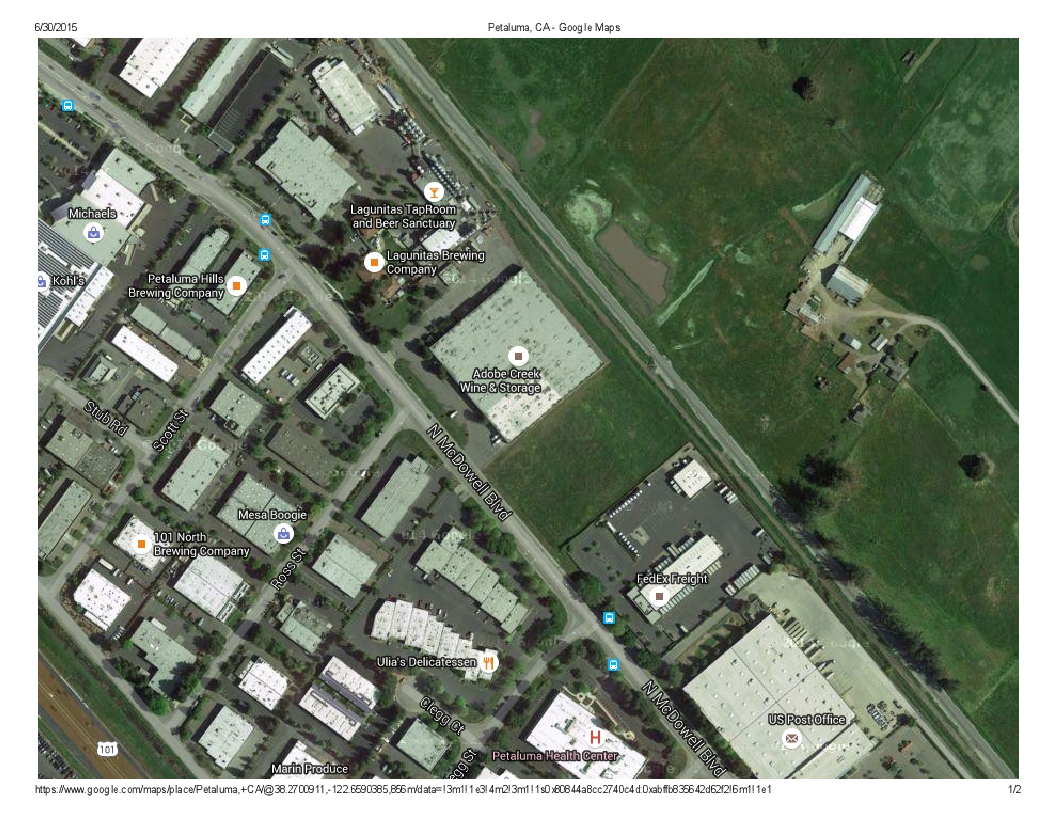
Seeing a possible impasse, I offered an alternative, geographically midway between the two possibilities, a currently undeveloped parcel on McDowell that is planned as a parking lot for the Lagunitas brewpub, but could perhaps be co-opted to serve as a train station with parking during the day and as brewpub parking in the evening.  With other infrastructure changes, including traffic calming on McDowell, it seemed an interestingly viable alternative.

However, I said that I would continue pushing the idea only if I knew that I’d committed comrades to help with the effort.

Today, I can report that, although my call didn’t go unheeded, I didn’t get enough response to continue advocating for the alternative solution.  I had two people reach out with offers of assistance, one with significant enthusiasm.  But both have positions in the community that would make it awkward for them to take active roles in the process.  They could have provided valuable inside assistance, but when it came to a public face for the proposal, I would have been tilting at the windmill by myself, a situation in which I too often find myself and in which I have no interest in doing again right now.

So I’ll set the idea aside for now, but with the possibility of disinterring it if the opportunity arises in the fall, when the land swap may again surface for discussion.

And it seems likely that the discussion will continue.  The local newspaper recently published an editorial arguing for the land swap, suggesting that putting the train station on Old Redwood Highway would be an acceptable solution.  The following week, a City Councilmember and a member of Friends of SMART replied with a guest opinion piece that cited the reasons the editorial was wrong.

I suspect that the guest opinion piece, with which I agreed on almost every point, reflects the collective opinion of the community, but it may take more volleys back and forth before the issue is truly put to bed.  And if those volleys give me the opportunity to again raise my alternative, we’ll see where that opportunity may go.

I have one last, mostly unrelated, point on my proposed train station site.  In an earlier post, I noted that clearing and grubbing had begun for the brewpub parking lot.  It now seems that the clearing and grubbing activity was limited to the route of the sidewalk that is to connect the parking lot to the brewpub.  That sidewalk has now been constructed, with only site cleanup remaining, even though no construction has yet begun on the parking lot.  It seems odd construction sequencing, but I assume there’s a reason.

But my comment today is about the design of the sidewalk.  I recently wrote with disappointment  about those who design pedestrian routes with seemingly random short radius curves that appear to be more about the designer’s ego than about respecting the role that walkability can fill in effective urban development.

At the time, I’d seen the proposed alignment for the brewpub sidewalk and found it more curvy than necessary, but marginally acceptable.  However, I was only given the horizontal alignment to consider.  With the sidewalk now built, I can see that it was the vertical alignment where my concern should have been.  The sidewalk seems to have random humps and bumps as it were designed for skateboarders, not folks ambling to a brewpub for camaraderie.

I’ll withhold final judgment until I use the sidewalk to walk between the future parking lot and the brewpub, but my initial response is a sniff of irritation.

Next time, I’ll ruminate on the upcoming decision by the Petaluma City Council on the EIR for the Rainier Connector.

As always, your questions or comments will be appreciated.  Please comment below or email me.  And thanks for reading. - Dave Alden (davealden53@comcast.net)

Friday, July 3, 2015

Checking for Support on the Flanks – Part Two


In my last post, I reviewed six possible sites for the second SMART station in Petaluma, four on the north side of N. McDowell Boulevard near Corona Road, a fifth on Old Redwood Highway, and a sixth that is between those two locations, on a parcel where a parking lot for the Lagunitas Brewery is currently being constructed.   (More details on the six sites, including a quick summary of the pros and cons of each, were provided in the earlier post.)

Today, I want to look more deeply at the sixth.  I’ll conclude with a check for allies willing to join me in advocating for the site to become the second station.

To begin, if I rank the sites solely in terms of suitability as a commuter train station, the sixth site, which I’ll describe at the Lagunitas parcel, comes in third.  Based on ease of access, I’d give the edge to the two sites that front on N. McDowell Boulevard on either side of Corona Road, followed by the Lagunitas parcel.

It’s true the two parcels at McDowell and Corona have acquisition issues, price on one and current use as a Post Office on the other, but the Lagunitas parcel is currently under construction for another use, so also has its challenges.  If we’re looking at the sites solely on the basis of suitability as a commuter train station, the Lagunitas parcel isn’t necessarily worth much further attention.

But we shouldn’t be looking solely at the commuter train station question.  There is second land-use issue in the vicinity of the Lagunitas parcel.  As I written several times, most recently here, there is a growing Petaluma brewpub district on N. McDowell.  On the north side of McDowell is Lagunitas, the phenomenally successful local brewery with its ever-crowded brewpub.  One south side is a pair of smaller, but still popular, breweries with operational pubs or future pub plans.

The immediate problem with the brewpub district is that there is little parking on the Lagunitas side of the street, so most Lagunitas patrons park in the industrial district across McDowell and then risk a crossing of the 40 mph arterial.  It’s a worrisome situation.  The community is probably lucky that no one has yet been hurt.

To their credit, Lagunitas is addressing the concern by building a new parking lot on the parcel I’ve now identified as a possible train station.

But the parking lot, however laudable it might be, is only a partial solution.  There is still the problem of patrons who park in the Lagunitas lot and then do a pub crawl, crossing McDowell between Lagunitas and the other brewpubs while dodging 40 mph vehicles.

Also, the Petaluma brewpub district may well become a regional destination, with beer fans coming from San Rafael or Santa Rosa by train to enjoy Petaluma and its hoppy beverages.  But if the train station is located at Corona, potential patrons are left with a quarter-mile along a pedestrian unfriendly sidewalk to reach Lagunitas and then must also navigate a crossing of McDowell to reach the other brewpubs.  It’s not the best way to treat folks who want to enjoy a day in Petaluma.

But if the train station, including parking, is built on the Lagunitas parcel and if crossing McDowell is made safer and easier, all of the concerns would be addressed.  Beer patrons could park on either side of McDowell and cross the street safely.  None of the brewpubs would be excluded from the boom.  Petaluma gets a tourist destination.  And train commuters, who still have readily available parking because the morning commute would be long before the brewpubs opened for business, could end their workday in a bustling pedestrian environment.

The conventional approach to crossing McDowell would be with a traffic signal.  But there is a problem with signal location.  Pub crawl patrons would want the signal near Lagunitas.  Train passengers who use Petaluma Transit to reach the train station and don’t want a post-work beer would want the signal in front of the station.  From experience, we know that some folks won’t walk several hundred feet to use a signal, but will cross on their most direct route.  Those folks would remain at risk from high-speed arterial traffic.

So, rather than a signal or signals, the better solution would be traffic calming McDowell to 25 mph so that painted crosswalks become effective and any pedestrians who might still be struck by cars have a much better chance of survival.  (Dave Edmondson, writing in Vibrant Bay Area, recently produced a bar chart showing how dramatically pedestrian deaths decline as traffic slows.)

An extensive traffic calming effort on McDowell might have a similar cost to the signals or signals, but would offer more benefits.  Indeed, with the train station on the Lagunitas parcel and McDowell simultaneously calmed to 25 mph, the benefits begin to flow as if from an open beer tap.   Let’s start counting the pros.

Pro #1: Petaluma would have a train station in a very acceptable location.  It might not be quite as convenient as a Corona location for many commuters, but would better serve beer tourists or commuters eager to stop for post-work camaraderie.

Pro #2: Petaluma would have a cohesive brewpub district.  The brewpub district grew up in an unexpected place.  Placing the train station in the midst of it would be way of endorsing the district and giving it further momentum.

Pro #3: Petaluma would have a new tourist destination.  If developed properly, the downtown train station already has the potential to welcome tourists into the historic downtown.  With a train station in the brewpub district, the second train station would also have a personality.  I’m tickled by the thought of someone staying in a downtown hotel, walking to the downtown station, riding to the brewpub district, and spending the afternoon enjoying music at Lagunitas.  Petaluma would cement its place on tourism lists.

Pro #4: Pedestrian safety would be prioritized.   A giant step would have been taken toward the community goal of making pedestrian safety rank above driving speed.

Pro #5: Other cross-McDowell connections would be enhanced.  This discussion has been about beer drinkers crossing McDowell.  But traffic calming McDowell between Old Redwood Highway and Corona Road would also facilitate other street crossings.  Train riders could more easily access the Petaluma Health Center.  Shoppers at OSH could more easily enjoy lunch at Beyond the Glory.  At present, McDowell is a barrier to all but car drivers.  Many new connections could blossom if pedestrians could more easily cross the street.

Pro #6: Transit-oriented development remains a strong possibility.   Transit-oriented development, usually residential with light retail, should be an element of most new train stations.  The Scott parcel is directly across the tracks from the Lagunitas site, so provides that possibility.  The Scott parcel has challenges, including being outside the urban growth boundary, not fitting well with a reasonable transect application, and having apparent wetlands, but those are challenges that can be overcome.

But, of course, there are also cons, limited in number but significant in presence.

Con #1: Lagunitas is already building a parking lot on the site.  I believe in the sanctity of entitlements.  Lagunitas did well by the community in proposing and entitling the parking lot.  If we’re going to unwind that approval, Lagunitas would need to be kept whole, although I’m not sure what that might mean.

Con #2: Reconfiguring an arterial to drive at 25 mph is a big paradigm shift for Petaluma.  There are precedents for this kind of change.  Many European cities have gone that direction and New York City is making similar strides.  But it would be a new and non-intuitive idea for much of Petaluma.

Con #3: There would be costs to reconfigure McDowell.  It would be an interesting challenge to find the right combination of reduced lane widths, bulb outs, and other traffic calming devices to cause drivers to stay at 25 mph while also allowing the semi-truck traffic that serves the businesses and warehouses along McDowell.  A cost tag of $1 million seems a reasonable starting point.  Grants might be available for some of the cost, but funding would still be a challenge.

And there you have it, my best summary of the alternative location for the second Petaluma SMART station.  I’m excited about the possibilities, while also realistic that the cons may well be insurmountable.  But with allies, I’m willing to tilt at the windmill.  And by allies, I don’t mean folks who are willing to offer good wishes before heading off to a social engagement, but folks who are willing to write letters, to stand up before the City Council and/or SMART Board, and to generally agitate for a farsighted land-use concept.

If you’re willing to be one of those allies, let me know.  Either a comment below or an email would be fine.  I’ll wait to see how many folks raise their hands and then we can formulate a plan.

A change of gears is coming in my next post.  For the past year, I’ve argued that Petaluma needs to become more officially supportive of block parties.  I haven’t gained much ground, but I’ve been invited to some great parties, including one coming up in the next couple of days.  I’ll report in my next post.

As always, your questions or comments will be appreciated.  Please comment below or email me.  And thanks for reading. - Dave Alden (davealden53@comcast.net)

Wednesday, July 1, 2015

Checking for Support on the Flanks – Part One

Writing about urbanism, and presumably about most subjects with practical community application, can require a careful husbanding of time and resources.  There are so many worthy ideas to be pursued that a writer can spread himself too thin trying to champion all of them.  It’s a battle I fight with myself every week.

Some idea people respond by choosing to serve only as a source of ideas.  If no one picks up on a proffered idea, the possibility dies, but the writer can rationalize that it wasn’t his fault.  Personally, I find that approach bloodless.  Offering ideas is an essential step, but never committing more of one’s self seems to show a lack of community commitment.

Others respond by jumping into every possible campaign.  Never saying no is a fine way to make friends, but it also dilutes effectiveness such that no good cause gets sufficient attention.

I try to find a happy medium.  Sometimes I’ll write about an idea and then let it go, hoping it does well in the future, but with no further commitment from me.

Other times I’ll jump in and devote my time and effort to further promote a concept which I’ve offered.  But I only take this course if it’s an idea that really moves me and if others will work with me in the effort.  It’s more fun to tilt at windmills if they’re worthy targets and if one has compatriots in the tilting.

However, I haven’t always been good about checking for support before charging off toward the windmills.  I’ve been too willing to hear what I want to hear in fuzzy comments of support, only to find myself alone in the lane approaching the windmill.

This isn’t going to be one of those times.  In this post and the next, I’ll lay out an opportunity and ask for support.  If it isn’t forthcoming, that’s fine.  I can save myself for another battle.  But if support is offered, then we can begin having fun.

The subject is a possibility has recently arisen in Petaluma.  I initially mentioned it casually, almost dismissively, because the barriers before it seemed too large to overcome.  But then several folks through different channels told me that they found the idea intriguing.  And the more I pondered the idea, the more it seemed to provide a great solution to multiple challenges.  Today, the barriers seemed as high or even higher than when I’d first assessed them, but the advantages and support seemed greater.  So, today I’ll begin a check to see if the support is real.

The issue is the second SMART station in Petaluma.   I’ve recently written at length on the situation.  I’ll give a summary and update below, but if you want my full bore approach, which wandered into a rumination about the best function of urban growth boundaries, you can read the four blog posts here, here, here, and here.

Summarizing and slightly updating the situation, SMART formulated their rail plan based on a second Petaluma station at the intersection of N. McDowell Boulevard and Corona Road.  (For those not in the North Bay, SMART is the Sonoma Marin Area Rail Transit District.  They’re implementing a voter-approved plan to return commuter rail service to the Sonoma Marin corridor, with revenue service expected to begin in late 2016.)

The first SMART station in Petaluma is downtown, near the historic train station, and has never been in question.  But the location of the second station has become a problem.

Presumably because of budget concerns from the recession, SMART held back from acquiring the initially intended site at the northeast corner of McDowell and Corona.  (The triangular parcel in the photo.)  The site subsequently went through a foreclosure and a sale, and is now back at the market, but at a price in which SMART seems uninterested.

Behind the first site is the Brody parcel, which would work for a train station but, being set back from McDowell, wouldn’t be as convenient for bus or private car access as the first parcel.  Plus, the Brody parcel would seem better reserved for later transit-oriented development (TOD).

Across Corona is the current U.S. Post Office site.  Many of the mail processing tasks have recently been moved away from the site, but the process to release a portion of the site for a train station is unknown and likely complex.

Behind the Post Office is the largest Corona alternative, the Scott parcel (bisected by Peterson Lane in the photo).  But the parcel is outside of the urban growth boundary, requiring a significant land-use action to make it available for the parking and/or TOD that should complement a train station.  Also, the Scott parcel may have wetland issues that would require mitigation.  Lastly, the Scott parcel would the same access concerns as the Brody parcel.

Perhaps influenced by the challenges at the four parcels surrounding the originally intended station location, SMART identified a possible trade of other land rights for a fifth station location, about a mile to the northwest on Old Redwood Highway, about a quarter-mile north of McDowell.  The station would be closer to office parks, but further from the housing that it was intended to serve.  Also it is tightly bounded by the urban growth boundary and a Community Separator, limiting the TOD potential around the site.   And the bus and car access concerns would be worse than for any of the sites near Corona.

And there we are, with five possible sites, all imperfect in one way or another.

Except that there’s a sixth site that, while it also has significant imperfections, offers rather remarkable benefits.

A short distance north of Corona on McDowell is a vacant industrial parcel.  It lies between a FedEx distribution center and a warehouse with multiple tenants.  As can be seen in the photo, it also backs on the rail tracks.  Lagunitas Brewery, which is on the far side of the warehouse, owns development rights to the parcel, recently secured approvals to build a parking lot to serve their on-site brewpub, and has begun clearing and grubbing the site.

But the site could also serve as a train station.  Indeed, it could solve a number of issues in the vicinity of Lagunitas and the other brewpubs that are popping up near McDowell.

A full explanation of the benefits and challenges of converting the site into a train station can be best addressed through a pro and con assessment.   That assessment, plus a check to see if any folks are interesting in making the argument, is what I’ll write about in my next post.  Please join me for the discussion.

As always, your questions or comments will be appreciated.  Please comment below or email me.  And thanks for reading. - Dave Alden (davealden53@comcast.net)