Showing posts with label retail. Show all posts

Thursday, August 18, 2016

The Shrinking Role of Retail in Planning Cities

Office over retail mixed-use in downtown Napa
In 1962, when I was a nine-year-old living in south Sacramento, Macy’s announced plans to build a store in downtown Sacramento.  It was big news for the adults in my world.  It was also big news for Sacramento, a point of new-found pride in a town that often thought of itself as falling short in comparisons with San Francisco and Los Angeles.

I wasn’t quite sure I knew what Macy’s was.  I doubt I’ve yet seen “Miracle on 34th Street”.  But I sensed the buzz of excitement about Macy’s coming to town.  Retail stores mattered.

I thought back on those days of innocence this week as word came out that Macy’s would close another 100 stores to instead focus on its internet businesses.

Macy’s isn’t a factor in most walkable urban districts, but the message still stands.  Retail stores are shrinking in importance and shrinking quickly.  And it’s not just the old-line department stores like Macy’s.

The failure of enclosed malls is well-known, with photos of derelict malls rivaling abandoned industrial plants as ruin porn.

Downtown retail is increasingly antique stores and boutiques rather the diapers and canned soup that make up daily shopping lists.

Many strip malls have storefronts lined with butcher paper and leasing signs out front.

The new generation of open malls, whether the conventional configuration with giant parking lots fronting on supersized strip malls or the downtown-emulating lifestyle centers, struggle to fill their space.

Even residential over retail mixed-used, the backbone of many walkable urbanist plans, often can’t find enough tenants to fill the retail space created.

We needn’t like this direction, much as many bemoaned the abrupt loss of a great number of newspapers a few years back.  But lamenting the shrinking role of retail won’t make a difference, just as it didn’t with the newspaper downward spiral.

Instead, our role is to accept the inevitability of the change and to adjust to it.  (Earlier this week, I listened as the Windsor City Council and Planning Commission debated whether to give developers the option to substitute horizontal mixed-use for vertical.  I agreed with those who argued to hold firm on vertical, but at the same time wondered if they weren’t fighting over a corpse.)

Petaluma had the dual good fortune of updating their downtown development code just as the slide in retail was becoming evident and of having a far-sighted planning firm, Opticos Design, doing the update.  As a result, the amount of required sidewalk retail was reduced to levels that will hopefully be more consistent with future demand.

The reduction of sidewalk retail has urban design implications.  Although a level of pedestrian interest must be maintained to promote walkability, with interest being one of Jeff Speck’s four keys to walkability, the relationship between the sidewalk and a home is fundamentally different than between a sidewalk and a store.  (Long ago, I noted some examples at BART TOD projects.)  Opticos understood this and gave good design direction in the Station Area Masterplan.

Macy’s isn’t coming back nor is the number of local bookstores likely to rebound.  The future will belong to those who quickly accept this new reality and adjust their planning to accommodate it.

When I next write, it will be to offer my weekly list of opportunities to get involved in the public advocacy for urbanism.  As fall creeps closer, the list is beginning to grow.

As always, your questions or comments will be appreciated.  Please comment below or email me.  And thanks for reading. - Dave Alden (davealden53@comcast.net)

Friday, March 7, 2014

Climbing Through a Fence for a Pommac

In my last post, I commented about the eastside of Suisun City needing a retail area to develop its walkability.  It’s an observation I’ve made previously.  But this time I thought about the proximity of the available site to the middle school serving Suisun City and measured that opportunity against my own youth.  What the introspection showed me is that we should be building a world that could be a training ground for our children as they learn how to be adults, but we’re not doing it.

Like many of my generation, I mostly grew up in drivable suburbia.  But there were times when my world brushed against the outer fringe of urbanism.  One of those times was in the spring of my eighth grade year.

My family lived in a conventional subdivision, perhaps six to eight lots per acre.  Good, solid middle class homes.  I attended an intermediate school about a mile away.  Most days, now to my chagrin, I got a ride to school.  The ride was mostly unavoidable.  I played the baritone horn (yup, band nerd), which wasn’t easy or safe to transport by bicycle.

But there were still days when I walked home after school, perhaps because passing on horn practice for the evening.  On those days, I often walked with a trio of friends, Marty, Phil, and Bucky.  (I seem to have grown up in Mayberry.)

Between the school and home was a standard-issue 1960s strip mall, with a grocery store, drugstore, hardware store, and a smattering of restaurants and other businesses.  That mall was a magnet for our post-school walk.

We cut through a walnut orchard to reach the back fence of the mall.  Knowing where there were broken boards, we slipped through the fence into the loading dock area and circled around to the storefronts.

Our first stop was always the barbershop to see if a classmate was getting a haircut.  This was 1967, so getting a haircut would be a sign that our classmate had lost a battle of will with his parents.  Peering through the front glass at the classmate with the sheet around his neck was our way of assuring him that we knew of his humiliation.

Next, we stopped in a liquor store for bottles of Pommac, a Swedish soft drink that had a brief spell of popularity in the 1960s.  I suspect that Pommac’s market, at least among eighth graders, was due solely to its beer-like flavor, amber color, and foamy head.  I doubt that any of us truly enjoyed the flavor, beer requiring a period of tastebud education, but we enjoyed the feeling of walking through a public place swigging from bottles of foamy, amber beverages.

Moving on, we crossed an intersection of busy four-lane streets and then cut through another walnut orchard.  Marty claimed to have once found a cache of Playboy magazines in the orchard.  He reported that he’d carefully tucked his find into the hollow beneath one of the trees, but several diligent searches never found the tree.

And with that, we were home, walking down tree-lined streets to our middle-class single-family homes.

As adventures go, our walks were mild.  But they were learning experiences.  And in retrospect, they were valuable to the process of growing up.

In “Happy City”, author Charles Montgomery reports on the work of University of Wisconsin psychologist Carol Ryff, who rejects the idea that a cow contentedly chewing its cud in the middle of a green pasture is a valid model for human happiness.  Instead, she argues that happiness comes from “the feeling that you are able to make the most of your abilities in life.”

To give more definition to the concept, Ryff lists six items that lead to happiness.  Two of them are “Environmental mastery – your ability to navigate and thrive in the world” and “Feelings of autonomy and independence”.

Sure enough, our eighth grade ambles were teaching us both of those.  We weren’t just delaying the evening’s homework, we were learning how to be happy adults and better people.

Some may ask “If youthful adventures can be found in the interstices of suburbia, is the need for youthful learning experiences a valid basis to argue for urbanism?”

To which I can only describe what has happened to the route I described above.  The orchard through which we cut to reach the back fence of the shopping center is now more housing.

The orchard that held the reported stash of Playboys is now an auto-centric business park.

The intersection of four-lane streets that we crossed is now an intersection of six-lane streets.

And if a group of eighth graders were to cross one of those six-lane streets carrying bottles of foamy, amber beverages, a call to Child Protective Services would likely soon follow.

I was lucky enough to have my youth before suburbia had reached its full childhood-suppressing bloom.  I feel sorry for the children who can’t have the type of experiences I did.  And I suspect that we’re impeding their chances of having fulfilling adult lives.

Now, does anyone know where I can find a bottle of Pommac?  After all these years of tastebud education, I suspect I’d actually enjoy Pommac for its flavor, not just for the temporary sense of adulthood it offered.

As always, your questions or comments will be appreciated.  Please comment below or email me.  And thanks for reading. - Dave Alden (davealden53@comcast.net)

Wednesday, June 19, 2013

A Young Urbanist in San Clemente


During successive summers in the early 1960s, my parents arranged the weekly rental of an apartment in San Clemente, north of San Diego.  (This would have been a decade before Richard Nixon made San Clemente famous for the “Western White House”.)

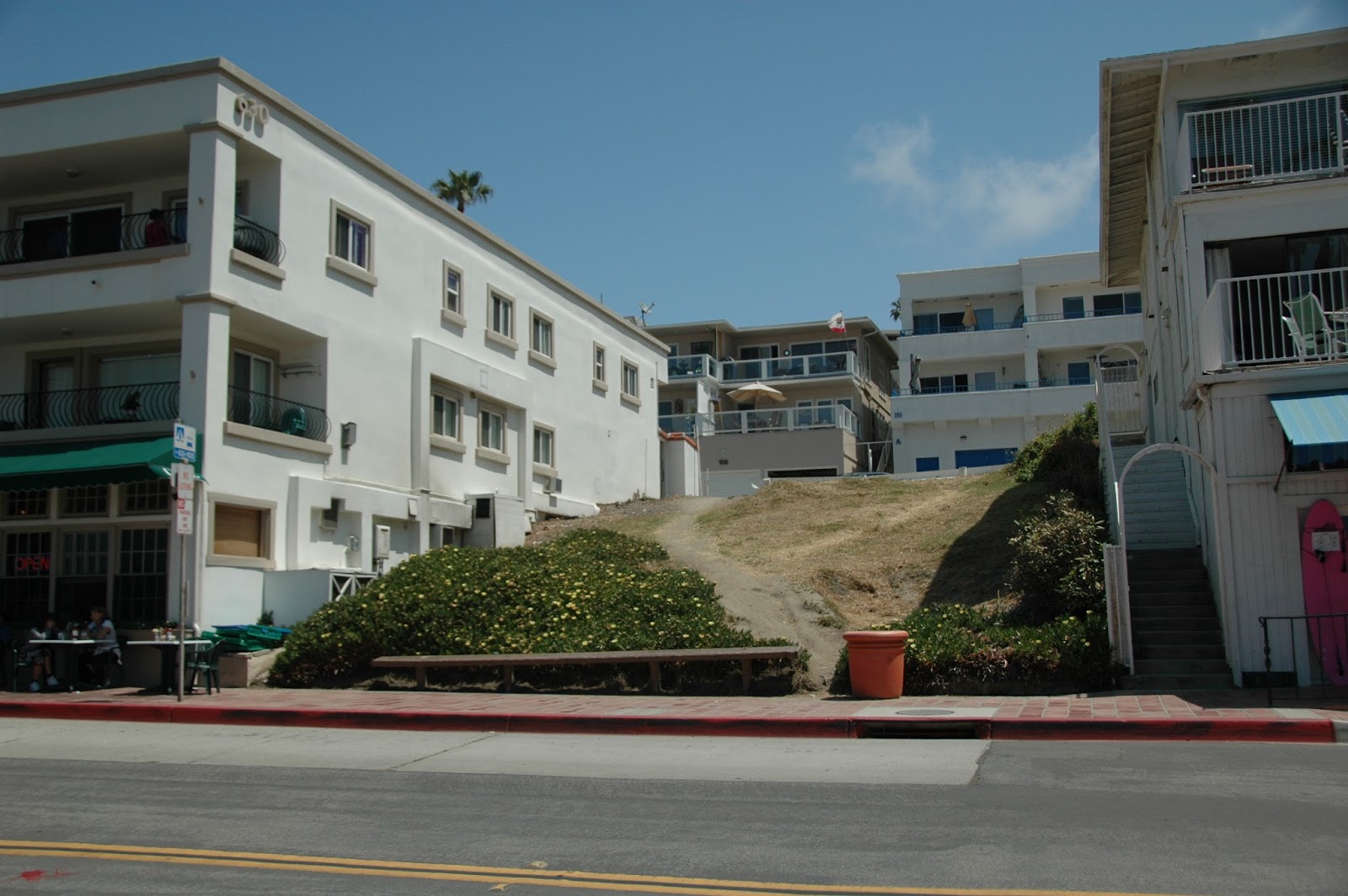
The apartment was a short block uphill from the waterfront with its pier and sandy beach.  At the foot of the dirt path that led to the ocean was a variety store where I could buy, in no particular order, comic books, ice cream cones, and live bait.  For a nine-year-old boy, it was pretty much all that was required for a week at the beach.

I recently visited San Clemente.  The waterfront was much the same, the store remained open, and even the dirt path survived.  Other than an apparent municipal dictate to paint all the buildings Positano white, the neighborhood looked remarkably unchanged since I last spent a week there in 1962.


I mention this because those weeks were the first time in my life when I was able to acquire the supplies of daily life within a short walk of my front door.  To my young mind, I thought it was a great arrangement, although probably something that could only be experienced during vacation.  Pedestrian access to shopping certainly couldn’t be a part of daily life.  It was probably a common belief among the suburban youths of my era.

Indeed, except for my years at Cal, several years in Seattle, and my last eight years in the North Bay, I’ve not lived within a quarter-mile of retail.  Luckily, we seem to be slowing moving in a direction that will ensure that future generations aren’t similarly deprived.

To my regret, I didn’t step into the San Clemente store during my recent visit.  Not needing comic books, ice cream cones, or live bait, I didn’t see the need.  I probably should have, but I fear that I might have been disappointed.  Perhaps none of those items remain in stock, having been displaced by designer sunglasses and souvenir polo shirts.   If so, the young boys visiting San Clemente in 2013 don’t know what they’re missing.

Scheduling Notes

Petaluma Urban has a couple of approaching activities.  On Tuesday, July 9, we’ll hold our monthly meeting.  We’ll convene at the Aqus Café in Petaluma at 5:30pm and will discuss “The Smart Growth Manual”.

Then, on Saturday, July 13, we’ll tour TOD developments on the BART system.

Several other activities are also in the planning stages.  If you’d like further information, please email me.  I can include you on the email list for meeting information.

I need to brag briefly about Urban Chat.  We began our monthly meetings little more than a year ago.  We’ve grown to a dedicated cadre of about a dozen.  I’d like to attract more folks, but we’ve made a nice start.

More importantly, we’re starting to take a role in Petaluma governance.  Last evening, three members of Urban Chat were appointed to the Recreation, Music, and Park Commission.  Barely twelve months old and we’re already on the edge of a Brown Act violation.

Two Urban Chat participants also applied for the Planning Commission.  Neither secured one of the highly sought-after appointments, but both received votes and finished among the top eight out of seventeen applicants.

Petaluma Urban Chat seems to be on a good path.

As always, your questions or comments will be appreciated.  Please comment below or email me.  And thanks for reading. - Dave Alden (davealden53@comcast.net)

Monday, February 25, 2013

From Today to TOD - Retail


In a pair of recent posts (here and here), I wrote about the difficulties of integrating transit-oriented development (TOD) into communities that have a drivable suburbia slant.  The two previous posts addressed how providing parking for transit users can conflict with a desire for mixed-use development near a transit stop.  I also wrote about a transitional solution that the City of Petaluma hopes will provide a working compromise and the hurdles that the solution must yet overcome.

But parking isn’t the only element issue that creates transitional difficulties.  Some are even more intractable than parking.  Such as retail.

A favored vision of TOD enthusiasts, and of urbanists in general, is streetfront retail.  The image they evoke is of the communities of the 1930s in which our parents or grandparents were raised, with rows of locally-owned storefronts marking the downtown.

Consistent with this vision, ground floor retail, underneath residential or office space, is a key element in many urban planning codes and conceptual plans.

But three key elements have changed since the 1930s.  First, cars have become far more pervasive.  And we’ve constructed a world in which the incremental cost of car usage is so small that few feel constrained in how many miles they drive.

Second, drivable suburban development has met the retail needs of the car drivers.

Third, the internet is capturing an ever increasing share of retail.  About 18 months ago, a planner told me that internet sales were only about 3 percent of all retail sales.  When one considers that cars and food are among the largest sources of retail sales and that both are relatively immune to encroachment from the internet, perhaps the number was correct.  But it seems evident that the internet’s share of retail will continue to increase, perhaps even finding business models that can capture shares of car and food sales.

Many have rediscovered, or never forgotten, the value of shopping downtown for a handful of screws or a sheet of sandpaper.  But most, when looking for a new power drill or belt sander, will drive to a home improvement store or shop on-line.  And the absence of those big-ticket, big-profit items from downtown undermines the commercial viability of downtown retail.

Developers have long understood that cities were seeking more retail than the market could support.  I’ve worked on multiple projects where the space designated by the code as streetfront retail was given transitional titles of “live-work” or “interim residential”.  A commitment was given that the space would become retail as soon as the market could support it.  But no developer believed that change would ever happen.

Within the past week, an architect told me of designing residential space with 14-foot ceilings to meet a city requirement that the space be easily converted to retail at a later date.  The developer didn’t believe that the space would ever be anything other than high-ceilinged residential.

Perhaps most tellingly, a developer acquaintance recently tried to sell an entitled, but unconstructed, mixed-use project.  The potential buyers were consistent in their determination of the project value.  Approximately $35,000 per residential unit.  And no value for the streetfront retail.  Although the buyers would build the retail, they expected to discount rents significantly in order to keep the spaces filled.  So they couldn’t project any profits.  At least they weren’t considering retail a negative asset.

And if you need yet one more example, look at the vacant spaces in the Theatre Square project in Petaluma, especially in the locations away from the primary pedestrian routes.

The Petaluma Station Area plan met the problem head-on.  The team headed by Opticos Design of Berkeley that developed the master plan knew that retail would be dodgy.  Especially in a city that recently gave the green light to two drivable suburban shopping centers.  Not surprisingly, the Opticos team found that the market didn’t exist for retail along the full street frontages.

In the words of the Final Draft report, January 2013, “Retail cannot be supported at every building, but if the current conditions change such that more retail can be supported, the code should be sufficiently flexible to allow that use.”  (For those who are reading along, this is from page 3-17 of the Petaluma Station Area Master Plan.)

The effect is that the initial buildings, if they comply with the master plan, will have some retail, but not as much as would have been required under the current code.  Instead, much of the street frontage will be residential.   (Techniques such as stoops or small private gardens will be used to transition between the public space of the sidewalk and the private space of the homes.)

If retail conditions change, later buildings might include a higher proportion of retail.  Although I suspect that Target and Amazon will be actively working to prevent that possibility.  And will likely succeed.

As always, your questions or comments will be appreciated.  Please comment below or email me.  And thanks for reading. - Dave Alden (davealden53@comcast.net)
Wednesday, November 21, 2012

Hometown Investment

About eight months ago, I wrote about the underlying forces that determine what retail businesses go into which locations.  I also noted a couple of unconventional approaches to tenant selection, including a Washington, D.C. development team that was polling the neighborhood for tenant ideas.  I was intrigued by the unconventional approach, but dubious about whether it would yield helpful results.

I was wrong.  Through their neighborhood interaction, Dan and Ben Miller identified a potential tenant who will move to the Millers’ building, expanding a successful business that is now located a block away.  And the neighborhood seems very happy with the result.

Of even greater potential importance, it seems that neighborhood involvement in tenant selection wasn’t the only cutting-edge task in which the brothers were engaged.  In an Atlantic Cities article by Emily Badger, she describes how the Millers decided to seek investment from their neighbors rather than going to traditional lenders.

It turns out that securing neighborhood investment is difficult option.  For generally good reasons, the Securities and Exchange Commission (SEC) limits investment in real estate deals to people who have established their expertise in real estate or to people who have a first-hand familiarity with the developers.  The prohibitions prevent unsophisticated developers from being bilked by unscrupulous developers.  But they also prevent unconventional ideas such as neighborhood investment.

The Millers choose to search for ways around the prohibition.  It was a memorable adventure that included a Goldman-Sachs attorney asking, in response to the Millers saying that they wanted to seek investment from the small folks, “Why would you want to do that?”

Eventually, the Millers found a little-used provision that allowed non-accredited investors to buy into a real estate project.  But the trade-off was an extensive and costly review by the SEC.  It was a route that the Millers took and eventually completed.

The article by Badger is long, but worth the read, especially if you have an interest in how money affects the development of our communities.

In past blog posts, I’ve noted that decisions affecting communities are disproportionately in the hands of lenders who have little stake in the communities and whose decisions are based almost exclusively on financial return-on-investment.  What the Miller brothers have done is to shine a light on an alternative course, one that would allow more of us to help direct the key decisions in our towns.

However, as noted by Badger, the mere fact that the Millers found a path doesn’t open up that path to others.  There are at least two major tripping points.  For one, the Millers probably spent more getting the neighborhood investment option approved than they can possibly recapture from the value of the neighborhood dollars.  It would have been cheaper and easier to secure the funds from conventional lenders and to put a more conventional business into the vacant space.  The Millers pursued neighborhood investment not because it was a financially prudent thing to do, but because they wanted to prove that it could be done.

Another tripping point is that the Millers seem to be particularly benevolent investors.  If a path to easier approval for neighbor investment can be found, it would likely soon be used by developers without the altruism of the Millers who will do exactly as the SEC fears, scam unsophisticated investors.

I’m thrilled by what the Millers managed to accomplish.  But it’s only one feeble shot in the effort to take community investment away from those who do not understand our communities as well as we do.

Follow-Ups and Schedule Notes

StrongTowns: In an outstanding example of serendipity, only a short time after publishing my post on StrongTowns, a pair of links (1 and 2) appeared in an email.  They are interviews by Ken Rose of Chuck Marohn, the founder of StrongTowns.  Being consumed by pre-Thanksgiving writing tasks, I haven’t yet finished both.  (I lack the teenage ability to write with one part of my brain while listening with another.  Actually, I suspect that teenagers lack it also, but they’re better at pretending.)  As far as I’ve listened, the interviews are great and I recommend them highly.

Petaluma Urban Chat: The next Petaluma Urban Chat will be Tuesday, December 11, 5:30pm at Aqus Café.  I wrote the date incorrectly in a couple of places, but have now confirmed and reconfirmed that December 11 is correct.  At this meeting, we’ll begin discussing the StrongTowns Curbside Chat booklet that can be found here .

As always, your questions or comments will be appreciated.  Please comment below or email me.  And thanks for reading. - Dave Alden (davealden53@comcast.net)

Wednesday, March 14, 2012

Which Retailers Go Where?

When a new retailer is announced, two responses are often heard. Some people question why the city allowed the proposed retail use when the community preferred something different. Others question why the developer or landlord isn’t more in touch with the community wishes. They then decry the developer’s “greed”.

Here’s a quick course in what drives decisions on retailer uses. What matters is: (1) What product or services is the community is willing to buy in sufficient quantity to allow the store to make a profit? Not what the community would like to be available, but for what they’re willing to put cash on the barrel head to buy. (2) If a new building or major interior upgrades are required, for what uses is the bank or other lender willing to provide funds? (3) On what business is an entrepreneur willing to risk his funds and time to operate?

On rare occasions, laws may prohibit a particular use. E.g., a bar may not be located next door to a school. But most retail decisions are based on the three criteria above. It is exactly the list of criteria that should occur in a capitalist state. If you want City Hall to decide which use should go into every vacant corner store, then what you want is a state-managed economy which, occasional scare stories notwithstanding, is a long ways from what the U.S. is.

But, if community preferences are not usually on the list of how retail locations are selected, are there more times when they should be? An owner of a vacant store in the District of Columbia is posing that question. Through a website, he is asking the neighbors around his property how he should use his vacant building. Not surprisingly, some of the responses don’t grasp the type of businesses that would be physically compatible with the space. Others don’t grasp the need for the retailer to make a profit. But people are responding to the website, which is a good thing. Dialogue, even when digital, is better than no dialogue.

Other property owners are concerned about the fallout from the process, wondering what will happen when the property owner selects a use that wasn’t the favorite of the neighbors. The property owner acknowledges the risk, but believes that the potential reward of learning of a new and creative use outweighs the risk.

In New Orleans, artist Candy Chang tried another approach to the community input question. As depicted in the movie “Urbanized”, she found retail structures that were abandoned in the aftermath of Katrina. At each, she posted a number of comment cards and a pen, asking neighbors to provide input on a proposed use. The responses ranged from possible to unrealistic to sarcastic, but at least the community was involved.

All of which leads to a question. If there are times when the community is so committed to a particular retail use or retail area that they willing to provide financial support, how can that support be delivered? Over the years, I’ve developed two thoughts.

Some of us may have belonged to country clubs, health clubs, or gyms that had dining assessments. Each month or each quarter, every member was required to spend as certain amount on food at the facility. A typical dining assessment might be $100 per month. If a member fell below the minimum, the difference was added to his dues. It results in great social opportunities on the last Saturday of the month when all the members congregate in the dining room to fulfill the last of their dining assessments before the first of the month.

Can the same approach be used in a multi-family building? Perhaps the developer promises that there will be a coffee shop and a deli in the lobby. To support the uses, the tenants are required to spend $50 per month in the two locations. If a tenant falls short, the deficiency is added to the rent.

A model like this can have problems. What if the tenants don’t like the food from the deli and resent having to spend money there? I once watched a fight on those grounds at a golf club north of Seattle. But the potential for an occasional conflict is not a sufficient reason to ignore an otherwise valid approach.

A second thought is a discounted debit card. All of the merchants in a downtown core or a walkable district agree to accept payment from a debit card specifically designed for their neighborhood. Local residents may sign up for the card, which is loaded with an initial $200 and tied to a checking account. When the card is empty, it’s automatically refilled. However, if the card was emptied in less than 30 days, then only $170 is charged to put a new $200 on the card, a 15 percent discount. If the card is emptied in 31 to 60 days, then $180 is charged. If 61 to 90 days, then $190. Over 90 days, the full $200 is charged.

If the merchants agree to accept a 12 percent on all debit card purchases, it may provide enough funds to cover the discounts and administrative expenses. The numbers likely require tweaking, but the model may have validity.

I recognize that there are few truly original ideas. If anyone knows of either of these two approaches being used to support walkable retail, please share.

As always, your questions or comments will be appreciated. Please comment below or email me. And thanks for reading. - Dave Alden (davealden53@comcast.net)