Showing posts with label New Urbanism. Show all posts

Friday, November 28, 2014

“The Planners” Keeps Hitting the Mark

I’ve previously offered praise  for the BBC show “The Planners”.  I find my enthusiasm continues to grow with every episode I watch.  Nor am I alone in my approval.  Writing in CityLab, Feargus O’Sullivan expresses similar feelings about the show, noting the captivating conundrums presented by the producers and the insights to English land-use philosophy.

Some readers may remember the U.S. television show “Picket Fences” from the mid-1990s.  The well-constructed scripts made it perhaps my favorite show ever.  The writers would select a potentially controversial aspect of everyday life, whether personal privacy, May-December romances, or school busing, construct a scenario that evenly balanced the points on both sides of the equation, and then allow the characters to become emotionally invested in arguing the pros and cons.

Many episodes ended at the courthouse, where Judge Bone would hand down his gruff, but Solomonic judgments, neatly cutting through the Gordian knots that had entwined the adversaries.  Although reality rarely plays out as neatly as Judge Bone would have it, “Picket Fences” still provided an introduction to ethics and morality in the modern era.

“The Planners” is the reality equivalent of “Picket Fences”, reaching similar heights in the land-use issues that are selected for the show.  Whether the balancing the rights of homeowners to mount solar panels on slate roofs versus the rights of historians to preserve medieval vistas or comparing the rights of farmers to build a new chicken facilities with the rights of neighbors to be free of chicken aromas, the land-use decisions to be made are neatly positioned on the blades of knives.

If there is a place where “The Planners” falls short, it’s the absence of a Judge Bone to rule with wisdom and curt certitude.  Although many of land-use decisions are ultimately reasonable, the planners often seem overly confined by the rule book and the planning councils (what we call planning commissions in California) often seem arbitrary, perhaps beholden to political interests that we don’t see.  But that’s often the nature of land-use reality.

Episode three of season one meets the standards established in the first two episodes, and perhaps even raises the show to a new level.  I highly recommend enjoying it while awaiting sandwiches of leftover turkey and dressing.

The four stories in the episode are summarized below, although you’ll have to watch the video for the decisions.

A family-owned development company owns a small brownfield site about a mile from an English village.  On several earlier occasions, they proposed a small housing project and renovation of the abandoned pub on the site.  The planning council rejected the earlier proposals because of a lack of transportation options to the village except for driving on the busy highway.  The council argues that the absence of a bicycle/pedestrian alternative makes the development “unsustainable”, a very different definition of sustainable than is typically found in the U.S., but one that I endorse.

The family is now proposing the same project, but with a mile-long footpath along the highway.  Rejection might cost the family their business and home.  Confounding the situation further, several national builders are proposing residential subdivisions on greenfields closer to the village.

An overcrowded mosque is proposing a major expansion.  But the addition would be architecturally banal and only provide three parking places compared to the 115 required under the code.  The members of the mosque argue that their use is primarily evenings and weekends when the adjoining industrial uses are quiet, so shared street parking would work fine.  The planner responds that the mosque could sell the building to another user who would need daytime parking.

A mechanical hobbyist has built, without planning approval, a backyard shed for his overly large toys.  Some neighbors are convinced that he must be running a truck repair business in his backyard, which is forbidden under the code.

A homeowner has replaced a four-foot high hedge with a two-foot tall picket fence to better contain his rambunctious toddler.  A by-the-book neighbor notes that fences are prohibited under the rules governing the homes.

All four are good planning conundrums.  And all four offer compelling television, at least for land-use geeks.  Enjoy.  There are lessons to be learned that can be applied to arguing effectively for urbanism.

Next time, I’ll talk about a holiday season plan to explore the best streets in the North Bay.

As always, your questions or comments will be appreciated.  Please comment below or email me.  And thanks for reading. - Dave Alden (davealden53@comcast.net)

Wednesday, September 24, 2014

For Good Government, Ideas Must Roam Freely


Many readers have likely had experiences similar to mine when it comes to sharing new concepts.  I’ll think through a thorny problem, find an alternative perspective to the conundrum, and use that perspective to find an unexpected solution.  But when I first share the idea, perhaps in a meeting where other’s thoughts are elsewhere, no one responds favorably.

However, a few days later, someone comes by my desk to acknowledge that there may be something in what I had said.  Over time, other folks grasp my way of thinking and the idea, likely edited and improved by the others, comes to be adopted.

Sometimes new concepts or ways of thinking can’t be transferred instantaneously, but need time to find fertile soil.  When I wrote about the Brown Act a few posts back, most recently here, I may have failed to adequately explain the extent to which the law can impede the flow of new and different ideas.

The obstruction is ironic because the intent of the Brown Act is to prevent secrets, specifically in the form of decisions made by public bodies away from the eyes of the public.  But an unintended side-effect is nonetheless to inhibit the flow of ideas.

The first time that a public official can share a novel idea or creative approach with the entire public body is when the matter is already under discussion in a public session.  The other officials may be focused on their own arguments and fail to recognize the value in the new suggestion.  And a couple of days later, when the penny finally drops, it’s too late to make a difference.  First, because the public body has already made a decision.  And second, because many public officials are unwilling to admit that they’ve changed their minds.

We often elect officials for their ability to bring creativity to the task of government.  But we then subject them to a set of rules that have the effect of putting a lamp shade over that creativity.

I have an anecdote from my long-ago past that can illustrate the problems that can result when the free flow of ideas is restricted.  It wasn’t a Brown Act situation, but provides some parallels.

In one of my Brown Act posts, I mentioned serving on the Design Review Committee for a large residential/recreational community in an Oregon community.  My involvement with the project was long and varied, extending nearly a decade from early concepts through entitlement to construction of many of the phases.

At the entitlement phase, there was a key question about project density.  Under Oregon law, a minimum density must be met.  Developers aren’t allowed to chew up large tracts of land without providing sufficient housing to meet the needs of the community.

Depending on the how the density was calculated, the project may have been short of the minimum density.  (Note: I’m not very proud to have been an integral part of a project that bumped against a minimum density standard.  However, bills must be paid.  Also, it’s possible, with clustered development, to have a relatively low density and still have a moderate level of walkability.  This project had elements of that potential, although the walkability never came to fruition due to later strategic decisions that were taken over my objections.  That’s a story for another time.)

To meet the minimum density standard, the development team constructed the argument that the golf course, which required a separate application, was a different land use and that the area occupied by the course should be excluded from the density calculation.  Part of the argument was that if the golf course were built now and the housing was entitled and built a decade hence, the density calculation wouldn’t include the golf course area, so why should it be included if the applications were simultaneous?  With that argument made, the minimum density was achieved.

Another aspect of the project was the need to modify the Urban Growth Boundary (UGB), which in Oregon is an action subject to review and approval by the state.  The team decided not to try to justify an expansion of the urban growth area.  Instead, we proposed a realignment of the boundary where it crossed the property, maintaining the same enclosed area, but configuring the UGB to accommodate the project configuration that best suited the proposed number of homes.

Another aspect of Oregon land use law that should be noted is the role of the hearings officer.  In California, the initial land use body is often the Planning Commission, with many decisions also requiring City Council concurrence.  But in Oregon, the Planning Commission is reserved for legislative and long-range planning issues.  Land-use applications are heard before a hearings officer, usually a local attorney with a land-use background.  And only appeals go to a City Council or County Commission, so the hearing officer is often the final word.

(I can see benefits to both the Oregon and California systems.  In California, the aesthetic judgment of the public is represented in a Planning Commission, but the logical cohesiveness of the process can be disrupted.  In Oregon, the hearing officer can be a stickler for the law, but project aesthetics are best raised through comments by the public.)

Also, an Oregon hearing officer is off-limits to the development team.  It might be possible in California to chat with a Planning Commissioner in the weeks before a hearing, but that type of contact is strictly prohibited in Oregon.  The opportunity for an effective meeting of minds is reduced.  And we had no opportunity to ensure in advance that he understood the density argument.

Thus, the big residential/recreational project went before a hearing officer.  There was opposition to the project.  Given the nature of the opposition, the team mentioned the density and UGB realignment arguments in passing, but reserved most of our presentation for addressing the concerns of the neighbors.

In the aftermath of the hearing, we thought we had done well, but could only await the decision from the hearing officer.  After a couple of anxious weeks, the decision was received.  The project was approved, but with conditions and modifications.

In particular, the hearing officer hadn’t grasped the argument about the golf course not counting in the density calculation.  In its place, he’d had a done an alternative computation.  (Even after twenty years, I still recall that he bumped the housing count from 529 to 676.)  And yet he’d approved the UGB realignment that had been configured to the smaller number, not giving the option to make adjustments to better accommodate his larger number.

In the subsequent team meeting, I presented the arguments that would support an appeal, first arguing that the original density calculation was correct and then arguing that, even if the hearing officer’s density was upheld, the developer should have been given the opportunity to adjust the proposed UGB.

The developer concurred with both arguments, but also knew that an appeal would take time and would be in front of the County Commission, so would involve educating new decision-makers.  In the end, he sighed and decided not to appeal, instead directing the team to find ways to add the additional housing units.

And so we did, adding a small-lot neighborhood, squeezing in a couple of townhome projects, and reducing the width of a number of larger lots.

The project did well, but the clunkiness of the density fix was occasionally noted.  In particular, potential upper-end buyers complained about the missing lot width, with some citing the lot width as their reason for not buying.

Flashing forward five years, I was continuing to work on the later stages of the project, but also had other projects, including an irrigation district that was pursuing funding for a water conservation project that would return water to the local river.  Among the potential funding sources was the federal government.

A newly-elected U.S. Senator wished to learn more about the project, so asked the district to give a tour to his local field representative.  I was asked to join the tour.  By chance, the field representative was the wife of the hearing officer from years earlier.

As we drove around the district, the field representative asked me about the other projects on which I was working.  I mentioned the residential/recreational project.

She responded. “I like that project, but keep hearing that the lots are too narrow.”

To which I replied, “You should ask your husband about that.”

She was surprised by the connection, so I gave a short explanation and considered the matter closed.  But a few weeks later, she and her husband attended a local minor league ballgame.  As part-owner of the team, I was greeting fans near the main gate, including the couple.  The hearing officer referenced the recent conversation and asked for more information.

And so it was, nearly five years after the hearing, that the hearing officer and I sat in adjoining boxes in a minor league ballpark talking about the fine points of the long-ago hearing.  Once he’d been briefed, he agreed with both of my points, that excluding the golf course from the original density calculation was correct and that, even if the density argument was rejected, the developer should still have been given an opportunity to adjust the UGB.

Of course, the horse was long since out of the barn and far down the road.  Perhaps one can argue that the project would have been more successful, generating more property tax revenue for the community, if the arguments had been understood on a timely basis.  But it’s equally possible that the only impact was that a few affluent home-buyers had a little less elbow-room than they might have wished.

But what happens if a similar communication failure occurs on an urban project, if a key element of walkability or transit access is omitted because the developer isn’t able to correct a misconception of the hearing body or if a public official has an inadequate opportunity to explain a new vision to his fellow officials?

We live in an increasingly complex world, where the accurate and comprehensive flow of information is key to making the world work well.  Whether it’s Oregon putting hearing officers in a bubble or California imposing the Brown Act on public officials, constrictions on the flow of information and ideas increase the possibility of weaker outcomes.  We should be constantly aware of that risk and looking for ways to minimize it.

In my New Year’s resolutions for this blog, I promised to look in depth at the specific issues of parking and senior living during 2014.  With fall upon us, it’s time to begin honoring those resolutions.  In my next post, I’ll begin a multi-post look at combining urbanism with senior housing.

As always, your questions or comments will be appreciated.  Please comment below or email me.  And thanks for reading. - Dave Alden (davealden53@comcast.net)

Wednesday, June 11, 2014

CNU 22: Only to Urbanists Would Buffalo Be Better than Dallas

In my last post, I began my report from CNU 22, the 22nd annual meeting of the Congress for the New Urbanism.  Today, I’ll offer some moments from the conference.  Not detailed analysis, but just moments.  Snippets of conversation or observations that give a flavor to what it’s like to hang out for five days with urbanists, looking at the world through urbanist-tinted glasses.

Buffalo versus Dallas: CNU 23 will be held in Dallas, a choice that many CNU members found odd because of the pervasive suburban slant of Texas.  The destination will be in sharp contrast to Buffalo with its proud history of urban glory and its current efforts to recapture some of that glory.

But CNU folks understood than much of the world would find Dallas the more desirable destination.  I rode in from the airport with a CNU member from Dallas who expressed it best, “Only to urbanists would Buffalo be better than Dallas.”

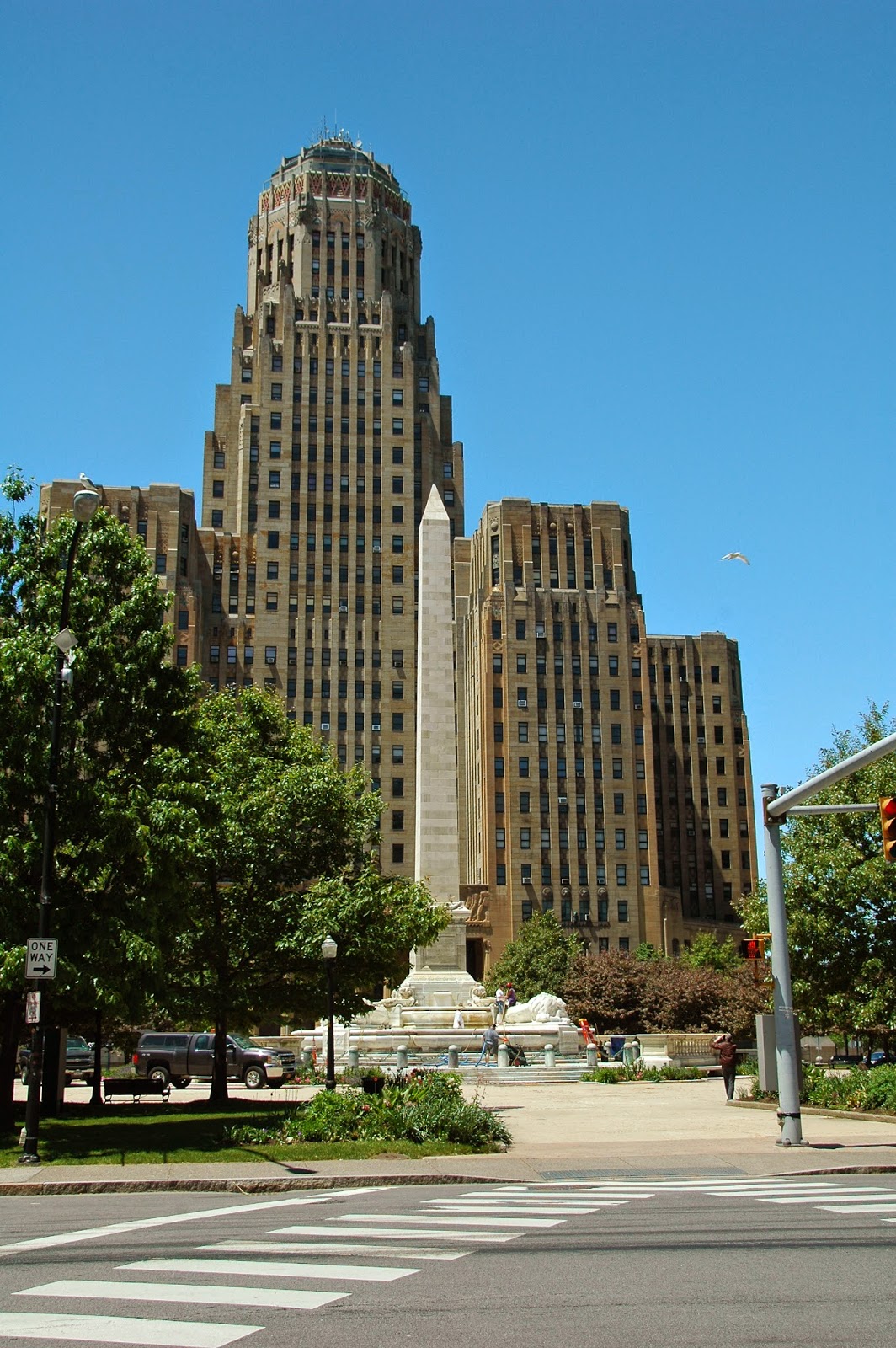
Buffalo Streetscape:  Downtown Buffalo is filled with great buildings.  The photo is of the Buffalo City Hall, an art deco masterpiece that is on the National Register of Historic Places.  And it’s surrounded by buildings that are equally striking.  They bespeak of a time when Buffalo was among the leading cities in the country.

But the sidewalks of Buffalo are oddly quiet.  The occasional pedestrians appear lonely among the tall buildings.  And they can jaywalk with ease because of the paucity of cars.  A fellow CNU attendee expressed it well.  “It’s as if we’ve come upon the abandoned city of a great civilization.  But we aren’t the first to arrive.  Others arrived before us and are now slowly beginning to repopulate the buildings.” 

Buffalo Weather:  Buffalo is well-known for its weather, particularly the “lake effect” snowfalls of wintertime.  On the opening evening, I chatted with a member of the local host committee and asked about the snow.  He acknowledged that it gets deep, but also noted that Buffalo knows how to deal with snow, so the city still functions well on most days.

Besides, he noted, “No one stays home when it snows heavily.  Those are the nights when you have to be at the pub with your friends, watching the snow pile up.”  That seemed a fine measure of civic life.

Buffalo Skyway: The outgoing CNU president and CEO, former Milwaukee mayor John Norquist, has been using his political capital to advocate for the removal of urban freeways where surface boulevards can provide the same traffic function.  Norquist argues that conversion to boulevards would eliminate community dividers, improving civic life and bumping property values.

In the Bay Area, removal of the Embarcadero Freeway and replacement of the Central Freeway with Octavia Avenue are examples of the kind of urban transformations that Norquist is seeking.

(In the North Bay, I’d suggest that Highway 12 east from Santa Rosa toward Bennett Valley is another freeway segment where the community would be better served by a boulevard.  And also perhaps Highway 29 through Napa.)

Given that background, it was interesting that the opening night function was held at First Niagara Center, immediately adjoining the Buffalo Skyway.  The Skyway is among the prime targets of urbanists who argue that the flyover of the Erie Canal accomplishes little except sapping the life of the land beneath it.

I walked to First Niagara Center with a group of conference attendees.  As we approached the building, I noted a sign on the surface street beneath the Skyway, “Watch for Falling Debris”.  Looking up, the Skyway was the only possible source of debris.  Yup, I can imagine that constantly looking for hubcaps falling from the freeway fifty feet above is a damper on urban street life.  We hurried inside.

More moments will follow in the next post.

Greetings

Blog readership jumped with my last post.  A really big jump.   And darned if I know why.  I checked several possibilities, but none proved out.  Perhaps it was only because I included “CNU 22” in the title.  To be safe, I again included CNU 22 in this title.  And will continue to do so for the next few posts.

But regardless of why the new readers arrived, you’re welcome.  I hope you stay around.  I’ve been described as an urban generalist, touching at various times on land-use, density, traffic, transit, municipal finances, climate change, travel, and any other aspect of urbanism that catches my attention.  And I often try, with varying levels of success, to apply the information to my home territory, the counties that are arrayed around the north end of San Francisco Bay.

If you have any questions or comments, let me know.

Milestone

Early in the history of this blog, I noted when readership passed 1,000, 5,000, and then 10,000 pageviews.  Those milestones seemed to add validity to my early efforts, but I eventually decided that I needn’t note every landmark.

However, I passed 100,000 early this week and couldn’t let that milestone pass unnoted.  (I probably would have passed 100,000 even without the readership jump, but the new folks assured that I moved past the threshold with good velocity.)

Thanks to all the readers who have been part of the 100,000.  Thanks for coming back three times a week and for becoming part of the conversation.

Schedule Notes

The first couple of downtown/ballpark outings are nearly upon us.  Dates and places are below.  If you wish to join the outings, let me know.  We can coordinate on meeting places, etc.

San Rafael: Friday, June 13 – Pittsburg Mettle at San Rafael Pacifics, first pitch 7:05pm
Alameda: Sunday, June 15 – Sacramento Spikes at Neptune Beach Pearl, first pitch 3:00pm

As always, your questions or comments will be appreciated.  Please comment below or email me.  And thanks for reading. - Dave Alden (davealden53@comcast.net)


Friday, June 6, 2014

Stopping for Pedestrians

A reader recently asked for my advice about adding crosswalk markings in his community.  I provided contact information for a key contact in his town.  But I also provided a warning about the response he might receive.

The crosswalk location of interest to him seemed, at first glance, to be a reasonable place for additional street markings.  The street crossing connected a district that is largely residential with a district that is more mixed-use, offering restaurants, niche retail, and office space.  A number of pedestrians already cross at the spot he identified and it seems likely that more would follow if a crosswalk was painted.

But the location was also on a busy arterial, marked for 35 mph and often driven at 40.  The nearest signals were several blocks away in both directions.

I warned my reader that he was likely to get pushback from City Hall about his suggestion.  And the concern from City Hall would be reasonable, because crosswalks often don’t function as we expect, especially as speeds increase.

Although drivers are required under the law to stop for pedestrians at crosswalks and intersections regardless of the speed limit, the rate of compliance drops at speeds above 30 mph.  The cause is probably a combination of the speed at a car approaches an intersection, reducing reaction time, and of the additional stopping distance required at higher speeds.

On the other side of the equation, pedestrians are often emboldened by a crosswalk, stepping confidently into a street and trusting drivers to respect the painted stripes.

As a result and paradoxically, vehicle/pedestrian accidents often increase when a new crosswalk is provided on an arterial.  Because many drivers fail to respect crosswalks, pedestrians are often more safe when they are careful to cross the street in the absence of a crosswalk.  Perhaps elevated levels of stress have unfortunate long-term health implications, but when the immediate goal is reaching the far sidewalk, fear can be a good thing.

I’m eagerly awaiting a report from the reader about his reception at City Hall.

Shortly after this exchange, Smart Growth America released their “Dangerous by Design” report.  The report looks at the conditions and design standards of U.S. roads for use by non-motorists.  I haven’t yet read the entire report and will likely write further after I’ve completed my reading.  But for today, I wanted to note one particular finding from the report.

A study was done on Florida arterials with speed limits of 35 to 40 mph, counting the number of drivers who stopped for crosswalks where pedestrians were waiting to cross.  They found that only 1.1 percent of all drivers stopped.  Perhaps the rate is Florida is lower than the national average, with drivers in other states more respectful of pedestrians, but 1.1 percent is so appallingly low that it remains an embarrassment regardless of the other states.  And, although it’s only one data point, the Florida study fully justifies the warning I gave to the reader to expect City Hall pushback on his crosswalk idea.

Of course, another way to look at the data is to question whether we’ve set speed limits too high when pedestrians are likely to be present.  Which brings us back to the “Twenty is Plenty” argument.  Perhaps 20 mph is too low for arterials, but even 30 mph could have a dramatic impact on pedestrian safety.

As always, your questions or comments will be appreciated.  Please comment below or email me.  And thanks for reading. - Dave Alden (davealden53@comcast.net)

Wednesday, June 4, 2014

City Grids are Evidence of Where We’ve Been

From above, the street pattern of Petaluma is engrossing.  Decade by decade, it shows who Petalumans were and how they thought about their town.   It’s a fine historical overview, even if some of the information it imparts is unfortunate.

Southwest of the river, many of the major streets are radial from town, showing a focus not on urban transportation, but on agricultural access.  Today Bodega Avenue, Western Street, D Street, and I Street may function more as urban collectors and arterials, but their alignments, spreading like fingers from a hand, shows that they were originally aligned to help farmers bring produce and eggs to town.

Even within the town, the cross-connectors between the early radial streets, Howard Street, Webster Street, the numbered streets, and others, are haphazard, responding not to a master plan, but to the immediate needs of the day.

C Street stops and starts intermittently.  Webster Street jogs oddly near the rear corner of the high school.  Brown Court and Coady Court almost connect, but don’t and probably never will.

These are signs that the town was dealing with day-to-day problem solving, not a long-term vision.  And that the town was responding to the geographic challenges of hills and streams with guile, not earthmoving equipment.

It’s only across the river, moving northeast, that the grid becomes more coherent.  Perhaps influenced by the continued flowering of the industrial world and the resulting belief that science could solve everything, the East D Street neighborhood is a fully connected grid.

But the planners hadn’t yet reached their ultimate conclusions, so the blocks are oddly configured, unusually long in the northwest-southeast direction and more suited for backyard egg production or truck gardens than full connectedness.  Nor is there a strong hierarchy between the streets.

Moving further northeast, across the freeway, the full flowering of post World War II land planning becomes evident.  A strong hierarchy of arterials and collectors isolate pockets of residential, some of which follow a near grid and others of which have follow a more sinuous, mock-organic pattern, pretending to be a bucolic countryside and attempting to ignore the enclosing street network.

Returning to the west side and looking beyond the first row of hills is hopefully the final gasp of land planning hubris.  Victoria and West Haven are pockets of residential housing of moderate density, but without schools, retail, or job centers, relying on streets and cars to reach the necessities of everyday life.

And all of this, a 150-year vista of land-use planning trends as applied to the particular circumstances of Petaluma, can be seen at a glance from 30,000 feet.

Petaluma is far from the only town for which this is true.  Starting in Novato and moving south, most Marin communities show the effect of geography, with older downtowns and housing clustered in the more accessible land close to the bay and pockets of more recent and car-dependent housing tucked into valley openings further uphill.

And in Sonoma County, the era in which municipal growth occurred can often be determined from the air.  Sonoma, with a largely intact grid downtown pattern, shows its origins in the Spanish era of California, while Rohnert Park, which has similarities to the east side of Petaluma, experienced its biggest growth in the years after the World War II.

Looking even broadly afield, this article in Urbdezine reviews what the grid patterns of some of the world’s great cities, including San Francisco and New York City, say about the history of their cities.

 Another way to look at city grids is the extent to which history and geography allowed a city to remain on a single grid or forced it to divert into multiple grids or a hodgepodge of random street directions.  In this article in City Labs (formerly Atlantic Cities), the compass orientation of all streets in a city are assembled into a single rose.  At a glance, it can be seen that the flat topography and coherent, steady growth allowed Chicago to stay largely on its initial grid, while the organic growth of London over centuries resulted in a rose that is nearly a circle.

The current generation of planners and developers will likely add little to the history of street grids, with infill of the existing grids being more the order of the day, which is a fine thing.   But the existing grids provide more than enough information to hold our attention and to impart a wealth of information about cities.

Schedule Reminders

The next meeting of Petaluma Urban Chat will be Tuesday, June 10.  We’ll convene at 5:30pm at our regular meeting place, the Aqus Café at 2nd and H Streets.  We’ll continue our discussion of “Happy City” by Charles Montgomery.  All are welcome, whether or not they’ve read the book.

Also, our first three outings to check out downtowns before attending local ballgames are quickly approaching.  Dates and places are below.  If you wish to join the outings, please let me know.

San Rafael: Friday, June 13 – Pittsburg Mettle at San Rafael Pacifics, first pitch 7:05pm
Alameda: Sunday, June 15 – Sacramento Spikes at Neptune Beach Pearl, first pitch 3:00pm
Healdsburg: Monday, June 16 – Sonoma County Chili Gods at Healdsburg Prune Packers, first pitch 7:00pm

As always, your questions or comments will be appreciated.  Please comment below or email me.  And thanks for reading. - Dave Alden (davealden53@comcast.net)

Monday, June 2, 2014

Walkability under Attack

A recent article in CNN Money reviewed Walgreen’s current strategies regarding store locations.  Much of the information was standard corporate-speak for the benefit of stock market investors.  But there was some startling information near the bottom of the article.  It was troubling in its content and in the fact that it was presented in a matter-of-fact manner.

The more mundane portion of the article was about corporate acquisitions recently completed by Walgreen’s.  The acquisitions had resulted in near-duplicate store locations, so closings were pending.  Chain consolidations steal character from our towns at a time when the towns should be aggressively preserving character, so the acquisitions and subsequent closings are disappointing.  Store closings also lengthen walks, inhibiting walkability.  But acquisitions and subsequent closings are part of many corporate business models in the early 21st century.

It’s also disappointing that the average age of the stores being closed is only ten years.  The fact puts a dent in the plans of many communities to rely on sales taxes for long-term financial stability.  But once again, it’s the current model for many corporations.

The new and distressing information is an admission by Walgreen’s consultants about a strategy for new markets.  They acknowledge that the chain sometimes acquires and develops multiple properties within a short distance of each other, especially if the locations are at key intersections and have good visibility.  Walgreen’s pursues this strategy despite the expectation that some of the locations will fail and soon be shuttered.  The argument is that Walgreen’s can afford to take a loss on some new stores if it allows them to secure key locations, to block competitors, and to saturate the marketplace.

I understand the corporate perspective.  But what about the civic perspective?  Walgreen’s strategy of cannibalizing their own stores might not do great harm in a drivable urban setting.  If a particular business is no longer available at one location, car drivers need only continue to the next block or the next community and do their shopping there.

But in a walkable urban setting, that underused building, whether shuttered or leased to a business with a lower sales volume, can become a barrier to walkability.  Faced with a large, unappealing building that fails the walkability standards for interest and usefulness, pedestrians might turn back, ending their shopping.  Or they might drive to destinations on the far side of the barrier.

In a world of subsidized streets, free parking, and underpriced gas, walkability is a delicate plant.  Walgreen’s, in its willingness to monopolize and then to under-utilize key locations, seems eager to stomp on the plant.

This subject relates to another concern about chains.  Many use a distinctive architecture as part of their branding strategy.  The problem is that when they abandon a building, such as when they cannibalize themselves, they leave behind a building that was clearly built for an earlier user and therefore exudes a sense of failure.  Restaurants seem particularly prone to this, with repurposed Denny’s and Taco Bells evident in many towns.  During my years in the Northwest, a restaurant with a giant anchor out front was the often the sign of a failed Sea Galley.

Compared to the restaurant chains, the Walgreen’s architecture isn’t particularly distinctive, but has enough character that a former Walgreen’s can be identified by a discerning eye.  And evidence of a failed Walgreen’s on a key downtown site can be a drag on a community.

This likely isn’t a workable solution, but it’d be good if all chains who insist on distinctive architecture can be required to provide a bond ensuring that all architectural details tied to the chain be removed when the chain ceases use of the building.  The problem is that it’s difficult to bond for an event that may occur a year from now or fifteen years from now.  But the goal is worthwhile and perhaps there are other ways to achieve it.

Until then, perhaps we should stop patronizing chains that shamelessly cannibalize themselves, thereby stealing our walkability.

(Acknowledgment: Walgreen’s is currently engaged in a tussle with the City of Petaluma over a proposed site near Petaluma Valley Hospital.  The primary point of contention is whether Walgreen’s can include a drive-thru pharmacy.  In general, I’m supportive of the Petaluma ban on drive-thrus, agreeing that they eat up space, waste gas, and reduce human interaction.  But if a case can be made for a drive-thru, it would seem to be at a pharmacy where ill people can be saved a long walk through a store.

I didn’t write today about the Walgreen’s anti-walkability strategy to influence the pending Petaluma decision.  It’s only a coincidence that the Walgreen’s consultants chose this particular time to stick their feet in their mouths.)

As always, your questions or comments will be appreciated.  Please comment below or email me.  And thanks for reading. - Dave Alden (davealden53@comcast.net)

Friday, May 30, 2014

Giving a Fair Start to the Next Generation

I recently spotted a building under construction in a redevelopment district.  I concurred with the mixed-use and transit master plan for the district, so was pleased to see the construction.

When I asked about the building, I was told that it was low-income housing, not surprising because the post-recession financing opportunities for low-income housing have been more robust than for other types of development.  But the information about the low-income housing came with a tone implying that it was housing for folks who weren’t like us.  It was housing for “others”.

I understood why this attitude exists.  Nor was it the first time that I’ve come across the attitude.  But I was still troubled by it. 

When we isolate low-income folks in low-income buildings, we give those folks a label that is often wrong and always unfair.   Sure, a low-income building likely has residents who have failed by laziness to grab opportunities or who have stooped to crime, but it also has residents who have been battered by misfortune and who are working hard to recover or who have chosen to follow a career passion that doesn’t pay well.  To paint all of the residents with the same brush is unfair.

And to none is it more unfair than to the children who live in the building.

Let me to offer a fictional vignette, although one in which I expect most readers to find at least a few reminders of events in their own pasts.

Let’s say that a little girl from a low-income building heads off to begin first grade.  As children tend to do, she looks about at lunchtime in hopes of making a friend.  And sure enough, she finds another little girl with whom to eat.

Over a couple of weeks, the two become chums.  The girl from the low-income building eventually invites her new friend to her apartment for a Saturday play date.

The friend goes home and excitedly tells her parents about the invitation.  The parents ask where the friend lives.  Upon hearing the address, they exchange a look and reply, “Well, perhaps she can come here to play.”  The friend is only a few weeks into first grade and has already learned that there are places and people that are somehow different and unacceptable to people like her.

This scenario is completely fictional, but it rings true, doesn’t it?  I expect that many can recall similar situations in their own lives.

So, what can we do about the labeling?  The obvious solution is to educate folks that there are many solid citizens living in low-income housing.  But that effort feels much like the racial equality issue which is still underway after sixty years without an end in sight.

The next alternative is to stop building projects that contain only low-income units.  I could write of a grand vision of a world in which low-income housing isn’t needed, but that’s far beyond the scope of an urbanist blog.  But I can write about beginning to incorporate all future low-income units into buildings that also include market-rate units.

This would also be a great change from an urbanist perspective.  Any timidity about walking past a low-income building would be eliminated if low-income units were instead integrated into market-rate buildings, enhancing walkability.

Changing this model won’t be easy.  There’s an entire industry built around low-income housing, from non-profit developers to government financing specialists to investors who specialize in the tax credits.  Restructuring the industry to a more integrated model will require many adjustments.  But the benefit is worth the pain.

Also, many folks in market-rate housing won’t be eager to have low-income residents down the hall, preferring that they remain in a separate building.  That’s okay.  Many of the same folks once felt the same way about African-Americans and were able to get over it.

Lastly, most market-rate developers, for good reasons, don’t want to incorporate low-income units into their projects.  It’s already hard to manage a project when building for a single demographic slice.  Adding architectural design for a broader range of units, managing additional subcontractors for different types of details, and training salespeople to work with both market-rate and low-income renters are all significant new burdens.

As a result, most developers, given the alternative, would rather pay a low-income housing fee than include low-income units in their projects.  But that’s an option that we need to take away from them.

Are there ways to make developers more content to broaden the range of the target demographic for their projects?  Many cities allow a higher density if low-income housing is included in a project, but the incentive isn’t enough to entice most developers.  Plus, the policy puts higher density on the wrong side of the equation.  It makes density something that cities are grudgingly willing to accept in exchange for a greater good, when density is something that cities should be actively encouraging.

The only solution seems to be something that I’ve suggested before.  We need to clean up the entitlement process, giving developers lower costs and more certainty.  And then we require the developers to apply their savings toward building the projects that walkable urban settings truly require, including residential projects that integrate market-rate and low-income housing.

Many believe that upward mobility, the belief that talent and dedication can overcome humble beginnings, is engrained into the character of the U.S.  But the reality is that, by many measures, social mobility within the U.S. has declined rapidly in our lifetimes and now trails much of the western world.

There are many reasons for this loss of social mobility, most of them beyond the realm of an urbanism blog.  But applying a tag of “low-income housing resident” at birth is one of those reasons.  And it’s one that urbanists should work to eliminate.  We need to stop slapping labels on the foreheads of first-graders in pinafores.

As always, your questions or comments will be appreciated.  Please comment below or email me.  And thanks for reading. - Dave Alden (davealden53@comcast.net)

Wednesday, May 28, 2014

How Much Democracy Can Land-Use Tolerate?

The biggest decisions in land-use should have broad public involvement.  Whether the decision might be the adoption of a general plan, downtown specific plan, or rewritten zoning ordinance, extensive public participation should be part of the process.  The involvement might be through a general vote or it might be through broad public input followed by the decision of an elected body.  Either way, our system of government demands that the public be involved.

At the other end of the scale, small and intimate development details, such as whether the bathroom counters are marble or granite, should be decided privately by the developer.  (I’ve known a few planning commissioners who seemed not to concur, but I discount them.)   These are marketing decisions to which the consumer can respond, but in which the general public has no legitimate role.

With the two ends of the spectrum defined, there’s a wide expanse of development decisions.  How tall can a building be?  What setbacks apply?  What size residential units should be provided?  How much parking should be provided?  What color should the cornices be painted?  How should the interior public spaces be decorated?

To deal with those decisions, we’ve devised a broad range of decision-making systems.  Zoning codes set standards to which most project details conform.  Warrants and/or variances may allow divergence from zoning codes.  Smaller projects may be subject only to administrative review.  Bigger projects may appear before design review boards, hearing officers, planning commissions and/or city councils, some of which allow public comment.  And that’s before we consider the role of court system which is occasionally pulled into the process.

As regular readers know, I’m not enamored with the current land-use entitlement system.  I think it imposes obstacles to urbanism that are unfortunate and harmful to our long-term good.

Nonetheless, the land-use entitlement system is a finely-tuned edifice to which tinkering should be done carefully and only with a well-conceived plan.

But a group of San Franciscans are taking a sledge hammer to that edifice.   They have proposed Measure B, which will appear on the June ballot.  Measure B will require a city-wide vote for any project that doesn’t conform to height restrictions now in place along the waterfront.  Forget the rules for changing the established heights.  Ignore the role of the Board of Supervisors.  If a developer wants to build a project one foot taller than the established limit, the project goes to the voters.

Propelled by an effective slogan “Let the people decide”, Measure B zoomed to a big lead in the early polls.  More recent polls show that the lead has diminished, which is fine because Measure B is a bad idea.

I’m not being dismissive toward the voters.  I believe much broad wisdom can only be discovered when the entire electorate participates.  But the electorate often struggles to make fine distinctions.  Is it reasonable to allow a building to exceed the height limit by five feet if it provides a well-configured public park at its base?  How about ten extra feet if the result is twenty extra low-income apartments?  Those are subtle questions that should be carefully weighed, not voted upon by members of the general public, some of whom will make up their minds by reading slogans on lawn signs.  

Also, if we give the electorate the right to vote on building heights near the waterfront now, what other subjects might become subject to voting?  C.W. Nevius of the San Francisco Chronicle summed up this concern in his editorial of April 26.  “If this is such a good idea, why stop there?  Shouldn’t other neighborhoods be able to vote on height limitations?  Or homeless shelters?  Or Muni routes?  Or whether the Mayor should have soup or salad for lunch?”

In a follow-up editorial of May 24, Nevius makes another good point about Measure B.  In both its public face and its fundraising, only a few people are involved.  Those folks are likely to continue their interest in the development of the parcels affected by Measure B.  If the ballot measure passes, it’s likely that future developers who wish to exceed a height limit will need to make accommodations with these folks, after which the developers can tout the backing of the shadowy power brokers during the election campaign.

In our rush to take decision-making away from the back rooms at city hall, we risk putting the decision-making in the back room of luxury condos.  It wouldn’t be a good trade-off. 

My opposition to Measure B doesn’t imply that I favor more height.  As I written before, it can be a design challenge to integrate people who live more than six stories in the air with the sidewalk where walkable urbanism must occur.

But the best urban solution can sometimes be three or four stories of zero setback mixed-use topped by a reduced footprint spire that contains another ten stories of residential space.  Vancouver is known for this style of urbanism.  If Measure B forces this type of site solution to a public vote, then urbanism suffers.

We need to make changes in the land-use entitlement process and we need to make them urgently.  But Measure B is a step in the wrong direction.  And I don’t want a bad idea to take root in San Francisco from where it can spread to the North Bay.

(Acknowledgement: I had no personal role in the 8 Washington project, the controversial proposed development which led to Measure B.  But I know and have worked with people who were involved.  I didn’t favor every detail of 8 Washington, but believe that San Francisco would have been a better place with it than without it.)

As always, your questions or comments will be appreciated.  Please comment below or email me.  And thanks for reading. - Dave Alden (davealden53@comcast.net)

Monday, May 26, 2014

Great Public Spaces Needn’t Be Owned by the Public

Most well-used public spaces are owned by the public.  When I talk with others of creating more energized public places in the North Bay, the initial assumptions are publicly-owned parks and downtown plazas.

Much of the reason for the assumption is that privately-owned public spaces in recent times are often dismal places.

As has been documented by William Whyte and others who have looked at the plazas of Manhattan, people rarely linger in most plazas owned by private corporations.  The problem is that the corporations were induced to provide public spaces in exchange for additional building height.  But having provided the spaces, they had no interest in maintaining a plaza which people actually used.  So they sought design solutions that would make the plazas as dreary and unfriendly as possible.  As a result, few folks find enough enjoyment to hang around.

Here in the Bay Area, the plaza in front of the Bank of America Building in San Francisco is an example of an unfriendly public space.

But there can be well-designed and well-used public places that are privately-owned.  Corporations that followed the concepts put forth by Whyte have often energized their plazas.  Examples in Manhattan include the CBS Building and Rockefeller Center.

Here in the North Bay, although not as fully energized as some may have hoped, Theatre Square Plaza is an example of a privately owned public plaza that offers some vitality.

Yet one more example, this one again in the state of New York, is Larkin Square in Buffalo.

The Project for Public Spaces, an organization that is well-aligned with the work of Whyte, interviewed the Zemsky family who own Larkin Square.  Having revitalized their obsolete industrial buildings and finding that they didn’t need as much parking as they had anticipated, the family began looking for other uses for the land that remained.  Trying to build a place that they would themselves enjoy and learning from the usage as the public space evolved, Larkin Square was the result.

The lunchtime office worker crowd, fed by a restaurant in the square, is typical of many better public spaces, but where Larkin Square excels is in the evening, when food trucks and free music can attract crowds of more than 1,000 people.

As Leslie Zemsky notes, the family couldn’t always justify the costs for Larkin Square based on the projected bottom line, but they were sure that building the square as an engaged public space would provide benefits to the family.  And they were right.

In describing the success of Larkin Square, the Project for Public Spaces notes their eleven steps for building great public spaces.  I’ve linked the eleven steps before, but they’re worth reviewing again relative to Larkin Square.  The concept of triangulation, the idea that site features can be configured such that strangers are induced to begin conversations, is particularly intriguing.

I’m writing about Larkin Square because the Congress for the New Urbanism will meet in Buffalo this year.  The 22nd annual conference, better known as CNU 22, will begin in Buffalo in a few days.  Having enjoyed and learned much at CNU 21 in Salt Lake City last year, I’ll be in Buffalo this year.  And with the conference closing party in Larkin Square, I’ll have a chance to look around the square myself. 

Based on the CNU 21 experience, I expect to rub shoulders for five days with inspirational urbanists and to return with lots to share, much of which will quickly find its way into this space.

As always, your questions or comments will be appreciated.  Please comment below or email me.  And thanks for reading. - Dave Alden (davealden53@comcast.net)

Friday, May 23, 2014

Balancing Tourism and Urbanism

Last year, a group of Sonoma citizens put forth a ballot measure to limit downtown hotel development in their city.  I was generally supportive of their goal, but disliked how the measure was structured.

I feared that setting a maximum hotel size and prohibiting new hotel development until high occupancy rates were reached in the existing hotels were ill-conceived tools, sufficiently flawed that the goal of managing hotel growth might be undermined.  As a result, I argued against Ballot Measure B.  My position elicited a strong response among many readers, particularly on the Patch website.

The ballot measure failed by a small margin.

This year, a group of Healdsburg citizens is beginning to bang the same drum.   Thus far, their primary effort has been the use of a poll with uncertain statistical validity to encourage the City Council to adopt lodging restrictions, encouragement against which the Council is pushing back.  Because they’re still early in their process, the group hasn’t yet defined the tools that they’d propose, although they’ve suggested a hotel size restriction similar to the Sonoma measure.

Once again, I’m supportive of the goal of balancing lodging versus local residents in walkable settings.  I understand the attractiveness to tourists of walkable urban places.  When I travel, I love to stay in small hotels from where I can walk about, enjoying the local shops and non-chain restaurants.

However, I understand that it’s possible to love a place too much, that too many visitors can destroy the character which they came to enjoy.

A recent article in Salon focuses on this concern, with particular attention to Barcelona and Venice.  The writer differentiates between voyagers who bore deeply into the local culture, exploring nooks far from the established tourist paths and dining in restaurants where none of the waitstaff speaks English, and tourists who take photos of the best-known landmarks, buy t-shirts, and head back to their cruise ships.

I like to think that I’m closer to the voyager model in my travels, but acknowledge that even voyagers can change the character of a place if there are too many of them.

On the other hand, tourism can bring economic benefits.  The Salon article notes that tourism makes up 12 percent of the economy of Catalonia, the Spanish province that includes Barcelona.  And tourists can help sustain the downtown restaurants that the locals love.

So, how to balance the two sides of the debate, without using the tools proposed by the Sonoma citizens that I found defective?

Having pondered the question since the failure of Sonoma Ballot Measure B, I have an idea to propose.  (I also offered some thoughts when I wrote about Measure B.  This proposal supplants those thoughts.)  I won’t try to phrase my idea in the legal language that would be required for a true ballot measure.  I’ll just offer a lay version.  If it finds resonance anywhere, others can worry about getting the words right.

I’ll start by limiting my proposal to hotels in walkable locations, which I’ll define as locations within a block of a sidewalk that has an average daily pedestrian count of at least 1,000 people.  I don’t know if 1,000 is the best value, but it seems about right and equates to a peak hour pedestrian count of perhaps 100, or slightly little less than two pedestrians per minute.  Many downtown sidewalks have much higher pedestrian counts.

This limitation would exclude the chain motels by the freeway.  The hotels may have their own land use issues, but have little relationship to walkable urbanism so can be addressed by others.

Once a hotel is determined to be in a walkable setting, a map should be drawn, determining all city blocks that lie completely within a line drawn 2,000 feet of the hotel site.  Like the 1,000 pedestrians per hour, 2,000 feet is a guess, but seems reasonable.  A quarter-mile is considered an easy walk and a half-mile is the usual outer limit of walkable urbanism.  Two thousand feet is a balance.  Also, including only complete blocks avoids dealing with partial lots.

For all the blocks identified, the number of permitted residences and lodging units should be tabulated.  This could become a challenging mapping effort, but not unlike other efforts required during an entitlement process

Then, no hotel project would be permitted if the resulting total of lodging units would be more than 40 percent of the number of residential units.

Once again, 40 percent is a best guess.  Less than 30 percent would seem to leave economic potential untapped and more than 50 percent would risk swamping the locals in a sea of tourists.  If someone has data to support a different number, I’m interested.

In addition to finding a good balance between tourists and locals, this standard would also offer several incentives that could benefit the community.  Homes in walkable urban settings often have unpermitted secondary living units.  An example might be a basement apartment with plumbing that doesn’t meet code.  A potential hotel developer might be motivated to work with homeowners to bring unpermitted living units up to code.  For every five units that are made legal, another two rooms could be added to the hotel.

Also, a potential developer might be more willing to invest in downtown residential projects.  Or to add a floor of residential units to a hotel.

Non-hotel lodging businesses, such as Airbnb and VRBO, would also factor into this subject.  The topic of a recent spirited meeting in Petaluma, I support the regulation of non-hotel lodging units, including the identification of all units and the collection of transient occupancy taxes.   Those units should then count against the 40 percent standard, but with the expectation that a potential hotel developer could pay an Airbnb operator to cease operation in order to increase the hotel room count.

Also, as with the hotel restrictions, no new Airbnb or VRBO units would be allowed if the 40 percent standard would be exceeded.

Some may note that downtown hotels aren’t the only source of downtown visitors.  I agree that folks staying in the hotels by the freeway or making daytrips from nearby towns may overload downtown settings.  But with the possible exception of adjusting the 40 percent standard if the number of day visitors is huge, I’d argue that the day visitor issue is a different challenge and should be addressed separately.

Before closing, some may note that the standard doesn’t touch on the aesthetics of hotels.  I’m sympathetic to the concern that many hotels present blank facades that deaden pedestrian interest.  But the same can be true of theatres or office buildings.  Rather than addressing the concern is a piecemeal fashion, I’d suggest that a comprehensive approach to downtown aesthetics is appropriate.  But if the aesthetics can be mastered and unit count fits within the 40 percent standard, I don’t care if a hotel is 25 or 125 units.

Lastly, I should note that the standard proposed above doesn’t apply in all settings, particularly the downtowns of major cities where most travelers are business people.  The standard would be nonsense in the Financial District of San Francisco.  But it seems that a standard like this would fit in every North Bay city.

As always, your questions or comments will be appreciated.  Please comment below or email me.  And thanks for reading. - Dave Alden (davealden53@comcast.net)