Showing posts with label SMART. Show all posts

Friday, August 12, 2016

Taking the Next Step - Opportunities to Get Involved during the Week of August 14

As we move into the heart of August, the near-term opportunities for urbanist involvement at public meetings remain scarce, but the September calendar remains promising.  Also, with issues such as municipal elections and the road diet in Petaluma looming, there are chances for neighborhood outreach.  If you want to make a difference in the world, there are always opportunities to do so.

Meetings this Week

Friends of SMART, Wednesday, August 17, 11:30am – Friends of SMART is a citizens group that was instrumental in getting the SMART Train ballot measure passed and continues to fill an oversight role as SMART moves toward revenue service.  I’ve been involved with FoS for more than a year and find them a passionate group, focused on the role SMART can play in the North Bay and on what the next SMART-type rail expansion should be.

If anyone is interested in attending the FoS  Board meeting, let me know and I’ll arrange an invitation.

Sonoma Marin Area Rail Transit Board, Wednesday, August 17, 1:30pm, 5401 Old Redwood Highway, Petaluma – The agenda for the SMART Board meeting still hasn’t been announced, but with the testing of the full schedule looming ever closer, to be closely followed by revenue service, the agenda will likely include items of urbanist interest.

Petaluma Recreation Music and Park Commission, Wednesday, August 17, 7:00pm, Petaluma Community Center, 320 N. McDowell Boulevard (Note: Not City Hall!) - Sunset Park is an odd little park, hiding in plain sight between the historic Silk Mill and Lakeville Street.  I suspect that many Petalumans don’t even realize that it’s a city park, but they’re wrong.

Furthermore, the park has an upcoming opportunity to take a bigger role in civic life.  As a part of the retasking of the Silk Mill into a hotel, the developer is proposing revisions to Sunset Park.  Should the park serve as the frontyard of the hotel, as a neighborhood park for the children living in the nearby homes, as a waystation for bicyclists traveling Lakeville, or as some combination of the three?

That will be the question in front of the Recreation Music and Park Commission Wednesday evening.  If you have an opinion, please come and share.

Meetings in the Weeks and Months to Follow

Petaluma City Council, Monday, September 12, 7:00pm, Petaluma City Hall, 111 English Street – The Petaluma Planning Commission recently rejected the site design for the proposed Marina Apartments on Lakeville Highway east of Highway 101.  The reason was concern over the building massing and architecture, but disappointments were also expressed about the recent Council decision to relieve the applicant of a requirement to build a segment of multi-use path.

The applicant appealed the Planning Commission rejection.  The appeal will be heard by the City Council on September 12.  Although the primary focus will be the design of the building, it’s likely that the multi-use path will also be a subject of public comment.  Legally, the City Council could re-impose the multi-use path condition, although it’s unlikely barring a major public outcry in support of the path.

Petaluma City Council, Monday, September 19, 7:00pm, Petaluma City Hall, 111 English Street – Petaluma staff will return to the Council for approval to submit a grant application for street improvements.  To best conform to the standards of the granting agency, staff initially proposed a road diet for Petaluma Boulevard South.  The Council, by directing that the item be removed from the Council agenda, effectively asked staff to look at other possible street projects as subjects for the possible grant application.

The Petaluma Boulevard South road diet reportedly remains the preferred project for City staff, setting up a potentially interesting discussion when the matter returns to the Council agenda on September 19.

I’ve been working with a group of citizens who are passionate supporters of the Petaluma Boulevard South road diet and have been working toward ensuring that the road diet returns to the Council with a strong public endorsement.

Joe Minicozzi Digs into the Municipal Finances of Urbanism, Week of September 19, Multiple locations - Many readers attended three evening of talks by Chuck Marohn of StrongTowns and Joe Minicozzi of Urban3 this past January in Santa Rosa.  The two spoke about the theory of why suburbia often fails and the data that supports the theory.  Conversations are underway for a return visit by Minicozzi to the North Bay later this year.

Exact dates and meeting locations are still being developed, but I encourage everyone to block out much of the week.  Minicozzi’s message could have profound consequences for North Bay cities.

Rail~Volution, October 10-12, Hyatt Regency, San Francisco – The leading conference on the use of rail for community building is coming to San Francisco this fall.  The coming role of SMART in the North Bay will surely be discussed, as will the increasing density around BART stations.

Even with the paucity of opportunities in the coming week, there are still lots of opportunities to get involved.  Please grab at least one and hopefully more.

When I next write, I’ll revisit the connection between suspended drivers’ licenses and urbanism.  It may seem an odd link, but it’s very real.

As always, your questions or comments will be appreciated.  Please comment below or email me.  And thanks for reading. - Dave Alden (davealden53@comcast.net)

Friday, July 1, 2016

Taking the Next Step - Opportunities to Get Involved during the Week of July 3

Pedestrian bridge toward
downtown Petaluma
Next week will be a short week, but concludes on a high note with another opportunity to hear Chuck Marohn in the Bay Area.  A pedestrian/bicycle meeting in Petaluma also offers chances for meaningful discussion, with many urbanist-related topics on its agenda.  As always, it’s a great time to add your voice to the urbanist conversation.

Meetings this Week

Petaluma Pedestrian/Bicycle Advisory Committee, Wednesday, July 6, 6:00pm, Petaluma City Hall, 11 English Street, Petaluma – The meeting agenda includes review of a residential project adjoining the proposed location for the Corona Road SMART station, the SMART bike parking study, a possible bike-share program, and a Caltrans bike/ped plan.  Additionally, although not noted on the agenda, the City Engineer has reportedly agreed to provide update on the Pacifica transit-oriented development project and the possible Petaluma Boulevard South road diet.

Novato Design Review Commission, Wednesday, July 6, 7:30pm, Novato City Hall, 901 Sherman Avenue, Novato – A public workshop will be conducted on a proposed hotel at the corner of Redwood Boulevard and Wood Hollow Drive.  The site is far from downtown, but is only a thousand marginally walkable feet from the Atherton SMART station, giving it a faint tinge of possible urbanism.

Recession Generation Conference, Saturday July 9, 10:00am, Omni Oakland Commons, 4799 Shattuck Avenue, Oakland – Chuck Marohn of StrongTowns will speak about strategies to navigate a post-recession world.  And he’ll be speaking to a younger group than his typical audience, which might open the door to an effective question and answer session.  For anyone who hasn’t previously heard Marohn speak, this is a good opportunity.

Meetings in the Weeks and Months to Follow

Sonoma Marin Area Rail Transit, Monday,  July 11, 9:00am, Santa Rosa City Hall, 100 Santa Rosa Ave, Santa Rosa – SMART staff will introduce the proposals received for transit-oriented development on SMART-owned property adjoining the downtown Santa Rosa station.

Petaluma Urban Chat, Wednesday, July 13, 7:00pm, Aqus Café, 2nd and H Streets, Petaluma – Urban Chat will discuss the proposed Petaluma Boulevard South road diet and also establish a plan of discussion topics for future meetings.

Sonoma County Board of Supervisors, Tuesday, July 19, 8:30pm, Board of Supervisors' Chambers, 575 Administration Drive, Santa Rosa – The Supervisors will take up proposed revisions to the Sonoma County greenbelts, lands that are limited to less intensive uses to retain agriculture and open spaces and to provide separations between communities.  Greenbelts and urbanism are two sides of the same coin, with greenbelts pushing development toward urban areas and urbanism being the study of how to accommodate that development.

I was briefed earlier this week by the Regional Director for Greenbelt Alliance on the status of the revisions and was pleased by how many areas were under serious consideration for new inclusion.  But it’s the Board of Supervisors, starting on July 19, who will make the final decisions.

Sonoma Marin Area Rail Transit Board, Wednesday, July 20, 5401 Old Redwood Highway, Petaluma – The agenda for the SMART Board meeting won’t be announced for another couple of weeks, but with the full schedule testing looming closer and revenue service shortly after that, the agenda is likely to include items of urbanist interest.

Rail~Volution, October 10-12, Hyatt Regency, San Francisco – The leading conference on the use of rail for community building is coming to San Francisco this fall.

Other Opportunities to Get Involved

Petaluma Boulevard South – Bikeable/walkable revisions to Petaluma Boulevard South recently flickered onto and off of the Petaluma City Council agenda.  A group of citizens was energized by the flicker and is organizing to ensure that the subject of calming Petaluma Boulevard South returns to the City Council with enough votes to approve it.

If you’re interested in advocating for improvements to Petaluma Boulevard South that will make the street more friendly for non-motorists and will allow better connectivity between the residential areas southwest of the street and the retail/recreational opportunities to the northeast, let me know.  I’ll get you in touch with the group, in which I’m participating.

Digging Deeper into Urbanism - Many readers attended three evening of talks by Chuck Marohn of StrongTowns and Joe Minicozzi of Urban3 last January in Santa Rosa.  They spoke about the theory of why suburbia often fails and the analysis that supports the theory.  Initial conversations are underway for a return visit by Marohn and Minicozzi to the North Bay later this year, a visit that is tentatively expected to include time in Petaluma and other Sonoma County communities.

Petaluma was well-represented at the January meetings, but it was largely urbanists who were already familiar with the work of Marohn and Minicozzi.  If we organize properly, having the two of them visit Petaluma can be an opportunity to educate others who hold positions from which they can make a difference.  And having the visit fall during the election season can make the visit additionally pivotal.

I’ll need folks to assist with organizational and fund-raising efforts.  Please let me know if you’re willing to lend a hand.

Lots of opportunities to get involved.  Please grab at least one and hopefully more.

When I next publish, I’ll try to summarize recent insights about urbanism and the electoral process.

As always, your questions or comments will be appreciated.  Please comment below or email me.  And thanks for reading. - Dave Alden (davealden53@comcast.net)

Friday, June 3, 2016

Taking the Next Step – Opportunities to Make a Difference during the Week of June 5

Residential density near
Kew Gardens, London
This is my third week of providing a calendar of opportunities to become more involved in urbanist advocacy.  I’m still fiddling with the content and format, but have received supportive feedback, so will be continuing with the concept.

This is also an interesting week to write about advocacy.  I have examples and am observation to share.

On Wednesday, I attended the Board meeting of Sonoma Marin Area Rail Transit, the folks who are returning commuter rail to the North Bay later this year.  The agenda included Board consideration of a fare structure for the train.  I attended with several other members of Friends of SMART, most of whom shared my concern that the fares under consideration by the Board were too high.

I had a number of specific reasons for my fare concerns, starting with the fact that the system is incomplete, missing extensions north and south, the second station in Petaluma, transit-oriented development throughout the system, and parking facilities, bike and car, at many stations.  I feared that the fares initially considered didn’t adequately reflect the unfinished state.

Also, I was concerned by talk among Board members about the need to “recoup” the costs of building the system.  Consumers don’t make spending decisions based on what the product costs to make; they make decisions based on the value they receive versus other choices, such as driving.  Being blind to how consumer decisions are made seemed a risk.

Lastly, I believed that the future success of SMART can’t rest solely on enticing current commuters out of their cars, but instead on nurturing the next generation of commuters to live transit-oriented lives, with fewer household cars and daily reliance on trains and buses.  To foster that generation required a fare that would encourage them to experiment with the new train until it became integrated into their lives.  And until the non-railroad improvements, such as transit-oriented development, were in place.

It was the last point on which I chose to focus in my comments.  Other public speakers chose different perspectives, but all expressed concern about the fares.

As best, we had partial success.  The Board approved a fare structure lower than we had feared, but higher than we had hoped.  However, several of the points that I’d made found their way into the Board discussion, including comments by one director who ended up voting against the adopted fare structure.  I’ve had many less successful advocacy efforts.

On Thursday, I was on the other side of the dais.  As the chair of the Petaluma Transit Advisory Committee, I’d been advised that a number of residents from a Petaluma neighborhood would attend our committee meeting to express displeasure with a proposed bus route.  They didn’t show up.  Instead, several seniors who were thrilled about the bus route provided supportive testimony and engaged in a helpful discussion on how to do effective community outreach with a limited budget and staff.

Both experiences reinforced a long-time observation.  Not every advocacy battle can be won.  But if you keep showing up, undeterred by past failures, you’ll find a moment in time when ground is suddenly gained.  The needle of public opinion on deep-seated cultural standards, such as our land-use forms, doesn’t spin easily, but it will move in fits and spurts if we keep our shoulders to it.

Please make use of this observation, perhaps starting with one of the opportunities below.

Upcoming Meetings

MTC/ABAG, Saturday, June 4, 8:30am, Corte Madera Community Center, 498 Tamalpais Drive, Corte Madera – This is one of a series of meetings seeking input for the Bay Area 2040 plan on transportation funding strategies.  (Reminder: These are the meetings that were largely shut down by Agenda 21 disruptions during the last planning effort in 2012.  I was at the Sonoma County meeting back then and ruminated at length on the disturbances, here, here, and here.  I still agree with much of what I wrote four years ago.)   I’ll attend this meeting and am willing to carpool from Petaluma if anyone wishes.

Petaluma City Council, Monday, June 6, 7:00pm, 11 English Street, Petaluma – Until yesterday afternoon, the agenda included a vote on whether to proceed with a grant application for Petaluma Boulevard South.  The scope of work would have “right-sized” the roadway, likely similar to the changes made several years ago to the downtown segment of Petaluma Boulevard.  The changes would have made the street friendlier to pedestrians and bicyclists.

It would have been a great project, one that Petaluma Urban Chat recently designated as one of the top five urbanist opportunities in Petaluma.

However, the item was removed from the agenda late yesterday, without explanation or a date to which the item would be deferred.

I suggest that proponents of right-sizing of Petaluma Boulevard South attend the Council meeting regardless and express their desire for the improvement during the Public Comment section.  (I’d do myself, but will be away at an urbanist conference.)

Petaluma Urban Chat, Wednesday, June 8, 7:00pm, Aqus Café, 2nd and H Streets, Petaluma –Urban Chat will discuss the Bay Area 2040 plan and the role of regional planning.  One goal will be encouraging folks to attend the Sonoma County outreach meeting on June 13.  Those who attended the June 4 Marin County outreach meeting will report on their impressions.  (Note: I normally facilitate Urban Chat but, in my absence, Bjorn Griepenburg will facilitate.)

MTC/ABAG, Monday, June 13, 6:00pm, Luther Burbank Center for the Arts, 50 Mark West Springs Road, Santa Rosa –This will be the Sonoma County outreach meeting for input to the Bay Area 2040 plan.

Sonoma Marin Area Rail Transit Board, Wednesday, June 15, 1:30pm, 5401 Old Redwood Highway, Petaluma – The agenda isn’t yet posted, but it was noted during the last meeting that a further discussion of Clipper, the only source of payment to be accepted on SMART, would be held, including the mechanics of using a Clipper card, the limitations of the current iteration of Clipper, and the possibilities of the coming Clipper 2.0.

Rail~Volution, October 10-12, Hyatt Regency, San Francisco – The leading conference on the use of rail for community building is coming to San Francisco this fall.  I’m tentatively planning on attending.

Other Involvement Opportunities

City of Petaluma – The City is seeking volunteers for openings on City Commissions and Committees.  In many years, some bodies, notably the Planning Commission and Pedestrian/Bicycle Advisory Committee, attract more applicants than openings, but other bodies struggle to maintain full complements.  Citizens willing to take an active role on these commissions and committees can be surprisingly capable of making community changes.  The application deadline is Thursday, June 9, so now is the time to make the commitment.

Lots of opportunities to get involved.  Please grab at least one and hopefully more.

My plan is to write an involvement post every week.  However, I’ll be at the urbanist conference next week, so my next involvement post will follow my return.

The conference will be in Detroit.  My next post will be a personal perspective on the past failures and future hopes of Detroit.

As always, your questions or comments will be appreciated.  Please comment below or email me.  And thanks for reading. - Dave Alden (davealden53@comcast.net)

Wednesday, June 1, 2016

Link-Fest: Rail Transit

A SMART train nearly ready to roll
Rail transit is coming to the North Bay!  I know that’s old news, but I still like saying it.  Rail transit is coming to the North Bay!

I’ve long been in a love affair with rail transit.  Perhaps it was the early years of my career, riding BART into San Francisco while reading Herb Caen and Armistead Maupin in the San Francisco Chronicle.  Perhaps it was traversing London on the Tube during my first trip to Europe.  Or maybe it was exploring the hidden corners of Montreal by subway.

Regardless, I love getting around by rail.  I know that buses have proponents who point to lower costs and greater ability to adjust routes.  The points are both good and accurate.  But the smoother ride of rail transit, the ability of many rail systems to bypass traffic, and the sense of arrival at a station, not a sidewalk, still puts rail ahead, far ahead.

Nor am I the only person to feel that way.  Rail lines have long been shown to encourage more adjoining development than buses.  But the most dramatic moment for me occurred at a presentation on a proposed Sacramento streetcar line.  One speaker asked the hundred or so attendees how many had ridden rail transit in a foreign city.  Perhaps sixty hands went up.  He then asked how many had ridden public buses in the same foreign cities.  Two hands.  I’m sure we miss something by not using buses overseas, but rail feels more familiar and comfortable.

It was at the same meeting that the president of the local minor league ballclub was asked a baseball/transit question, “Name the current Major League team with a nickname that originated with transit.”  The team president was unable to answer.  Hopefully, the readers here are better with their baseball/transit history but, in case not, I’ll provide the answer near the end of this post.

My affection for rail transit and for the impending arrival of the SMART train in the North Bay leads me to a series of rail transit links.  Enjoy.

Transit-Oriented Development: I’ve often opined that the North Bay should have done more to have transit-oriented development underway before the SMART train arrived.  But at least we got most of the zoning in place on a timely basis.  Salt Lake City is only now adopting appropriate zoning along the alignment of the Sugar House streetcar, two years after it opened to underwhelming ridership.  (Need I connect the dots on why the ridership was underwhelming?)

Development-Driven Transit: Much of the early transit development in the U.S. was driven by developers and development.  Streetcar lines would be installed to deliver home buyers to far-flung suburbs.  Although technically sprawl, it was a fairly benign form of sprawl, especially compared to the car domination that occurred when the streetcar tracks were removed.  Overall, it’s a shame that the model has mostly faded away.

But it hasn’t completely disappeared.  A proposed privately-funded railroad in Florida would rely on increased value of adjoining properties for a portion of its financial feasibility, an aspect that seems so puzzling that it’s reduced to a single line in an article that mostly focuses on whether ridership will be sufficient to sustain the rail line.

One other comment on the private Florida railroad.  The headline writer of the CityLab article implies that the public needn’t care about the financial feasibility of the railroad as long as the funding is private.  I disagree strongly.  If we allow land uses to develop along private transportation facilities and the transportation system then fails, the public must either support the transportation system or build roads to replace its function, either of which has financial implications.

There is a legitimate place for private transportation investments, but the public can’t take a laissez-faire attitude toward those investments if land use is affected.

Transit as a Public Hand-Out?:  A public official in Virginia is under attack for suggesting that voter support for transit is little more than a demand for a public hand-out, somehow forgetting that roads are often subsidized more than transit.

Autonomous Trains before Autonomous Cars: With the buzz about autonomous cars, a subject into which I should soon dive, we might overlook that autonomous trains are closer to being reality.  Indeed, it seems that autonomous trains are sometimes performing better than human-driver trains.  Personally, I’m fine with computer-driven trains if it frees a transit employee to keep the peace among the riders.

A Quartet of Links from the New York Subway: Many are pondering how to reorient subway passengers before they climb stairs back to the street level.  From my New York experiences, I can confirm that disorientation can be real.  And my traveling companions were stricken even worse.

Totonno's near Coney Island
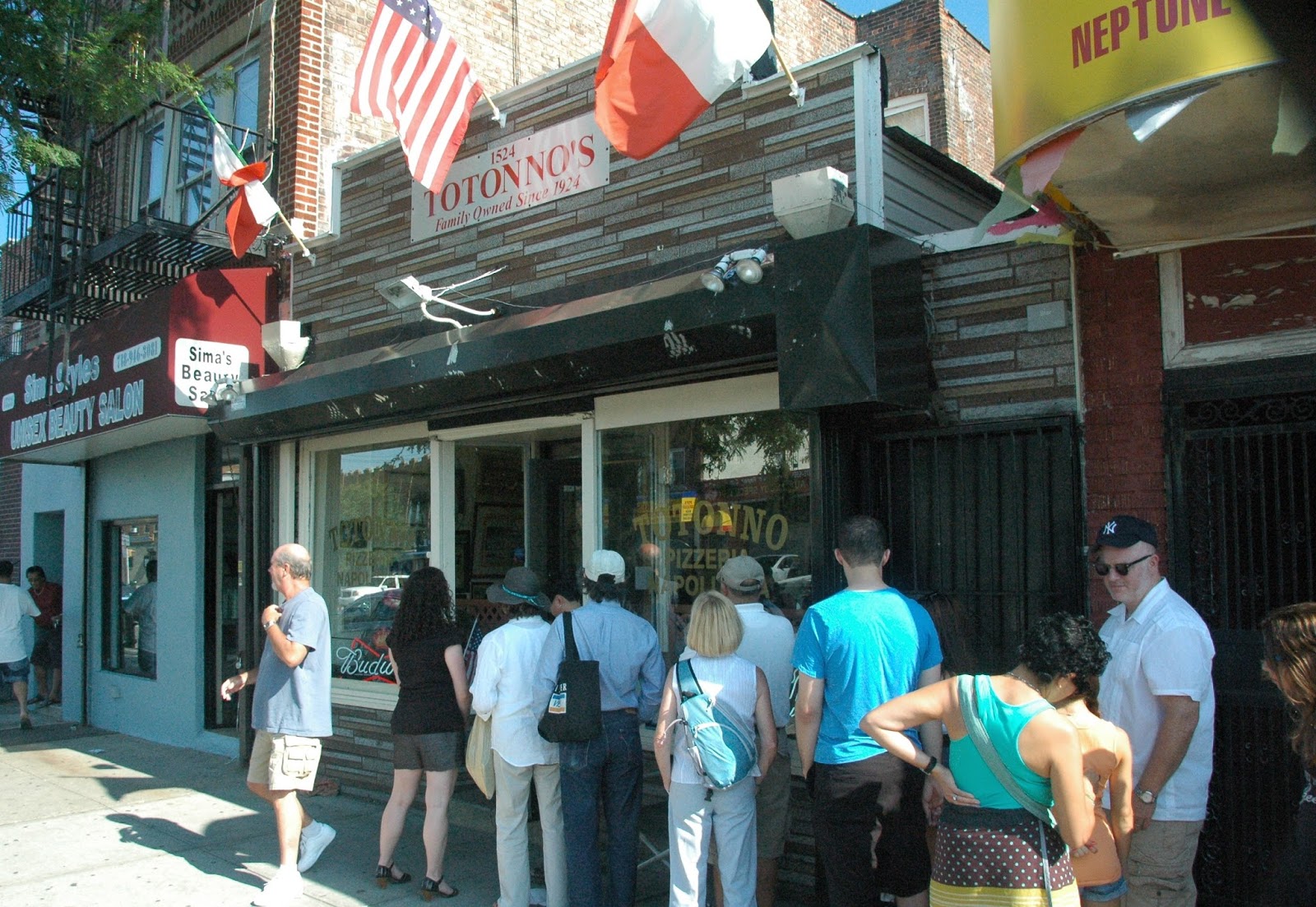
An interview chats with the writer of a book on what is at the far-flung and seldom visited ends of New York subway lines.  In the writer’s comments on the D Line ending at Coney Island, she mentions the pizza at Totonno’s.  From personal experience, I can confirm that the pizza is good and the lines are long.

A subway rider strikes up conversations with strangers about the books they’re reading during their trips.

Lastly from the New York subway, a group of strangers engage in an impromptu sing-along to pass the time during a two-hour service delay.  The video starts slowly, but feels good before it finishes.

Before closing, a couple of transit quips, presumably rail transit, that make me smile.

Keith Law is a baseball analyst for ESPN.  Last winter, baseball’s Atlanta Braves pulled off a shockingly good deal, securing the first pick from the most recent draft, Dansby Swanson, and two other good players in exchange for one good, but not great pitcher.  Braves fans were ecstatic.  One of them posed an on-line question to Law, “Can you give Braves fans an idea of just how great it is to have picked up Dansby Swanson?”  To which Law replied, “It’s ‘having a major league stadium on public transit’ great.”  Even baseball folks get it.

And Brent Toderian, an urban planner who had a key role in preparing Vancouver for the 2010 Winter Olympics, recently tweeted “I have something to say that might shock some of you, but really shouldn’t.  We brought our new-born home from the hospital on public transit.”  Good for him and his wife.

Finally, the answer to the quiz.  The team name Dodgers is a shortened version of Trolley Dodgers, which came from the need to dodge trolleys to reach the front gates of the Dodgers’ ancestral home, Ebbets Fields in Brooklyn.  That history and the subsequent relocation of the Dodgers to Los Angeles led to the anomaly of a transit-derived team name in one of the less transit-friendly towns in the U.S.

On the other hand, it is any worse than having the Los Angeles Lakers in a basin that’s close to being a desert?  (For those who don’t know, the Lakers began life in Minneapolis, where the Lakers name made more sense.)

The next post will be my weekly summary of upcoming meetings and involvement opportunities.

As always, your questions or comments will be appreciated.  Please comment below or email me.  And thanks for reading. - Dave Alden (davealden53@comcast.net)

Monday, May 30, 2016

It's Time to be Mature, Deliberate Civic Mentors

Historic train station in Petaluma
Sometime in the next few weeks, SMART will begin running their full schedule of trains.  All thirty daily runs, fifteen southbound and fifteen northbound.  No passengers will be aboard, but otherwise the operation will be identical to the future passenger service.  Proving up the system with this full-scale multi-week test, including crossing gate operations, station wait times, lift bridge management, and use of double-track sections, will be a critical step toward gaining approval for revenue service.

I’ve asked about an exact start date for the test, but haven’t yet been told one.  SMART may still be in discussions with federal regulators over scheduling and test conditions. 

I had hoped to publish this post a day or two before the testing begins, but will be leaving for an urbanism conference in a few days.  Not wanting to miss the window, I’ll publish today and hope I write memorably enough for my suggestion to be retained.

The start of full-scale SMART testing is also that start of an opportunity for North Bay urbanists to provide an essential service to their communities.  But we can only do so if we keep our heads.

I’ll begin with a hypothetical question.

Imagine you’re an uncle with a 25-year-old nephew who has made bad life choices.  (If you want to make it an aunt and niece, that would also work.  Feel free to adjust the story elements to fit the chosen gender.)

Let’s say the young man ended his education short of his high school diploma, has a spotty job record, largely because of a problem with authority, has had alcohol abuse issues, and has a child for whom he’s in arrears on support payments.  It’s a not uncommon story.  He may not yet have a criminal record, but he’s on a path for which problems with the law is a possibility.

Now let’s say that the young man has been startled into wanting to turn his life around.  Perhaps a current friend has been arrested.  Or maybe a friend from high school, who made different choices, is doing well in life.  Either way, the young man has found motivation to change his life path.  But having burned bridges with his parents, he comes to you for advice.

You help him develop a plan.  Begin studies toward his GED and explore options for further education.  Dial down his attitude so he can retain a job.  Cut back on the partying.   Work with the child’s mother to come up with a payment plan.  Begin building a relationship with the child.

It’s now been three months.  You and your nephew meet to review his progress.  He’s making progress on the GED, will take his final tests in the next month, and has begun talking with a counselor at the junior college about class options.  He’s still at the same job, although he missed a promotion when he picked the wrong moment to spout off.

He’s nearly stopped partying, although there was one evening at a pub when too much beer was consumed, words were exchanged, and punches were thrown, none doing damage.

He’s making child support payments and spending every Sunday afternoon with the child, although there was one shouting match with the mother that resulted in the police being called.  Tempers cooled before the squad car arrived.

So, what is your response as an uncle/mentor?  Do you praise him for the progress he’s made and work with him on changing behaviors to address the instances of backsliding?  Or do you lambaste him for his mistakes?

Although many of us would enjoy the adrenalin rush that would be triggered by an angry outburst, we hopefully also understand that good mentoring requires the calm blending of positive reinforcement with problem solving assistance.

And it’s a great thing we know that because it’s a lesson that will soon become important to the North Bay communities.

When SMART begins running thirty trains each day, many of our towns are going to be challenged, especially those with tracks running through key downtown transportation corridors.  That list begins with San Rafael and Petaluma, but Santa Rosa, Rohnert Park, and Novato may also have issues.  Streets that are already near capacity will be pushed into traffic jams and tempers will be frayed.

And that will only be the start of the problems.  Later in the year when passenger service begins, the problems will be multiplied as drivers circle, looking for parking places near the train stations, and as transit buses, trying to deliver passengers to the stations, become ensnarled in seas of cars.

Faced with the chaos, many in the North Bay will make three accusations.  They’ll claim that the North Bay cities, through typical incompetence, failed to plan for the arrival of the trains, that SMART was always a dumb idea, and that trains don’t work in the modern world.

Urbanists must be prepared with calm, measured responses, continuing to praise the region for the foresight that resulted in SMART, noting that the North Bay cities have done much to accommodate the return of passengers trains to downtowns after an absence of a half-century, and that transit, including trains, is an essential element of the contemporary world, pointing to BART and Caltrain as examples.

But it’s also fair to leaven the praise with the acknowledgement that SMART and the cities could have done more to prepare for the return of passenger rail, including better parking plans and more progress toward transit-oriented development.

In essence, urbanists will need to act as calm, restrained mentors to their North Bay communities, praising the progress that has been made with the opening of rail service, encouraging further progress toward integrating the train with land uses, and deflecting the arrows from those who are interested only in the adrenalin rush of uninformed indignation.

It won’t be an easy job, but it must be done for our communities to continue to mature away from the car-oriented paradigm.  I hope you can all join me in the task.  Your cities/nephews will appreciate it.

In recognition of the coming SMART milestones, my next post will be a collection of links about rail transit.

As always, your questions or comments will be appreciated.  Please comment below or email me.  And thanks for reading. - Dave Alden (davealden53@comcast.net)
Friday, May 27, 2016

Taking the Next Step – Opportunities for Public Education and Participation, Week of May 29

Urban setting in London
I write about urbanism and enjoy doing so.  I hope I’ve opened some eyes to different ways to configure our North Bay communities, alternatives that will make us more resilient, sustainable, and financially solvent.

However, growing a cadre of enthusiastic, but closeted, urbanists doesn’t change the world.  Instead, those converts must take part in the decision-making processes.  Voting wisely in November is a good start, but attending meetings with urbanist angles and looking for the right moments to put a shoulder to the wheel is also important.

Thus, I present a weekly summary of meetings that urbanists, newly-minted or long-standing, might consider attending and at which they can look for the right time to add their thoughts.  I also note a few other opportunities for public involvement.

Upcoming Meetings

Sonoma Marin Area Rail Transit, Wednesday, June 1, 1:30pm, 5401 Old Redwood Highway, Petaluma – The SMART Board is scheduled to meet, although the agenda isn’t yet posted.  (Update: The agenda has now been posted and will include the discussion of fares, a subject noted below under Other Involvement Opportunities.)

Sonoma County Transportation and Land-Use Coalition, Wednesday, June 1, 4:00pm, Environmental Center of Sonoma County, 55 Ridgway Avenue # A, Santa Rosa – SCTLC has been a long-time leader in forward thinking about more sustainable land-use options, including early advocacy for SMART.  Their next meeting will consider the next generation of land-use changes, including a discussion of rail options beyond SMART.

MTC/ABAG, Thursday, June 2, 11:00am, Finley Community Center, 2060 W. College Avenue, Santa Rosa – The Metropolitan Transportation Commission and the Association of Bay Area Governments are kicking off their Bay Area 2040 plan to identify the best strategies for efficient investment of transportation resources.  This will be the scoping meeting to elicit public input on the environment impact study to be prepared for Bay Area 2040.  (Note: This meeting is strictly on the EIR and is different than the outreach meetings that will seek input to Bay Area 2040 and are noted below.)

Petaluma Transit Advisory Committee, Thursday, June 2, 4:00pm, Petaluma City Hall – MTC has delayed the due date for the Short Range Transit Plan, allowing more time for North Bay transit agencies to consider their interconnections with the coming SMART train, but the Transit Committee will still have SRTP decisions to ponder, including possible adjustments to evening service.  (Acknowledgment: I serve as chair of the committee.) 

MTC/ABAG, Saturday, June 4, 8:30am, Corte Madera Community Center, 498 Tamalpais Drive, Corte Madera – This is one of a series of meeting at which input will be sought for the Bay Area 2040 plan on transportation funding strategies.  (Reminder: These are the meetings that were largely shut down by Agenda 21 disruptions during the last planning effort in 2012.  I was at the Sonoma County meeting back then and ruminated at length on the disturbances, here , here, and here.  I still agree with much of what I wrote four years ago.)

Petaluma Urban Chat , Wednesday, June 8, 7:00pm, Aqus Café, 2nd and H Streets, Petaluma –Urban Chat will discuss the Bay Area 2040 with the goal of enticing folks to attend the Sonoma County outreach meeting on June 13.  Those who attended the June 4 Marin County meeting will report on their impressions.  (Note: I normally facilitate Urban Chat, but will be away at an urbanist conference.  Bjorn Griepenburg will facilitate in my absence.)

MTC/ABAG, Monday, June 13, 6:00pm, Luther Burbank Center for the Arts, 50 Mark West Springs Road, Santa Rosa –This will be the Sonoma County outreach meeting for input to Bay Area 2040.

Other Involvement Opportunities

City of Petaluma – The City is seeking volunteers for openings on City Commissions and Committees.  In many years, some bodies, notably the Planning Commission and Pedestrian/Bicycle Advisory Committee, attract more applicants than openings, but other bodies struggle to maintain full complements.  Citizens willing to take an active role on these commissions and committees can be surprisingly capable of making community changes.

California Road Charge – Although the deadline is only days away, volunteers are still being sought to help conduct a pilot study on the use of vehicle mileage charges to replace the gas tax.  Although 7,400 volunteers have already signed up for 5,000 spaces in the study, the organizers are still trying to fill demographic groups they believe are underrepresented.  (I’ve previously signed up.)

SMART – The SMART Board is still seeking your thoughts on a fare structure.  Since I first mentioned this poll a week ago, questioning its over-simplicity, the North Bay has largely agreed with me and gone much further.

A Petaluma architect wrote a pointed email to SMART management asking about connections between fares and whether employees would get living wages, whether the extension to Larkspur would be completed sooner, and whether the second Petaluma station would be build sooner.  To my knowledge, he didn’t get a response.

Perhaps even more importantly, many in the North Bay are greatly concerned by the fares, with the fear that ridership will be depressed if the fares don’t offer a sufficient incentive to overcome the advantages given to cars in our car-centric land-pattern.

I find the point reasonable.  My thought is that fares need to be set such that ridership approximates the initial estimates.  If we’re going to spend the money to build a game-changing rail system, we need to ensure that enough people ride for the game to be truly changed.

Meanwhile, folks interested in the role of SMART in the North Bay may want to mark June 15 on their calendars.  It seems likely that the SMART Board will continue their consideration of fares at that meeting.  (Update: The discussion will instead be on the June 1 agenda.)

Lots of opportunities to get involved.  Please grab at least one and hopefully more.

With the full-scale testing of the SMART train likely coming in June, my next post will offer some perspective on the immediate impacts to the communities to be served by the train.

As always, your questions or comments will be appreciated.  Please comment below or email me.  And thanks for reading. - Dave Alden (davealden53@comcast.net)

Saturday, May 14, 2016

The Train is Coming, Are We Ready?

SMART train in the shop
I’ve written before about Friends of SMART.  The citizen advocacy group was active in the initial formulation and voter approval of SMART, the coming commuter rail system for the North Bay.  They’ve continued to provide encouragement and occasional constructive criticism as the SMART moved into construction and now nears operation.

I became involved with Friends of SMART when our positions aligned in the discussion about where the second train station in Petaluma should be located.  I then played a role in their battle to allow an effective bicycle/pedestrian crossing at Jennings Avenue in Santa Rosa.

I enjoy hanging out with the folks at Friends of SMART who give liberally of their time to help improve their communities.

Now, it also turns out that being a member of Friends of SMART has perks.  The SMART General Manager recently contacted the Friends of SMART president and invited him to bring the membership for an early morning tour of the SMART shop, followed by a preview train ride from the shop to the downtown Santa Rosa station and back.

Friends of SMART (photo by Chris Stevick)
Thus, I found myself gathering with thirty other folks on a grey morning earlier this week at the SMART yard near the Santa Rosa Airport.

As a civil engineer, I’ve been around a fair number of industrial sites, from hydroelectric powerhouses to steel fabrication yards.  And yet there was still something uniquely impressive about the SMART shop with its sparkling newness, its array of tools and spare parts waiting to spring into full use, and the visual incongruity it offered, with the hulking mass of a train ready to carry passengers but confined for the moment inside a building.

SMART staff
Equally impressive was the SMART staff who spoke with us, comfortably and familiarly citing the various sections of the CFR (Code of Federal Regulations) with which rail systems must comply, the procedures SMART was implementing to assure that compliance, and anecdotes from the world of railroading that justified the strict regulatory approach.

Although the train ride was more within the everyday experience of many people, and therefore less new and different, the improved train technology was still impressive.  From the smoother acceleration and braking to the lack of clacking over rail joints, the changes were incremental but noticeable.  Also, compared to the aging interiors of the BART cars, the new and better appointed SMART cars were a very different experience.

But, as positive as the experience was, the view from the rolling train still gave me pause.  Almost a year ago, in writing about the location for the second Petaluma station, I used these words, “If we can’t facilitate the type of places where people would live who would be likely to ride the SMART train, then the train may be an engineering success, but a financial and social failure ….”

Riding the train
Those words were directed at SMART, but can equally well apply to many of the cities along the SMART alignment and also some regulatory agencies.  During the short ride taken by Friends of SMART, we saw the downtown Santa Rosa station where any new housing is still years away and the North Santa Rosa station where the Jennings Avenue crossing remains blocked by fencing, forcing potential riders into a longer and uncomfortable walk, while the Public Utilities Commission ponders a decision.

Looking beyond the extent of the preview ride, Rohnert Park is just getting underway with transit-oriented development.   Petaluma is even further away, with the exception of a project that is more suited to car-oriented families than to bike/ped/transit-oriented millennials or seniors.  Nor, with the exception of local transit service, has Petaluma made much progress with parking or improved pedestrian/bicycles routes.  And Novato, despite a late decision to add an eventual downtown station, will greet the first SMART train with stations that have few homes within walkable distance.


To be clear, the cities don‘t have the sole responsibility for some of these deficiencies.  Other agencies, including SMART itself, share some culpability.  But spreading the blame around doesn’t make it less of a concern.

Earlier this week, I had lunch with a career hotelier.  Our conversation was about the steps leading up to a hotel opening.  He made the point that having the hospitality operation complete and integrated on opening day set a tone that could carry through the life of the hotel, but that making up for a disorganized opening day could take years.

 I don’t think commuter trains are quite as prone to the ”Day One Equals Destiny” equation, but starting strong still matters.  With stories rolling in about low ridership on new rail systems elsewhere in the country, many of them related to a failure to encourage land use that would provide passengers for the rail line, it’s a concern that the North Bay will have so little development in place for SMART’s opening day.

Also, low initial ridership will embolden the critics of the SMART who have predicted few passengers, perhaps allowing them to further slow the needed strategic decisions.

Promoting land uses to integrate with the coming rail service was a task that needed to be tackled on a timely basis.  Unfortunately, the window for a timely response has already closed.  But sooner still remains better than later because the train will arrive whether or not we’re ready.

When I next write, I’ll take note of a recent poll that showed a third of all Bay Area residents thinking of moving elsewhere.  I don’t believe they really mean it, but the poll still tells us something to which we should be listening.

As always, your questions or comments will be appreciated.  Please comment below or email me.  And thanks for reading. - Dave Alden (davealden53@comcast.net)

Wednesday, April 6, 2016

After Community Announcements, April Fools’ Day – Part 1

Current Community Separator
Before getting onto today’s “business”, I have reminders of three upcoming meetings of potential interest to North Bay urbanists, particularly those in Petaluma.

Connecting with SMART – On Thursday, April 7 at 4:00pm in the Petaluma City Hall, 11 English Street, the Petaluma Transit Advisory Committee will take up the draft Short-Range Transit Plan.  A key element of the plan is the proposed rerouting of buses to strengthen connectivity with the coming SMART commuter train.

The meeting may sound dull and bureaucratic, but it’s truly thrilling to ponder a future, now only months away, in which Petaluma residents can leave their front doors and walk a block or two to stops from where Petaluma Transit buses will convey them to the SMART station from where trains can be taken to destinations from San Rafael to Santa Rosa.

Although I think the Petaluma Transit staff has done a fine job of framing the challenge and of developing bus route solutions, there remains an opportunity for local citizens to ask questions and to suggest even better solutions.  More details are in a post I wrote a few days back.

Connecting with SMART, Part 2 – On Tuesday, April 12 at 5:30pm at the Aqus Café, 2nd and H Streets, Petaluma Urban Chat will convene with much the same agenda as the Transit Advisory Committee, discussing the integration of Petaluma Transit and SMART.

Petaluma Transit will have a representative present, so for those who can’t attend 4pm meetings or are allergic to City Hall, this will be another chance to be heard.  I also wrote about this meeting in my earlier post.

Moving the Community Separators Ahead – On Wednesday, April 13 at 4:00pm at the Petaluma Community Center, 320 N McDowell Boulevard, Sonoma County Planning will convene a community workshop on community separators.

The separators are areas of restricted land use between communities, intended to keep cities from growing together.  The goal is to keep Sonoma County looking like Sonoma County, not the Los Angeles Basin or the South Bay where the only way to know you’ve moved between cities is a green traffic sign alongside a gridlocked arterial.

As I wrote several months ago, if you want Healdsburg, Windsor, Petaluma, and other character-filled Sonoma County cities to continue to feel like distinct places, community separators is a key element.

The separators are up for renewal and possible expansion.  The Petaluma workshop will be the third of three workshops that are part of the process.  The Greenbelt Alliance, which strongly supports the separator renewal, has written about the workshops.  Also, the Greenbelt Alliance regional director has made a Facebook page on which residents can indicate their intention to attend the meeting.  If you support the goal of community separators, you should attend the workshop.

I’ll attend all three meetings and encourage readers to join me.

Onward to the topic I’d intended for today, the recently passed April Fool’s Day.

Over the history of this blog, I’ve often touched on April Fool’s Day.  Although walkable urbanism isn’t necessary prone to pranks, normally considered the key element of April Fool’s Day, it can provide settings for whimsy, quirkiness, and fun, which I’m willing to connect to April Fool’s Day.

Early on, I wrote quarterly updates about April Fool’s Day.  But now I’ve transitioned to a giant annual April Fool’s Day blow-out, with all the fun, quirky, and whimsical stories that I found worth sharing over the past twelve months.

So, over the next four posts, including today, I’ll present the 24 best and oddest urbanist stories of the year, at least in my opinion.  The stories will be presented in the reverse order of my personal rankings, so today may start a little slow, but I find myself laughing out loud at the stories I’ll reach a couple of posts hence.

#24 Walkable Urbanism as a Party Game – Urban planners, recognizing that they sometimes talk in lingo intelligible only to other planners, have invented a game intended to introduce their terminology to the masses.  I suspect they’ll still only be understandable to each other, but at least they’ve found a fun way to do so.

#23 Mass Transit as an Art Form – Those who have visited London are familiar with the look and feel of a Tube station.  From the font on the signs to the station layouts, Tube stations are distinctive.  Which led artist Camilla Barnard to make a slightly off-kilter rendition of a Tube for her entry in the London Design Festival.  Is it truly art?  I don’t know.  But I find it both visually and intellectually intriguing.

#22 Reversing a Decision for Politically Forward-Thinking Pedestrian Signals – After following other Austrian cities in the adoption of pedestrian signals that acknowledge gay relationships, the city of Linz decided to remove the signals.  I don’t think I would have thought to use pedestrian signals to acknowledge the range of romantic preferences, but having done so, it seems small-minded to opt back out.

#21 Steampunk Condos – In a decision that seems dubious at best, a New York City condo is being marketed with a steampunk theme, that puzzling celebration of industrial revolution meets Victorian England.  I fear what will come next, evocation of Dickensian slums or the Roman estates of 2nd century Gaul?  Personally, I’m fine if we leave one-off historical architectural knockoffs to Las Vegas.

#20 Bridge to Nowhere – A Danish architectural firm has built a 200-foot diameter circular bridge, without handrails, over an arm of the North Sea.  It’s visually appealing and might be fun to walk a couple of times, but I don’t see any longevity to the concept.  And the absence of handrails would drive an American building inspector crazy.

#19 Error 404 Tree Not Found – Today’s offerings will end with a bit of whimsy from a concerned citizen who used internet lingo to alert the city to a tree that had gone missing.

When I next write, it’ll be to offer items #13-18 on my April Fool’s Day list.  And perhaps also to note some news from SMART.

As always, your questions or comments will be appreciated.  Please comment below or email me.  And thanks for reading. - Dave Alden (davealden53@comcast.net)