Showing posts with label Petaluma Transit. Show all posts

Wednesday, May 25, 2016

Is It Time for Regional Government?

Housing in the Goose Hollow District of Portland
Events might be leading the Bay Area to a fundamental change in our pattern of governance.  I think it’d be a good change although, as on most topics, I remain willing to consider counter-arguments.

Let me begin the discussion with a hypothetical question.  Imagine a large business with operations in many regions.  Within its domain is one particular region where it produces several highly profitable products.

To earn that profit, there are three departments in the region, sales, manufacturing, and shipping, which must work well together.  Each department is organized with a staff overseen by a department manager.

Here’s the question.  To whom should the three department managers report?  Should there be a regional director to oversee interdepartmental coordination first hand?  Or should the departments report to a vice president in the corporate office who would be at a distance and would have more departments in other regions to also oversee?

Perhaps I’ve presented the question with a too obvious slant, but I expect it’s apparent to most that a regional director would be the better solution.  If effective integration is essential to an operation, the person responsible for that integration should be in a position to closely oversee the integration, which almost always means daily eye-contact.  Most readers who have worked for larger corporations have likely experienced this structure as the standard organizational approach.

(I once worked for a corporation that tried the other approach, with each group within an office reporting to group directors in the corporate office.  It wasn’t effective.  Along with most other offices, the office where I worked gave lip service to the corporate dictate, but resumed coordination within the office long before the corporate office gave up the experiment.)

Now, here’s the unfortunate fact.  What is a commonsense organizational structure throughout the business world isn’t followed at a crucial level of government.

Within a region, cities and counties are the equivalent of departments.  The roles of the local governmental units may not be as clear-cut as sales, manufacturing, and shipping, but each city and county is unique, providing a distinctive blend of residential, agricultural, manufacturing, professional, creative, and tourism roles without which the region would be diminished.

And yet much of the coordination between the local governments is overseen not at the local level, but at Sacramento, where the governor and legislature must worry not only about the Bay Area, but also San Diego, Los Angeles, Fresno, and a multitude of other regions and districts.

Regional government isn’t an unknown concept in the U.S.  Portland is often cited as the gold standard, with the only elected regional government in the country.  Minneapolis –St. Paul is often noted as rivaling Portland for regional coordination and Unigov in Indianapolis has also had successes.

But the origins of those regional governments trace back several decades.  With the exception of some rumblings in Cleveland, creation of new regional governments doesn’t have any current momentum.  As a former head of Portland Metro was quoted in CityLab on Portland and Minneapolis-St. Paul, “How is it that you can have these two models who apparently sit atop two very successful metropolitan regions, where costs have been managed more efficiently than other places, where they’ve gotten their regional act together – why doesn’t that spread?  Why isn’t it imitated?”

To be clear, it’s not that the Bay Area is without regional coordination.  There are a number of organizations that fill a coordination role, starting with MTC (Metropolitan Transportation Commission) and ABAG (Association of Bay Area Governments).  But their roles are more related to setting regional strategies and serving as conduits for state and national funds than as a true level of government.  To the extent that they have authority, it comes from the control of purse strings.

But there are rumblings of change.  MTC’s Bay Area 2040 plan, now getting underway, will again focus attention on the correct role for regional planning.

Also, using their role as a principal funder of ABAG, MTC is conducting a study into the merger or “functional consolidation” of the two agencies, a possible step toward regional government.  Although MTC is aggressively promoting the idea as good for the region, some journalists are questioning the process and the underlying motives. 

Within the North Bay, the Press Democrat considers regional government worth possible study, but remains concerned that the North Bay would be trampled under a regional government.

I share the concerns of the Press Democrat, but lean more strongly toward a regional government.  I lived for many years in Oregon and watched as Portland made progress as a region.  They didn’t reach perfection, no place ever does, but they made better progress than they would have without the regional focus.

Alert readers may see hints of contradictions in my intended support for official regional problem-solving.

For one, I’ve always argued for the primacy of cities as the level of government from which economic productivity flows.  However, regional government would put another level of government above cities.  I see the conflict, but will argue that it’s the only possible response to the growth of suburbia.

San Francisco, Oakland, and San Jose are the beating hearts of the region and set the stage for much of the economic activity.  It’s hard to conceive Silicon Valley or the Wine Country having the worldwide impact they do without the biggest cities having established the regional framework.

But the other cities and counties also play roles.  If San Francisco, Oakland, and San Jose are the triple beating hearts, then San Rafael, Santa Rosa, and Healdsburg are other essential organs.  (This is an analogy that I’d best not carry too far.)  In the absence of strong regional coordination, the flow of oxygen and nutrients isn’t as effective as it should be.

So regional government wouldn’t be about suppressing the biggest cities, but about adjusting the region to allow the biggest cities to excel at what they do best.

Also, barely more than a year ago, I argued that Petaluma Transit shouldn’t be folded into a regional transit provider.  (Acknowledgment: I chair the advisory committee for Petaluma Transit.)  My grounds were that Petaluma Transit was better positioned to respond to the local demands on transit, such as adjusting bus schedules to better accommodate the final bell at local high schools or modifying routes to serve newly opened senior communities.

I still believe that argument, while also seeing the value in more regional government.  It’s the eternal challenge to government of how to provide a friendly, helpful attitude toward local problems while also claiming the efficiencies of bigger operations and coordinated strategies.  But the fact that it’s a hard balance to find doesn’t mean that we shouldn’t keep trying.  And any attempt at regional government must decide which functions should be regionalized and which should stay local.

So, I favor regional government, at least until someone convinces me otherwise.  But I’m eager to hear other perspectives.  Feel free to join the debate.

When I next write, it will be to provide a schedule of upcoming meetings and other involvement opportunities at which urbanist thinking can be advanced and urbanist voices can add to the conversation.

As always, your questions or comments will be appreciated.  Please comment below or email me.  And thanks for reading. - Dave Alden (davealden53@comcast.net)

Wednesday, April 6, 2016

After Community Announcements, April Fools’ Day – Part 1

Current Community Separator
Before getting onto today’s “business”, I have reminders of three upcoming meetings of potential interest to North Bay urbanists, particularly those in Petaluma.

Connecting with SMART – On Thursday, April 7 at 4:00pm in the Petaluma City Hall, 11 English Street, the Petaluma Transit Advisory Committee will take up the draft Short-Range Transit Plan.  A key element of the plan is the proposed rerouting of buses to strengthen connectivity with the coming SMART commuter train.

The meeting may sound dull and bureaucratic, but it’s truly thrilling to ponder a future, now only months away, in which Petaluma residents can leave their front doors and walk a block or two to stops from where Petaluma Transit buses will convey them to the SMART station from where trains can be taken to destinations from San Rafael to Santa Rosa.

Although I think the Petaluma Transit staff has done a fine job of framing the challenge and of developing bus route solutions, there remains an opportunity for local citizens to ask questions and to suggest even better solutions.  More details are in a post I wrote a few days back.

Connecting with SMART, Part 2 – On Tuesday, April 12 at 5:30pm at the Aqus Café, 2nd and H Streets, Petaluma Urban Chat will convene with much the same agenda as the Transit Advisory Committee, discussing the integration of Petaluma Transit and SMART.

Petaluma Transit will have a representative present, so for those who can’t attend 4pm meetings or are allergic to City Hall, this will be another chance to be heard.  I also wrote about this meeting in my earlier post.

Moving the Community Separators Ahead – On Wednesday, April 13 at 4:00pm at the Petaluma Community Center, 320 N McDowell Boulevard, Sonoma County Planning will convene a community workshop on community separators.

The separators are areas of restricted land use between communities, intended to keep cities from growing together.  The goal is to keep Sonoma County looking like Sonoma County, not the Los Angeles Basin or the South Bay where the only way to know you’ve moved between cities is a green traffic sign alongside a gridlocked arterial.

As I wrote several months ago, if you want Healdsburg, Windsor, Petaluma, and other character-filled Sonoma County cities to continue to feel like distinct places, community separators is a key element.

The separators are up for renewal and possible expansion.  The Petaluma workshop will be the third of three workshops that are part of the process.  The Greenbelt Alliance, which strongly supports the separator renewal, has written about the workshops.  Also, the Greenbelt Alliance regional director has made a Facebook page on which residents can indicate their intention to attend the meeting.  If you support the goal of community separators, you should attend the workshop.

I’ll attend all three meetings and encourage readers to join me.

Onward to the topic I’d intended for today, the recently passed April Fool’s Day.

Over the history of this blog, I’ve often touched on April Fool’s Day.  Although walkable urbanism isn’t necessary prone to pranks, normally considered the key element of April Fool’s Day, it can provide settings for whimsy, quirkiness, and fun, which I’m willing to connect to April Fool’s Day.

Early on, I wrote quarterly updates about April Fool’s Day.  But now I’ve transitioned to a giant annual April Fool’s Day blow-out, with all the fun, quirky, and whimsical stories that I found worth sharing over the past twelve months.

So, over the next four posts, including today, I’ll present the 24 best and oddest urbanist stories of the year, at least in my opinion.  The stories will be presented in the reverse order of my personal rankings, so today may start a little slow, but I find myself laughing out loud at the stories I’ll reach a couple of posts hence.

#24 Walkable Urbanism as a Party Game – Urban planners, recognizing that they sometimes talk in lingo intelligible only to other planners, have invented a game intended to introduce their terminology to the masses.  I suspect they’ll still only be understandable to each other, but at least they’ve found a fun way to do so.

#23 Mass Transit as an Art Form – Those who have visited London are familiar with the look and feel of a Tube station.  From the font on the signs to the station layouts, Tube stations are distinctive.  Which led artist Camilla Barnard to make a slightly off-kilter rendition of a Tube for her entry in the London Design Festival.  Is it truly art?  I don’t know.  But I find it both visually and intellectually intriguing.

#22 Reversing a Decision for Politically Forward-Thinking Pedestrian Signals – After following other Austrian cities in the adoption of pedestrian signals that acknowledge gay relationships, the city of Linz decided to remove the signals.  I don’t think I would have thought to use pedestrian signals to acknowledge the range of romantic preferences, but having done so, it seems small-minded to opt back out.

#21 Steampunk Condos – In a decision that seems dubious at best, a New York City condo is being marketed with a steampunk theme, that puzzling celebration of industrial revolution meets Victorian England.  I fear what will come next, evocation of Dickensian slums or the Roman estates of 2nd century Gaul?  Personally, I’m fine if we leave one-off historical architectural knockoffs to Las Vegas.

#20 Bridge to Nowhere – A Danish architectural firm has built a 200-foot diameter circular bridge, without handrails, over an arm of the North Sea.  It’s visually appealing and might be fun to walk a couple of times, but I don’t see any longevity to the concept.  And the absence of handrails would drive an American building inspector crazy.

#19 Error 404 Tree Not Found – Today’s offerings will end with a bit of whimsy from a concerned citizen who used internet lingo to alert the city to a tree that had gone missing.

When I next write, it’ll be to offer items #13-18 on my April Fool’s Day list.  And perhaps also to note some news from SMART.

As always, your questions or comments will be appreciated.  Please comment below or email me.  And thanks for reading. - Dave Alden (davealden53@comcast.net)
Friday, April 1, 2016

Circling Back to Buses and Books

Petaluma Transit bus
I have several North Bay updates to share today, from new and improved bus routes in Petaluma to a revisited book club to a request for reading list suggestions.

A couple of months back, I wrote about how the staff at Petaluma Transit was working hard to build connections with SMART, the commuter train system that will begin rolling through the North Bay later this year.

The building of bus-to-train connections was a high priority effort for many parties, from SMART, which is eager to have fare-paying customers delivered to its stations, to Petaluma Transit, which is always seeking to better serve its community, to the City of Petaluma, which has an interest in keeping SMART riders from driving cars that would overburden streets and available parking.

The earlier post asked that local citizens attend the February meeting of the Petaluma Transit Advisory Committee, a group that I currently chair.  At the meeting, Petaluma Transit staff would present the route realignments and the public would be allowed to comment.

 The suggestion didn’t take root.  Perhaps because I began my marketing effort too late or perhaps because I didn’t reiterate the request enough, there wasn’t a single member of the general public in the City Council chambers that day.

It’s possible I wasn’t a complete washout as a publicist.  It may be that a greater number than usual watched the meeting on the local community access channel.  I know that a surprising number of local citizens watch the broadcasts regularly.

(True story: I began a trip last summer with a 3:15am taxi ride to the Sonoma County Airporter pickup.  Enroute, I chatted with the driver about Petaluma.  But he soon interrupted the conversation, asking how he knew my voice.  I said I had no idea, but he persisted, asking if I was ever on television.

The only television exposure I could suggest was the transit committee meetings on the local channel.  To which he responded, “That’s it!  I knew I recognized your voice.  You’re a local celebrity!”  Darned if I know how he might have set it up, but I still think it was a prank.)

Despite the apparent desultory response to my earlier public outreach, Petaluma Transit continued to refine the route realignments, which will soon be folded into the MTC-mandated Short-Range Transit Plan (SRTP).

The draft SRTP, including the route realignments, will receive its final review during an upcoming transit committee meeting, followed in May by its adoption, first by the committee and then by the City Council.  Implementation will be in August.

Everyone, from Transit staff to SMART to MTC to me, would like Petaluma citizens to look at the route realignments and to provide comments on points that might have been missed.  For the community to effective embrace SMART, and to thrive with reduced car dependence, it’s important that the routes work.

So please join us on Thursday, April 7, 4:00pm in the City Council Chambers at 11 English Street.  If you insist on watching from home, that’d be okay, but we’d really rather have you there in person.

If you want an advance look at the route proposals, Transit staff has assembled an on-line poll that depicts the routes and asks questions about how the new routes will serve your needs.  You’re encouraged to look at the poll and to offer thoughts.

And if you want to review the entire SRTP, which addresses many aspects of Petaluma Transit’s operation beyond route planning, it can be viewed under Item 7.A. of the agenda for the meeting.

Also, recognizing that 4:00pm public meetings don’t fit everyone’s personal schedule, Petaluma Urban Chat will dedicate their next regular meeting to the route realignments.  Petaluma Transit staff will attend the meeting, which will be Tuesday, April 12, 5:30pm at Aqus Café, 2nd and H Streets in Petaluma.  As always, all are welcome.

Staying on the topic of Petaluma Urban Chat, a casual gathering of urbanists that sprung from this blog and has been meeting since 2012, I recently turned over management of the group to Teddy Herzog, a Petaluma resident with an interest in urban topics and a desire to grow the group.  I love the meetings and will continue participating, but feared that my other personal and civic obligations, including this blog,  were interfering with my ability to nurture the group, so was pleased to accept Herzog’s offer.

Herzog and I have been meeting to plot a trajectory for Urban Chat.  An idea I resurrected was a book club.  There was a time when the entire Urban Chat functioned as a book club.  I thought it was a successful effort, but it ultimately became clear that not everyone had the time or inclination to be book readers.

So I won’t propose that Urban Chat return to being a book group.  But if there is a small group of readers and thinkers who wish to return to a study of books on city planning, I’d be happy to facilitate book selections and meetings.

The group needn’t be limited to Petaluma.  It might be fun to have participants throughout the North Bay, especially if we can find brew pubs along the SMART corridor and assemble for the meetings by train.  Perhaps we could even begin with a book on effective transit planning.  If you’re interested in participating, let me know.  A comment below or an email would be great. 

I have one last topic that continues on the subject of books.  In nine weeks, I’ll head to Detroit for the annual meeting of the Congress for the New Urbanism.  CNU meetings are always great, but I’m particularly intrigued by the prospect of spending four days in Detroit, a key place in the debate over the future of cities.

To ensure that I’m prepared, I’ve assembled an expansive list of books about Detroit, seven total of which I’m deep into the third.  But if readers have Detroit tomes are of particular interest to them, I’d appreciate titles.  I may have time to slip an eighth or even a ninth book into my reading list.  An email or a comment below would be great.

That covers my topics for the day, from bus route planning to urbanist reading.  Lots of chances for community involvement.

Next, I’ll return to the topic of universal housing, the extent of its deficiencies and how walkable urbanism can help.

As always, your questions or comments will be appreciated.  Please comment below or email me.  And thanks for reading. - Dave Alden (davealden53@comcast.net)

Monday, February 1, 2016

Supporting SMART by Attacking the Last Mile with Buses

Petaluma Transit bus in downtown Petaluma
In a few days, I’ll help introduce some clever and insightful ideas of others, proving one more time that it’s better to be associated with clever people than to be clever oneself.

My opportunity to bask in the reflected glow of others will come when I chair a meeting of the Petaluma Transit Advisory Committee.  At the meeting, the staff of Petaluma Transit will introduce ideas for adjusting bus routes.  The proposed realignments have the goal of better positioning Petaluma to embrace SMART, the upcoming regional commuter train.

(For those not in the North Bay, SMART stands for Sonoma Marin Area Rail Transit.  The SMART train, which is scheduled to begin revenue service later this year, will initially run from San Rafael in the heart of Marin County to Santa Rosa in the heart of Sonoma County, with stops at cities in between.  Further extensions and more stations are being planned.)

Conducting the Transit Committee meeting will be my latest step in nearly four decades of awareness of a crucial transit challenge.

After those four decades, I don’t remember if it was by luck or design, but I often had convenient, walkable connections to transit during my commuting days.

I can cite two noteworthy examples.  I owned a home from which I had a half-mile walk along an asphalt shoulder to a BART station, with a two-block walk to my downtown San Francisco office after the ride.  I quickly fell in love with the commuting routine and often didn’t touch my car between weekends.

From there, I moved to a home from which I had a quarter-mile walk along a tree-lined path to a King County Metro bus stop, with a one-block walk to my downtown Seattle office after the ride.  For my first several months in that house, I didn’t own a car.

Those were good years.  But those situations are not typical.  Because our cities have been allowed to sprawl in all directions under the drivable suburban paradigm, many folks don’t have convenient access to the transit facilities by which they might otherwise conduct their daily lives.

Transit managers call this challenge the “last mile problem”.  Commuters might be willing to ride SMART from San Rafael to Santa Rosa, finding appeal in the possibility of answering emails or reading the morning paper during their commute rather than watching the brake lights of the car in front.  But if they live or work at an inconvenient distance from the SMART stations, the appeal can quickly wane.

There are many ways to tackle the last mile.  Walking, bicycling, driving and parking, and private car drop-offs are all solutions that can have applicability.  But each also has negatives, from walks of lengths beyond the comfort level of many, to the fear of bicycling on crowded streets, to the desire of communities to have highly productive land uses near transit stations, to the congestion caused by drop-offs.

Feeder buses and shuttles can also be used to address the last mile problem, but have their own downsides.  Riding a bus to a train station is a “multi-modal commute”.  It has been historically difficult to secure ridership for multi-modal commutes.  In a world in which transit is competing with private cars, a walk to a bus stop followed by a wait for the bus followed by another wait at the train station can soon seem unattractive compared to hoping into a car and driving directly to a destination.

Thus, if feeder buses are to provide a useful function, they must collect riders near where they live or work, must run frequently enough and on a sufficiently stable schedule that riders feel confident in the bus arrivals, and be sufficiently coordinated with the train operation such that the riders have only a short walk to a platform at which a train will soon arrive.

In looking at how to make Petaluma Transit meet these goals, the staff tapped a number of resources from reviewing ridership data collected by recently implemented Automatic Vehicle Location software to polling the community about where SMART riders would originate to looking at projected land-use patterns.

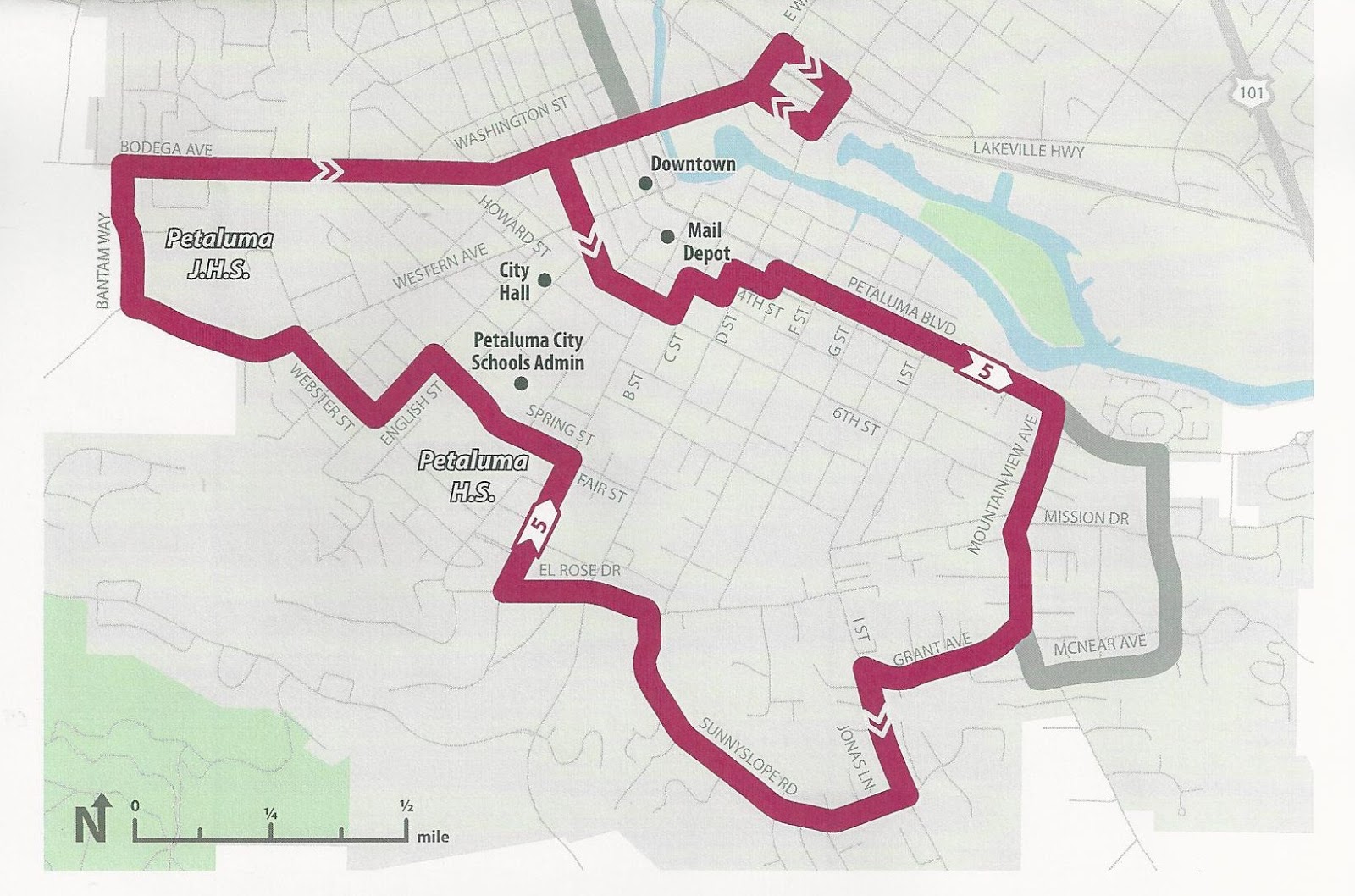
Proposed realignment of Route 5
After mixing and matching the data, the transit staff proposed a new bus stop near the SMART station along with modifications to current Routes 1, 5, and 24.  (As an aside to my Twitter followers, you may remember a recent Sunday morning when I was forced to defend the honor of Petaluma Transit against barbs from around the country directed at the drunken sailor path of Route 24.  My primary response was that the route was a temporary response to a land-use action that had ignored transit.  Sure enough, Route 24 would be tidied up under the current proposals.)

The modified routes would serve a number of anticipated SMART riders, from numerous westside residents who have told Petaluma Transit about their plans to ride SMART to St. Vincent High School students who live in Marin County and plan to ride SMART to Petaluma.

Of course, the modifications also have negatives, from tapping reserves to reducing service to a major shopping center.  Particularly painful to transit staff is ending convenient service to residents of a senior living community who have only recently become enthusiastic transit riders.  But within the limited funding typically available to transit agencies, hard choices must always be made.

The current proposals may not be the realigned routes that are eventually adopted.  Everyone involved remains open to further ideas.  But the current proposals are a powerful step toward making SMART successful.  Credit is due to the Petaluma Transit staff who are bringing them forward.

All are welcome to attend the meeting of the Petaluma Transit Advisory Committee, whether to learn more about the route modifications or to become part of the process.  The meeting will be held on Thursday, February 4, convening at 4:00pm.  The committee meets in the Council Chambers at Petaluma City Hall, 11 English Street.  I hope to see many familiar and new faces.

In my last post, I wrote about the upcoming hearing of the California Public Utility Commission on the proposed Jennings Avenue pedestrian crossing over the SMART tracks.  In my next post, I’ll provide a post-hearing update.

As always, your questions or comments will be appreciated.  Please comment below or email me.  And thanks for reading. - Dave Alden (davealden53@comcast.net)

Friday, November 13, 2015

We’ll Talk About Murals, But Only After Transit

I promised that today’s post would be about the murals newly adorning American Alley in Petaluma.  And it will be, but only after I chat about a transit issue that is even more essential to the future of Petaluma.  It’s a challenge that will be faced by many North Bay communities in the coming year.

I sit on Petaluma’s Transit Advisory Committee.   As such, I’ve had a front row seat for the magic that the Petaluma Transit staff has worked over the past few years.  With less than two-an-a-half full-time employees, transit ridership had nearly tripled since 2010.  Rider satisfaction is increasing.  The bus maintenance facility was expanded.  And technology such as an automatic vehicle locating system for the buses is being rolled out.  (While the Transit Committee has made a handful of useful suggestions, most of the credit must go to the staff.)

But the most significant opportunity yet may now be arriving at the two Petaluma train stations.  Late in 2016, the Sonoma Marin Area Rail Transit (SMART) will begin running trains between San Rafael and Santa Rosa.  With the Petaluma prospects for station parking ranging from inadequate to non-existent, with bike routes degraded by hazardous segments that deter casual riders, and with transit-oriented development still nothing more than a glimmer on the horizon, there is a potential deficiency in the delivery of passengers to the train stations.  Petaluma Transit may be able to help.

Furthermore, with the success of the SMART likely to span transit-oriented development and walkable connections into existing neighborhoods, Petaluma Transit’s ability to deliver passengers to the train, if it can make the train successful, could be a critical step toward a more urbanist future.

But Petaluma Transit is already heavily stretched in meeting its current obligations of serving the segments of the community that rely on local transit to live their daily lives.

And there are few if any resources evident to help Petaluma Transit stretch even further.  At one time, it was expected that SMART would help in funding shuttles between train stations and destinations such as places of work and residential districts, but the recession and the resulting reduced SMART-funding sales tax proceeds forced numerous cutbacks, including the length of the system, several stations, and any hope of train-connecting shuttles.

So the a large portion of the burden of delivering people to the Petaluma train stations will fall solely on  the Petaluma Transit, who will try to pull yet another rabbit or two of their hat.  (And perhaps the Transit Committee will again be able to provide a few constructive ideas.)

The Petaluma Transit planning effort is just getting underway, but there is a way that readers can help.  If you live in Petaluma and expect to ride the SMART train, even if only occasionally, you can respond to this poll about the location of your home, how often you expect to ride the train, and how you hope to reach the station.  Your assistance will be appreciated.  This may even be the beginning of a long-running dialogue about how to tackle this puzzle.

Okay, now we can move onward to murals.

I previously wrote about a proposal to paint eight murals along American Alley in downtown Petaluma.  The Petaluma Planning Commission saw the opportunity as I had, approving the murals unanimously after only a short conversation.  The murals were completed over the weekend of November 7 and 8.

I wasn’t able to visit downtown during the mural painting weekend, but recently walked the alley, camera in hand, on a weekday afternoon.

It was an insightful experience.  The murals were much as had been proposed to the City, so it was like seeing old friends to amble down the alley and to come upon each mural looking both familiar and new.  But those who might have expected the murals to transform the alley would have been disappointed.  It was the same old American Alley, still utilitarian and still slightly dirty and smelly, but now with a hint of promise.

As Chuck Marohn of StrongTowns explained in a webinar early this week, the best urbanism is the urbanism that evolves slowly over time, incremental step after incremental step.  Urbanism that is brought to life fully formed will wear thin uniformly and may not adequately induce reinvestment thirty years hence.  But urbanism that is built incrementally and ages on a range of schedules will always be able to justify upkeep and regeneration.

The murals are one of those incremental steps.  They don’t completely change the alley, but they encourage more people to wander down a slightly tawdry alley.  And some of those people will visit the handful of shops along the alley.  And building owners, noting the increasing pedestrian activity, will find nooks and crannies for yet more shops.  If, ten years from now, American Alley is a bustling place, the weekend the murals were painted may be seen as a key step in the history of the alleys.

And, as recently noted by Sarah Goodyear in CityLab, the murals can serve to mark the alley as off-limits to the disreputable handful who would deface it with graffiti.

My favorite mural is the mosaic.  It’s not so much the design as the material choice.  I like adding one more texture to the range of textures already filling the alley, from the rough bricks with aging grout to the worn concrete driving surface to the newer stucco walls.  The mosaic seemed to add a grace note.

I can’t recommend visiting to downtown Petaluma to see the murals.  They’re not that impressive on their own.  But there are enough interesting places to shop and to eat in downtown Petaluma that I can recommend an outing there.  And as a part of your adventure, you really should wander over to American Alley to check out the new artwork.

In my next post, I’ll return to the subject of induced traffic.  I recently came across an article that does a fine job of explaining the concept in layman terms.  And I had a conversation with the staff of the Sonoma County Transportation Agency who gave me a different way to look at the subject.

As always, your questions or comments will be appreciated.  Please comment below or email me.  And thanks for reading. - Dave Alden (davealden53@comcast.net)
Wednesday, May 27, 2015

Covering the Transit Spectrum

A recent report caused me to ponder the role of transit in small towns, including Petaluma where I live.  And to reject one of the lesser strategies offered by the authors.

The report was prepared under the aegis of SPUR, a San Francisco organization with a long urbanist tradition incorporating both definitions of urbanism, the study of alternative patterns of human settlement and the advocacy for the best solutions. 

Originally founded in 1910 as the San Francisco Housing Association with the goal of addressing lingering housing issues from the 1906 earthquake and fire, the organization went through numerous transitions over the next century.  It eventually became the San Francisco Planning and Urban Renewal Association, now shortened to SPUR.

I’ve long admired the work of SPUR.  I’m not a member, but that’s only because I can’t possibly join all of the urbanist organizations that I admire.  If I ever decide to increase the number of organizations to which I pay dues, SPUR would be on the short list of organizations that I’d consider.

The transit report released under the imprimatur of SPUR was Seamless Transit, a call for improved connectivity between the many transit agencies that serve the Bay Area.  The extensive list of coordination items, including greater fare consistency, better located transfer points, more attention to schedule coordination, and a stronger focus on making the use of multiple transit systems transparent to riders, is well-conceived and comprehensively executed.

For those interested in the future of transit in the Bay Area, I recommend the report.  Its details can seem overwhelming, but the subject matter requires the level of attention provided.

When I first learned of the report, I wasn’t as positive.  I’d been told that the report called for consolidation of the transit agencies in the region, a subject on which I had misgivings.  However, upon reading the report, I found that the authors acknowledge the possibility that limited consolidations could provide benefits, while also suggesting that it would be harmful if the conversation became too focused on mergers.

Overall, they argue that cultural changes are more important that rearranging organizational charts, a point with which I concur.

My concern with consolidation pertains to the different roles that the transit agencies can fill.  The SPUR report focuses on the services that transit can provide for commuters or other travelers such as tourists who make extended trips within the Bay Area, using multiple transit systems.

I acknowledge that long-distance riders are important.  Personally, I remain frustrated that I don’t have a reasonable option to use transit for traveling from Petaluma to the Cal campus in Berkeley for a basketball game.  (And no, I don’t consider BART to San Francisco and a late night ride home on Golden Gate Transit to be a reasonable option.)

But not every transit agency is focused on long-distance riders.  Some agencies have service goals that are more local and are equally important.

Petaluma is served by Petaluma Transit, a division of the City of Petaluma.  (Acknowledgement: One of my community roles is a seat on the City committee that advises Petaluma Transit on long-range strategy, policy decisions, contractual issues, and land-use matters.  However, I’ll acknowledge that virtually all of the successes of Petaluma Transit, which have been considerable in recent years with greatly increased ridership, are due to the work of the staff and the contractors.  The Transit Advisory Committee’s only role is to spurt the occasional drop of oil into a well-tuned machine.)

At present, Petaluma Transit serves relatively few long-distance, multi-transit system riders.  The primary reason is free parking.  Commuters who wish to use Golden Gate Transit or Sonoma County Transit can drive private cars to the vicinity of bus stops where they can park without charge.  Free parking will always affect consumer decision-making in this way.

Instead of those riders, Petaluma Transit largely serves youths who rely on city buses rather than private cars to reach school and other members of the community who don’t drive, but need access to stores and jobs.

Petaluma Transit does a fine job of serving those folks.  Within the context of the available funding and a land-use pattern that doesn’t facilitate effective transit, the community is well-served.

It’s hard to imagine that a more regional transit agency could do a better job of serving the current local ridership than the current staff and contractors who live and work in the community.  Consolidation in the case of Petaluma Transit and other municipal transit agencies that serve communities with well-defined boundaries and a large load of local riders is a poor idea which should be quickly rejected.

(I had the chance to run this thinking past Portland Jarrett Walker at the recent CNU 23.  Walker, who is respected nationally for his acumen on the philosophy of transit, concurred with my position.)

But that doesn’t mean that Petaluma Transit can ignore the Seamless Transit report.  The report still sets forth multiple strategies of which Petaluma Transit should remain aware.  As the land-use patterns of Petaluma become denser, and as more people choose to leave their cars in the garage when they commute or perhaps not to own a car at all, Seamless Transit will provide guidelines for serving those people effectively.

The coming of the SMART train, especially when the system opens with only a single Petaluma station of limited parking, will also make the strategies in Seamless Transit important.

For those reasons, the Transit Advisory Committee met with a representative of SMART at its May meeting and will discuss the Seamless Transit report at our June meeting.  As a committee member, I understand the need for the policies that SPUR sets forth.

Even if I think consolidation would be bad idea.

Next time, I’ll cover several Petaluma subjects, including the long-promised Fairgrounds update.  But all readers are encouraged to check in.  Perhaps the urbanists in Petaluma are implementing ideas that can be exported. 

As always, your questions or comments will be appreciated.  Please comment below or email me.  And thanks for reading. - Dave Alden (davealden53@comcast.net)

Friday, May 1, 2015

Tackling the Bigger Transit Questions

I chair the Petaluma Transit Advisory Committee.  It’s a good gig that I enjoy greatly.  I have a fine group of fellow committee members and appreciate the effort that the Transit Manager makes to provide us with comprehensive background information and to respond effectively to our questions so that we can provide meaningful service to the City. 

But I’ll admit that many of the topics we tackle may often seem dull to those on the outside.  The nuances of whether we should order 35-foot or 40-foot buses and how many mechanics we need to maintain the fleet may seem critically important to us, but would likely evoke yawns from others.

(For those wondering, the question about bus length pivots around a downtown intersection that’s challenging to longer buses.  Also, Petaluma Transit has been lucky to survive thus far with a single mechanic plus vacation replacements, but as the fleet and the number of riders grows, we’re looking at adding a second mechanic.)

Perhaps my most surprising moment as the committee chair came when I was sitting in the Council Chambers observing a meeting of another City body.  The 88-year-old woman sitting next to me leaned over and told me that I did a better job of running meetings than the chair we were watching.

I assumed she had mistaken me for someone else, but when I tried to explain that, she responded that she knew exactly who I was and that she organized her schedule around watching the Transit Advisory Committee meetings every month when they air live on the local community access channel.

Given that the average number of members of the general public in the Council Chambers for a Transit meeting is somewhere between 0.5 and 1, I was surprised, but pleased, to learn of the possibility of dedicated home viewers who find interest in what we were doing.

Now that I’ve downplayed many of our agenda topics, I’ll note that sometimes the stars align and we have an agenda item or two that could interest a wider following.  One of those times seems to be upcoming meeting on Thursday, May 7.

First up will be the Greenbelt Alliance wishing to engage us on the subject of an upcoming County ballot measure.   Measure A would impose a five-year, quarter of a cent sales tax for transportation improvements.  Other jurisdictions in the County have indicated a willingness to devote a portion of the Measure A proceeds, if it passes, to transit.  Thus far, the Petaluma City Council has been silent on the subject, perhaps as the result of a reasonable concern about promising more than they can deliver.

But the Greenbelt Alliance still wishes to lobby the Council on the subject, at least to plant an idea for post-election discussions.  And they want to talk with the Transit Committee before approaching the City Council.

It’ll be the first time for the Transit Committee to get this close to politics.  The discussion should be interesting.

Next up will be a discussion that could be complementary to the Greenbelt Alliance topic.

The Transit Advisory Committee is excited about the pending arrival of the SMART train, seeing it as a needed expansion of the transit options for the community.  But, with the beginning of train service only 18 months away, we’re concerned about the status of the coordination on scheduling and on a physical connection between the train and the buses.  We love the idea of the train, but fear that having the trains run nearly empty at first will have long-term repercussions.  We want to ensure that Petaluma is fully ready to support the train.

A SMART representative will appear at the May Committee meeting so we can ensure that the coordination efforts are being given sufficient attention.

If this description makes you interested in attending the May meeting, that’d be great.  We’d like to have a number of folks in the Council Chambers.  Thursday, May 7, 4:00pm at the Petaluma City Hall, 11 English Street.  (We normally finish about 5:45pm because another committee meets at 6:00pm.)  Please come, observe, and/or speak.  Public participation is a fine thing.

Before my next post, I’ll have returned from the most recent annual meeting of the Congress for the New Urbanism.  (But this doesn’t mean that I’ll miss any of my thrice-weekly publishing days.  I wrote several posts in advance, such as this one, that have been running in my absence.  By the time this blog is published, I’ll be nearly home.)

CNU 23 will be held in Dallas.  Much as I did for CNU 22 in Buffalo a year ago, I intend to fill my next post with the most clever, cogent, and impactful bon mots from CNU 23.  And if my fellow urbanists are as eloquent as usual, I may even have enough excerpts for two or three posts.

As always, your questions or comments will be appreciated.  Please comment below or email me.  And thanks for reading. - Dave Alden (davealden53@comcast.net)

Friday, January 2, 2015

Looking Back and Looking Ahead

(Note to regular readers: With a New Year dawning, it seemed a good time to play with the appearance of this blog.  What you see today is a work in progress.  I’ll continue to fiddle over the next week or so.  Your comments would be appreciated.)

In my last post, I presented my urbanist resolution for 2015.  I vowed to dig more deeply into the reasons why suburbia is failing and why urbanism is part of the solution.  I understand that most readers of this blog don’t need the further explanation, but I’ll be prepared for the skeptics who may wander through.

Pondering my resolution for 2015 induced me to revisit my urbanist resolutions of years past.  Doing so was insightful.  My first resolution in this blog was for New Years 2013.  I’d recently been called an urban generalist and I resolved to embrace the description.

I think I’ve succeeded as I’ve continued to probe a wide breadth of urbanist topics.  Indeed, I think a strength of urbanism is that it has so many facets and seems a remedy to so many challenges.  In my effort to remain a generalist, it sometimes feels as if I’m walking a fine line between being an urbanist renaissance man and being an urbanist with an attention disorder, but I’m okay with tiptoeing.

For New Years 2014, I laid out a number of goals, from writing better to becoming more active in the community to doing more advance study of urbanist destinations before traveling.  I can’t claim to have fully succeeded at any of the resolutions, but nor do I think I’ve failed at any.  Instead, they remain a comprehensive checklist which I can continue to monitor as long as this blog continues.

Of course, urbanist resolutions are only as important as the changes one hopes to induce.   The New Year’s Day issue of the weekly Petaluma newspaper provided a remainder of the progress that urbanism has made and the challenges that remain ahead.

On the front page of the Argus Courier is an article about the automated vehicle locating (AVL) system that will be implemented on Petaluma Transit buses during 2015.  The article notes with approbation the improvements that the AVL system will bring to the passenger experience, from real time information about bus locations to better management of transit center connections.

But as a member of the Petaluma Transit Advisory Committee, I know that the AVL can have deliver even broader benefits, such as improved data about passenger loading and off-loading locations, allowing the transit staff to respond more quickly with schedule adjustments to meet the changing needs of the community.

A transit system that can compete with cars is an essential component of urbanism.  The AVL system will help Petaluma Transit provide that competition.

Elsewhere in the newspaper is a story on the approaching opening of the Big Easy, a jazz club on a downtown alley that is intended to evoke the era of the 20s and 30s.  Urbanism needn’t include gin joints, but a gin joint emulation makes a lot more sense on a downtown alley than in a suburban strip mall.  It’s great to see creative uses coming to downtown Petaluma.

But just when those two stories make it seem that urbanism is making good progress in the North Bay, there’s an Argus Courier article, reprinted from the North Bay Business Journal, about Deer Creek Village, a new shopping center on the east side of Petaluma.  In the first sentence, the project is described as “Petaluma’s premier mixed-use infill center.”

I’m forced to agree with the “infill” description.  Deer Creek does occupy a tract of land that had been left vacant as development occurred around it.  But I’d prefer that “infill” be saved for small parcels in more downtown locations, where the infill can buttress walkability and lead to truly walkable urban places.

However, my real objection is to “mixed-use”.  Perhaps Deer Creek Village meets that zoning code definition of mixed-use, but only because the zoning code is hopelessly deficient on the point.  Jane Jacobs, who did so much to highlight the benefits of mixed-use, described it as combination of uses intended to provide active users and watchful eyes on the sidewalks for many hours of the day.  A shopping center, especially one that doesn’t include any residential uses, can’t possibly meet that standard of mixed-use.

A world in which Deer Creek Village can be described as “mixed-use” is a world in which urbanist resolutions are still desperately needed.

Luckily, there’s always hope.  In the words of Jacob Riis who highlighted the social needs of New York City at the dawn of the 20th century, “When nothing seems to help, I go look at a stone-cutter hammering away at his rock perhaps a hundred times without as much as a crack showing in it. Yet at the hundred and first blow it will split in two, and I know it was not that blow that did it, but all that had gone before."  It’s a fine image for 21st century urbanists to keep in mind.

Several weeks ago, I reported a suggestion that I occasionally offer a helping hand to those who are interested in urbanism, but may need a reminder of the basics.  Although unworthy of providing of a comprehensive introduction to urbanism, I can provide a summary of the subject as I view it.  A multi-part introduction to my personal view of urbanism will start in my next post.

As always, your questions or comments will be appreciated.  Please comment below or email me.  And thanks for reading. - Dave Alden (davealden53@comcast.net)

Monday, August 25, 2014

Looking Around Town: Checking on Continuing Stories

I describe this blog as a perspective, with an urbanist eye, on land use in the entire North Bay.  However, I live, work, and participate in the Petaluma community.  Unless I watch myself carefully, I can easily find myself writing only about Petaluma.  Lately, I haven’t been watching myself carefully.

That became evident when I began to write updates on several stories I’ve been following.  All of the stories were based in Petaluma.  Oops.

I promise in the near future to again begin traveling beyond the Petaluma city limits.  At least I’ll do so as soon as the broken glass is swept up.  (For those not in the Bay Area, the North Bay sustained a 6.0 earthquake early Sunday morning.  The entire household was awakened, except for the 14-year-old Golden Retriever who continued to snore blissfully.  We sustained no damage, not even a picture askew, but the towns of Napa and Sonoma weren’t as lucky.)

I have a working list of projects which I intend to visit around the North Bay.  But if readers have particular projects they’d like me to visit, or public hearings they think I should attend, let me know.  I’m always interested in inside information.

So, today will be a summing up of older Petaluma stories.  My next post will be final thoughts on the athletic field at the River Front project in Petaluma (where else?) about which I’ve recently written twice.  And then I’ll take a quick look at planning in England.  But after that, I promise, I’ll widen my perspective to include more of the North Bay.

Fairgrounds: As I’ve previously written, there will be a special meeting of Petaluma Urban Chat this coming Tuesday, August 26th.  We’ll continue our independent analysis of the redevelopment options for the Sonoma Marin Fairgrounds.  Several members are preparing sketches for sharing and discussion.  The meeting will be at the Aqus Café at 2nd and H Streets.  We’ll begin at 5:30.  Everyone is welcome.

I’ve been corresponding with a parent who has been active with the Live Oak Charter School on the fairgrounds.  She advised me of several factors, including funding for improvements under the recently passed Petaluma City Schools bond measures, that increase the likelihood that Live Oak will remain in its current location.  Anyone who is preparing a sketch for Tuesday evening may want to include Live Oak in its current setting on the Gnoss Concourse.

Block parties: In response to my recent suggestion that readers contact their favorite City Councilmembers to advocate for loosening and clarifying the block party rules in the Petaluma Municipal Code, several readers promised to do exactly that.

One faithful reader even copied me on her emails to all seven Councilmembers.  To their credit, six of the seven responded.  The messages ranged from “That’s interesting” to “Let me look into it and see what I can do” to “Here are some thoughts for making a change in 2015.”

I’m pleased that she received responses, but would have preferred if at least one had been “Let’s get this fixed right now!”  Perhaps I was hoping for too much, particularly during an election season.  Plus, reduced City Hall staffing has an effect on the speed of administrative changes, no matter how laudable.  I’ll let this situation perk for awhile in hopes that something develops.  But failing that, at least we have a plan for 2015.

Celebration of Evening Bus Service: I haven’t yet seen the numbers, but suspect that the celebration of Petaluma Transit evening bus service was a failure to launch.  I hung out near the Boulevard Cinema for an hour in the early evening.  I saw a few students hanging about, perhaps ready to take advantage of the reduced admission charge, but it was far short of a critical mass.

The failure is disappointing.  Not so much because of the time spent by transit staff in organizing the event or the post that I devoted to the subject, but because the community needs strong transit service, including evening service.  And because local students need to achieve transit comfort to reach their full potential in the 21st century.

However, as Thomas Edison was reported to have said upon the failure of another light bulb concept, we’ve haven’t failed as much as we’ve found another idea that doesn’t work.  We’ll take a step back, reassess the opportunities, and try again.  And we’ll eventually succeed.

Keller Court Commons: I previously wrote of this pocket neighborhood project that would bring an alternative and more compact land use pattern to Petaluma.  In my post, I noted my disappointment that the zoning code required the project to become a planned unit development (PUD), arguing that the additional hurdle shouldn’t have been required for the more benign land use.

The project easily secured its first Planning Commission approvals a couple of weeks ago.  Afterwards, I finally met the developer face-to-face.  He hadn’t seen my post, but among his first comments was astonishment that he’d needed to form a PUD, noting that no other community in which he’d worked required more than a conditional use.

It was great that Petaluma was able to approve Keller Court Commons.  It was less great that the city made the process more difficult than elsewhere.

Next time, I’ll conclude my thoughts on the athletic field at River Front in Petaluma.

As always, your questions or comments will be appreciated.  Please comment below or email me.  And thanks for reading. - Dave Alden (davealden53@comcast.net)