Showing posts with label Tacoma. Show all posts

Wednesday, August 29, 2012

Place Review: Downtown Tacoma


By foot and by trolley, I explored downtown Tacoma earlier this summer.  Having lived a half-decade in Seattle earlier in my life, Tacoma felt familiar, sort of like the undersized and slower sibling of the Emerald City.  Apparently coastal timber towns in damp climates on glaciated hillsides all feel alike.
I retain a fondness for Seattle.  I hoped that would carry over to Tacoma.  It did, sort of.  But I found Tacoma harder to love than Seattle.

Tacoma does many things right.   I’ve already written about the trolley.  Also, there is a fine museum district.  The highlight is the Museum of Glass with a “Hot Shop” where the creation of glass artwork can be observed and with extensive exhibits on the history and craftsmanship of glass.  On the other side of railroad tracks, connected by an aerial walkway adorned with glassworks, is the Washington State History Museum.

Next door to the history museum is the former Union Station, now converted into a federal courthouse.  Given the differing needs between the openness of a train station and the security of a courthouse, it’s a remarkable conversion.  And the desirable preservation of a downtown landmark.

Further up the hill is Broadway, converted into a one-way street to create a pedestrian-friendly environment, with architecturally interesting old buildings, flourishing street landscaping consistent with the climate, and a brutalist fountain that places the street conversion firmly in the 1960s.

And there is a sense of safety in downtown.  I returned to my downtown hotel after midnight one evening and found people sitting on the street furniture provided by the hotel chatting as comfortably as it was noon.

About the only physical element that could be better is the connection to the waterfront.  With the exception of the Museum of Glass walkway, the other pedestrian connections to Commencement Bay are car-oriented and unfriendly to walkers.

Despite all the positive physical aspects, downtown Tacoma isn’t a success as an urban place.  It lacks people.   I wasn’t alone in my explorations, but sure felt like it.  I found myself chatting with strangers while waiting for traffic signals to change just to break the solitude.  Yes, it was a Thursday, but a good urban place needs to have life seven days a week.

Weather is part the reason that downtown feels empty.  When much of the year is wet and drippy, people learn daily habits to stay dry, habits that they don’t change for the short months of summer.  A few more downtown arcades or colonnades would be helpful in creating different habits, but would only be a partial fix.

(Many years ago, I took a wintertime trip to Phoenix.  My traveling companion and I decided to make do without a rental car, thinking that our lodging location would allow us to explore on foot.  Walking the streets of downtown Phoenix is an even more lonely activity than walking the streets of downtown Tacoma.  More so that the winter drizzle of Tacoma, the summer sizzle of Phoenix has taught the locals never to be away from their cars.)
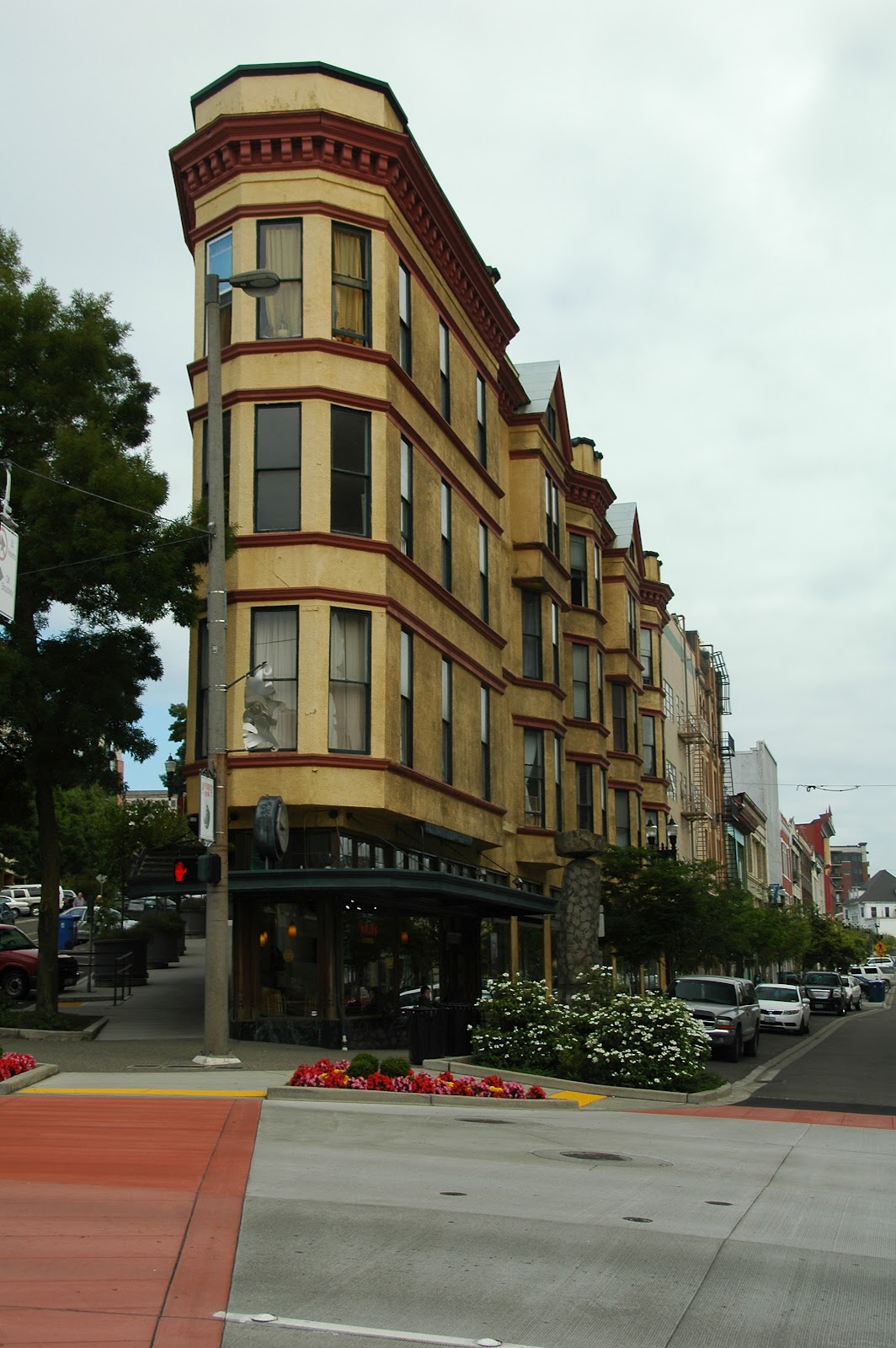
But there is a bigger reason for an absence of people in downtown Tacoma.  There are few downtown residences.  Many of the buildings are two or three stories and dedicated solely to office space.  There is an architecturally interesting residential area at the north end of downtown, near the Theatre District, but it’s too little to make downtown a lively place.

Offering lunch to downtown workers will keep a few restaurants alive.  But keeping a downtown vibrant takes residents who are on the sidewalks throughout the day.  When those people are out and about, downtown feels like a more interesting place, drawing more visitors and supporting more businesses.  It’s a virtuous cycle that begins with people who live downtown.

If your community is considering downtown public places that will provide places for people to gather, good for your community.  But you should ask where the people will come from to use those public places sixteen hours a day, seven days a week.

Follow-Ups:

House names - A couple of weeks ago, I wrote about Ross Chapin’s pocket neighborhoods where many of the cottages have names.  More recently, I wrote about rock songs that address urbanism.  After those two posts, I was intrigued to hear the following lyrics in “Shangri-La” by the Kinks.

And all the houses in the street have got a name
‘Cause all the houses in the street they look the same

I don’t think the Kinks would have a problem with Chapin’s neighborhoods.  They just weren’t familiar with the concept when they wrote the song.

Olympics - If anyone has any lingering belief that the Olympics inevitably lead to urban renewal, take a look at these stories about the disuse of the facilities left behind after the Athens and Beijing Games.  Olympic-initiated urban renewal is certainly possible, but there are more ways to fail than there are to succeed.  I hope that London succeeds despite the lack of good precedents.  I’ll be watching with interest.

Scheduling Note:

Petaluma Urban Chat - The standing date for Petaluma Urban Chat has been moved to the second Tuesday of each month.  The Aqus Café meeting place and 5:30pm start time remain unchanged.  The next meeting will be Tuesday, September 11.  We have something fun planned for the October meeting, but advance planning is required.  If you’ve been thinking about joining our small band, please come in September so you can be included in the October event.

As always, your questions or comments will be appreciated.  Please comment below or email me.  And thanks for reading. - Dave Alden (davealden53@comcast.net)

Monday, August 27, 2012

Tacoma Trolley

During my summer travels, I was pleased to find an operating trolley in downtown Tacoma.  It’s a simple trolley line, running 2.6 miles from the Tacoma Dome to the far end of downtown.  And it’s free.  No fares are collected.

During much of the day, two trolleys run back and forth, with 15-minute headways between trolleys.  In the early morning and evening hours, with only a single trolley in use, the headway doubles to 30 minutes. 


I took advantage of a gap in my schedule to ride the trolley.  I hopped on and off several times to sample different parts of downtown.  The trolley was never more than 30 percent of capacity, but it was mid-afternoon on a Thursday, so not peak usage time.

Transfers to other types of transit are provided at all stops, including a connection at the Tacoma Dome stop to a regional railroad with passenger service to Seattle.

The trolley stops are located to provide access to key areas of downtown, such as the museum district and the Convention Center.  The northernmost station is in Tacoma’s theatre district.  Today, there isn’t much theatre action, although a couple of historic theatres remain in use.  But at one time, top acts would stop in Tacoma.  To recognize that history, playbills of those long-past days have been reproduced on thin granite slabs and attached to the sidewalk near the trolley stop.  It’s a nice touch.

Regular readers know that I often highlight institutional biases against urbanism.  Some might wonder if a free trolley in downtown Tacoma with convenient access to other forms of transit is a bias in favor of urbanism.  However, one justification for the trolley was to allow commuters to park in lots at the outskirts of downtown from where they could ride the trolley to downtown jobs.  So the trolley is intended to facilitate both urban and suburban lifestyles.
 
I don’t recommend taking a trip to the Northwest just to ride the Tacoma trolley, but if you find yourself in Tacoma, I recommend using the trolley to look around downtown.  For me, it facilitated a pleasant afternoon of exploration.  And it can fire the imagination about what trolleys could offer to North Bay communities.

As always, your questions or comments will be appreciated.  Please comment below or email me.  And thanks for reading. - Dave Alden (davealden53@comcast.net)

Wednesday, August 8, 2012

Urban Eating: Seattle, Tacoma, and Suisun City

There are many different directions in which I could take this blog.  My only constraint is my perceived covenant with you, my readers.  And I figure that as long as I remain on topics that affect urban life, I’m within that covenant.  So, today I choose to talk about urban restaurants.

My definition of an urban restaurant is highly personal, but I think it’s reasonable.

First and most importantly, chains need not apply.  I’m willing to consider restaurants with two or three locations.  An owner with a sound vision can operate a few nearby locations without defaulting to a corporate mindset.  But Applebee’s, no matter how well a franchise might physically adapt to an urban setting, will never be an “urban” restaurant.  An Applebee’s would be beholden to a vision from corporate headquarters in Kansas, not its urban location.

Second, the location must be walkable urban, meeting three criteria: little or no parking on the street side of the restaurant, good sidewalks or other pedestrian accommodations, and a location close to transit or within a short walking distance of homes.

Third, the restaurant must have character.  I don’t much care what kind of character, but it should be the kind of place that isn’t easily forgotten.

With those criteria in place, I have three places to share.  Two would require airfare for most readers, but one requires only a short detour when you’re next heading to Sacramento.

Voula’s Offshore Café is in a gritty, water-oriented industrial district of Seattle.  I-5 is on an overpass far overhead.  But at ground level, the key feature is the waterway connecting Portage Bay and Lake Union, part of the water landscape that defines Seattle.  Early development of hydroplanes happened in this neighborhood.  And, for many years, Pocock racing shells were made only a few feet away.

Today, marine businesses continue to be the primary employers.  And marine employees seem to be among Voula’s primary customers.  But an older residential neighborhood begins only a few blocks to the north.  And even closer is the Burke-Gilman Trail, a well-used bicycle-pedestrian trail, making Voula’s a convenient stop during weekend rides.

Voula is Greek and the hospitality reflects that heritage, but the menu is broader, including standard American diner fare and nods to the Pacific Northwest.  The salmon smoking in the parking lot reflects the latter.

The interior reflect Voula’s status as a neighborhood hangout, clean but not fussy.  Heavy, solid furnishings.  And a corner dedicated to the rowers who use Pocock shells.

The food matches the décor.  Nothing pretty, but well-prepared, simply-presented hearty fare.  My breakfast choice was the Greek Hobo, a scramble of eggs, potatoes, onions, mushrooms, and Greek sausage, topped with feta cheese.

The sausage was marvelous, with a good texture, firm but not overly coarse, and light seasoning.  But what made the dish was the gentle touch with the eggs.  Only enough egg was used to bind the other ingredients together.  It wasn’t an egg dish.  It was a potato and sausage dish that held together well.  It was also a meal that I could have again and again.

I was also tempted by the Chinese pancake, which you can watch on the video clip on Voula’s webpage.  Maybe next time. 
My only regret is that I now know that Voula’s opened its doors in 1984, three years before I moved from Seattle.  And it’s on a street that I often drove back then.  Had I found it back in 1984, I might never have moved away.

I was in the Northwest escorting my mother on a baseball roadtrip.  She’s a season-ticket holder for the Sacramento River Cats.  Beginning six years ago, she and I have taken annual roadtrips with the ballclub, giving her a chance to see her team in visiting uniforms.  We’ve gone to Portland, Albuquerque, Memphis, Nashville, and elsewhere.

I mention this because a feature of the each trip has been a meal with the ballclub’s radio broadcaster, Johnny Doskow, who has become a friend.  Doskow has been broadcasting in the Pacific Coast League for nearly fifteen years, which has given him the opportunity to find the best restaurants throughout much of the country.  Mother’s in Portland, Gus’s Fried Chicken in Memphis, Pancake Pantry in Nashville.  All were Doskow’s recommendations and all were good food.

In Tacoma, his recommendation was Southern Kitchen, a restaurant about a mile uphill from downtown Tacoma and nicely settled within the older residential grid of the city.

Not surprisingly, the cuisine was southern.  Perhaps more surprisingly, it was good southern food despite being about as far from the South as one could be in the U.S. without venturing to Alaska or Hawaii.

At the server’s recommendation, I went with the chicken-fried steak.  It wasn’t a regular breakfast choice for me, but I’m glad that I took the advice.  Nicely crispy, with a well-made gravy, and paired with a couple of eggs that were exactly as requested.  The only weak note was the grits and that was my fault.  I think I should like grits so keep ordering them.  But I’ve yet to find grits appealing and should just go with the potatoes.

In addition to good recommendations, the server also brought life to the meal with attentive service and a good line of patter.  When I asked for the check, “Skitzo” offered a sorrowful look and explained that he was no longer allowed to handle cash “after that $2,000 went mysteriously missing.”  When I went to the register to pay, Skitzo was there to take my money, explaining that he was “just  messing” with me.

Overall, solid food in a comfortable, enjoyable setting.  Highly recommended.

Lastly, I’ve twice mentioned Bab’s Delta Diner in this blog.  But I hadn’t yet found the right opportunity to eat there.  Recently, I was finally able to drop by Suisun City while it was open.  It was worth the effort.

Architecturally, Bab’s Delta Diner is a bit of a puzzle.  The exterior shell is consistent with the downtown redevelopment, a competent structure that seems recently built and fits with the waterfront theme of the redevelopment.  But step through the door and it feels like a diner of fifty years ago.  I don’t mean that in a negative sense, only that the layout seems a bit random and the furnishings are worn in the right spots.  It feels comfortable in a well-worn shoe kind of way.

And the food is consistent with that feeling.  Nothing very fancy, just good solid diner fare.  I had Rod’s Special, corned beef hash topped with cheddar cheese and a pair of poached eggs.  Normally I’d worry that the cheddar cheese would overpower the hash, but it was a full-bodied flavorful hash that allowed the cheese to be an effective complement.  And the eggs were done perfectly.

I arrived late in the Delta Diner’s business day.  People were still coming in the door, but the place was gradually emptying as the 2:00pm closing time approached.  As a result, the diner was overstaffed, with the young waitstaff clustered near the register, slightly giddy with the approach of a Saturday evening.

The young man who waited on me, a white teenager with a buzz cut, was in an effusive mood, quickly dubbing me “Buddy” and waiting on me with an alacrity that verged on haste.  I had to catch the silverware before it slid off the counter.  When he called the middle-aged African-American man next to me “Brother”, I found it a bit close to the edge, but no one took offense.

While I ate, the Olympic 10,000 meters was playing on a television, although the race length wasn’t being shown on the screen.   It was interesting to watch the waitstaff try to figure out the length, given the elapsed race time and the number of laps being run.

After long consideration, one decided that it was 100 meters (huh?).  Another went with 6 miles (close but the Olympics went metric before any of them were born).  A third came up with 9,000 meters (not a traditional race length).  They finally settled on 10,000 meters, but only after the high school teachers in the diner were hanging their heads in shame.

It was fun to watch the youthful exuberance.  Some patrons might have found it a distraction, but I enjoyed remembering the days of my youth.  And it reminded me that a primary reason for urbanism is leaving a more sustainable world for the next generation.  Even if they think that it takes nearly thirty minutes to cover 100 meters.

As always, your questions or comments will be appreciated.  Please comment below or email me.  And thanks for reading. - Dave Alden (davealden53@comcast.net)