Showing posts with label parklets. Show all posts

Friday, October 30, 2015

Making a Difference - Parklet Version

Parklets are small, sometimes temporary, uses of a parking space or two near an existing business, often akin to a sidewalk café but with a greater range of design possibilities.  The photo is a good example of a parklet.  It’s from the Better Block Newark website, which offers good insights on parklets.  Closer to Petaluma, the Greenbelt Alliance shares stories from a recent parklet event in Walnut Creek.

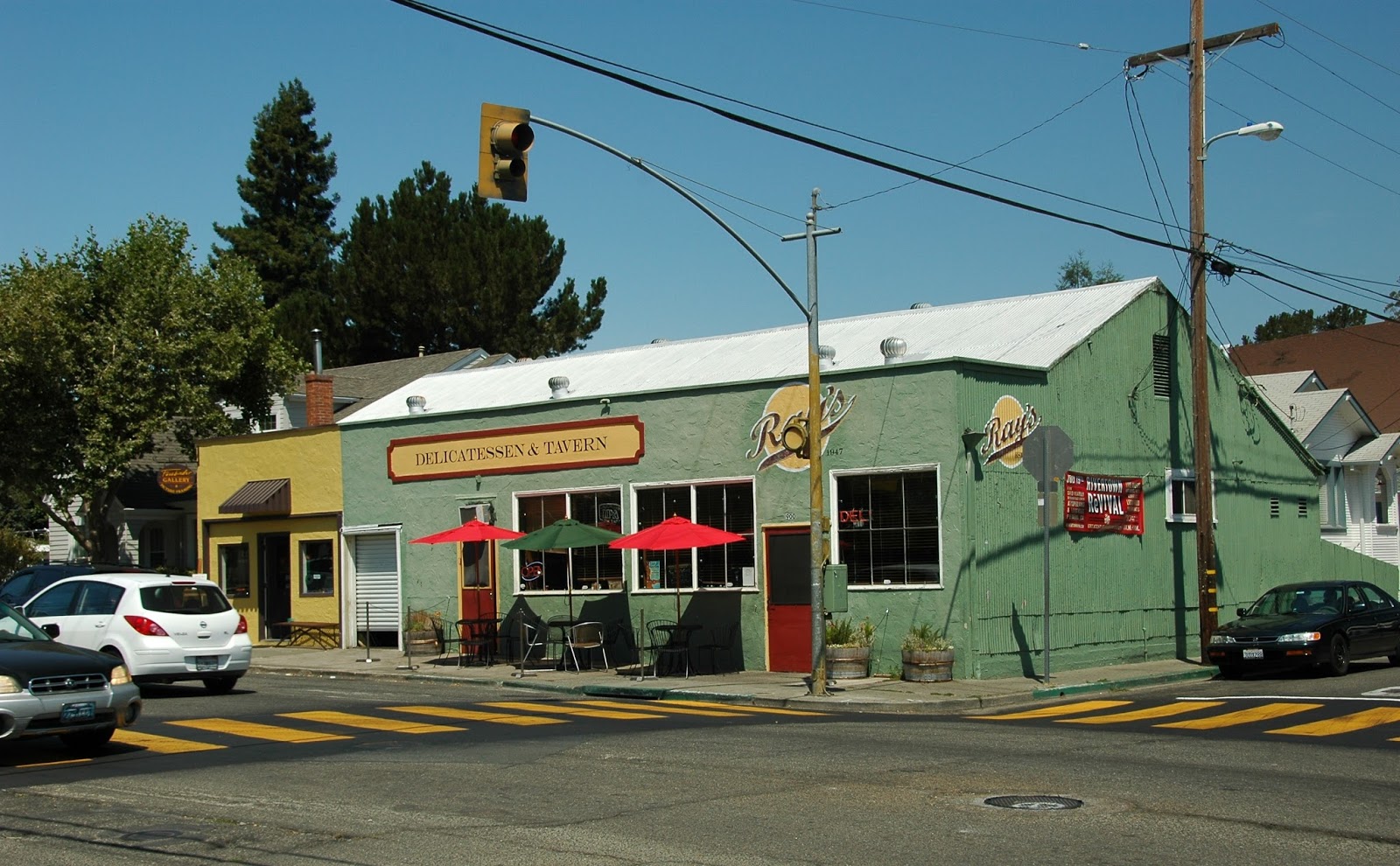
A few weeks back, I endorsed the concept of a parklet at Ray’s Delicatessen and Tavern in Petaluma.  I envisioned a possibility that a parklet would complement Ray’s existing business and make the establishment an even more vital element of my neighborhood.

In my last post, I responded to those who had questions or concerns about the parklet idea.

And now it’s time to move on to the next step toward making Petaluma a parklet-friendly place.  And your help could be essential.

If sufficient interest can be generated, a group will be formed to write a draft parklet policy.  The draft would be presented to the City, with the hopes that the City would build from the volunteer effort to make a few edits and to adopt the policy.  A kick-off meeting for this possible parklet committee, which would be an offshoot of Petaluma Urban Chat, is scheduled for a few days hence.

Several months ago, I noted that writing about urbanism can lead to a great number of possibilities for further advocacy and activism, more than I can reasonably accommodate with my other life activities.  The observation remains true and I’m still hesitant to take on new commitments.  However, the parklet situation is different.  I have a partner who is committed to the effort and who will cover a good portion of the task.

Bjorn Griepenburg grew up in Petaluma, graduated from Petaluma High, and then headed off for an education in land-use planning.  Now the possessor of a newly-minted Masters in City and Regional Planning from the University of Oregon, where he also learned to appreciate the parklets of nearby Portland, he has returned to Petaluma, working during the day for Muni in San Francisco and spending his evenings looking for ways to improve the town he already loves.

Bjorn recently presented his master’s thesis, on bicycle access to the downtown Petaluma SMART station, to Petaluma’s Pedestrian Bicycle and Transit Advisory Committees.  His presentation is worth viewing, in part because it follows a model of bicycle accessibility that conforms to the best current approach to the subject.

Our tentative plan is that Bjorn would focus on the technical side of the parklet effort, reviewing parklet standards of other communities and digging into Petaluma’s codes looking for places to effectively graft parklet rules.  Meanwhile, I’d pay attention to the organizational and strategic elements.

However, it wouldn’t be a two-person effort.  We’d need more folks to assist in the tasks, to challenge assumptions, and contribute toward consensuses.

The special meeting of Petaluma Urban Chat for this parklet effort will be the evening of Tuesday, November 3.  We’ll meet at the Aqus Café, 2nd and H Streets in Petaluma, and convene at 6:30pm.  (Note: This is an hour later than the normal Urban Chat meeting time.)

After spending time chatting about the concept of parklets and answering questions, including covering the parklet presentation that Bjorn made to the Petaluma Downtown Association earlier this year, we’ll ask for volunteers willing to commit to another half-dozen meetings at which a draft policy would be developed.

Nor are we only looking for parklet converts.  Parklet skeptics would also be welcome.  The best and most robust policies often result from the creative tension of disagreement.

Please note, this direct goal of this effort isn’t constructed parklets.  We won’t be selecting locations for parklets or sketching up parklet plans.  Parklets are very much a bottom-up planning concept, with the vision and impetus coming almost solely from the business owners who see value in the concept.

Instead, the goal would be a set of rules that would allow the business owners to know how to proceed.  We would be suggesting to the City that they adopt a plan for a ladder that would allow bottom-up instigation, saving the business owners from the possibly disheartening task of figuring out the ladder themselves.

If some are uncertain still puzzling over the value of parklets and therefore uncertain about joining us on the 3rd, I’ll share another couple of stories.

Perhaps five years ago, as parklets were beginning to gain ground but I was still unconvinced of the value, I made a trip to Berkeley.

On Shattuck Avenue, just north of University Avenue, are several blocks with a center median, an uninspired six feet of intermittent low shrubs and patchy grass.  And sitting on the grass were people eating lunch.  Six feet of scraggly grass surrounded by four lanes of traffic in the middle of a dense city, and yet people found the setting sufficient salubrious to lean back, unwrap a sandwich, and savor a leisurely lunch.   And they seemed to be enjoying themselves.

The moment I saw those folks, the value of parklets became clear.  Even if we love the vibrancy of a busy, successful city, there are times when greenery and blue sky is good for the soul, and we’re willing to risk a bit of car exhaust to secure that food for the soul.  Parklets are a better delivery system for that manna.

I’ve been engaging in a correspondence with a reader who vehemently disagrees with my advocacy for parklets.  In his most recent missive, he argues that if people want to be outside, they should secure a seasonal pass for the Sonoma County beaches and take regular drives to the coast.

I love the fact that Petaluma is a short drive from some of the most scenic coastline in the country.  But the reader’s suggestion that beaches are a reasonable substitute for parklets misunderstands the lives of many folks.  Writer Richard Louv makes a point about how infrequently many youths travel beyond their neighborhoods.  I don’t recall his exact statistic, but it was something like sixty percent of all ten-year-olds in San Diego had never seen the ocean.  And that was in San Diego, a place where many think life revolves around the beach!

There are likely a variety of reasons so few San Diego children have seen the ocean.  Perhaps it’s parents unwilling to use the gas or to fight through the congestion.  Perhaps it’s parents who work schedules that don’t leave time for outings.  Perhaps it’s a culture that doesn’t value seeing new places, even those that are only a few miles away.  But for at least some of those folks, gathering for sandwiches at a parklet might be their substitute and we should be open-minded enough not to preclude those outings.

I’m excited by what we can accomplish starting on the 3rd.  Bjorn and I hope to see a good group of folks that evening.  Aqus Café, 6:30pm, Tuesday, November 3.

Next time, I’ll write about the future of business parks, a future that could have implications for the SMART train.

As always, your questions or comments will be appreciated.  Please comment below or email me.  And thanks for reading. - Dave Alden (davealden53@comcast.net)

Wednesday, October 28, 2015

Responding to Parklet Questions

I recently wrote about the possibility of a parklet at Ray’s Delicatessen and Tavern, a neighborhood gathering place a short distance from my home.  My comments were intended to note the potential of the idea and to encourage Ray’s to continue with their study of the concept, including the development of a site plan and other data the City of Petaluma would need before making an approval decision.  I specifically withheld my own approval until those latter steps were complete.

In the way of too many land use discussions, some readers didn’t grasp the nature of the land-use process, including the balancing of pros and cons yet to come, overlooked the statement of my withheld judgment, and assumed that I’d was advocating for a fully fleshed out idea.  The resulting comments and emails took a variety of tones.  Earlier today, I finished the last of my responses.

Although many of the respondents misunderstood the status of the parklet idea, many of the comments touched on valid points that were worthy of sharing.  Below, I’ve tried to capture the sense of the questions posed and my resulting responses, starting with the more general questions and proceeding into those more specific to Ray’s.  However, I’ll reiterate that I’m writing for myself, not for Ray’s or for any other parklet applicant.

Who would pay for a parklet?: Elsewhere, parklets have always been applied for and installed by the nearby businesses, sometimes with support from citizens or non-profits with an interest in the changes that would be brought by parklets.  I wouldn’t expect Petaluma to be any different.

Wouldn’t a business propose a parklet only so they can make more money?: We live in a market economy.  No reasonable business owner would propose a parklet unless he expected the additional business created by the parklet to justify the expense.  But it’s also true that most parklets are proposed by local businesses that also value their community and are eager to give something back.  You don’t see many parklets at Starbucks.

How can we justify frills like parklets when our roadways are falling apart?: It’s true that infrastructure maintenance is badly in arrears in Petaluma.  The same is true of most U.S. communities.  The bill is coming due on the drivable suburban experiment and the public is unwilling to pay the tab.  It’s a problem that will require a multi-faceted solution.  Providing more places that people can reach without getting into their cars, such as parklets at neighborhood gathering places, can play a small role in that solution.  So parklets would be part of the solution, not the problem.

Wouldn’t a parklet use up scarce parking?: If a parklet includes bike parking, the parking demand created by the gathering place might decrease.  People are willing to walk and to bike when those modes are made as convenient as driving.

How would deliveries be accomplished if a parklet occupies the curbside space in front of the business?: That’s a site-specific question that any applicant would need to answer.

If Petaluma suddenly had a multiplicity of parklets, wouldn’t traffic congestion clog the community?: If parklets popped up all over town (an unlikely event, but a theoretical possibility), the likely effects would be a small reduction in traffic, a noticeable increase in pedestrian and bike traffic, and an incentive for other building owners to change to uses that would serve the increased foot and pedal traffic, which would have a multiplicative effect on reducing traffic.  Even in the best case, the effect on traffic would be minor, but a step in the right direction.

If you think it’s such a great idea in San Francisco and Portland perhaps you should move there: Petaluma has a mixed reputation in planning circles.  On one hand, it was the city that pioneered urban growth boundaries and that was the earliest adopter of form-based coding, both of which have become key elements in modern city planning.  On the other hand, as those of us who live here know, Petaluma has often backslid between those giant steps forward.

On the whole, Petaluma is perceived as a place not content to stay with the status quo.  I like living in a small city that is among the most likely to adopt urban strategies such as parklets.  As much as I enjoy San Francisco and Portland, I’ll be staying in Petaluma.

Why even consider a parklet in a residential neighborhood like that around Ray’s?: In its early history, the neighborhood around Ray’s was a place where residents walked to do daily errands.  Ray’s is a remnant of that early history, as are several other businesses such as the Fairwest Market.  It was only later generations that decided that transportation should focus solely on the automobile.  A parklet at Ray’s wouldn’t be breaking new ground; it would be returning the neighborhood more to as it was in the 1920s.  And there is significant evidence that the land-use pattern of the 1920s was more sustainable, both environmentally and financially, than the current drivable suburban model.

There are traffic problems near Ray’s.  Doesn’t that make it a bad place for a parklet?: It’s true that the intersection of Western and Webster is awkwardly configured.  I traverse it many times each week and am always alert to traffic misbehavior.  However, I think the problem is primarily due to the unfortunate geometry.  Given the likely location of the parklet, I don’t see how it could worsen the situation. Instead, it's well established that the appearance of constricted lanes slows traffic, so it’s possible that a parklet would decrease the frequency and severity of collisions.

Ray’s is near three schools with the resulting twice daily congestion.  Does that make a parklet a bad idea?:  Unless the parklet creates increased traffic, I don’t see a conflict.  Also, the peak school traffic at is at 8am and 3pm which aren’t the peak business hours at Ray’s.

What would happen to the bike lane in front of Ray’s?: Parklets are generally proposed for parking spaces only.  I would expect the bike lane to remain on its current alignment.

If you have further comments to offer, please offer them here.  However, remember that I’m not Ray’s, I’m not working for Ray’s, nor am I suggesting that a Ray’s parklet is fully designed and ready for installation.  But if you have questions that you’d like Ray’s, or any other parklet applicant, to answer before getting approval, feel free to share.

In my next post, I’ll build on another topic from my earlier parklet post.  I’ll announce tentative plans for a group that would work toward a draft parklet policy for consideration by the City of Petaluma.  If the topic interests you, even if you’re not yet sure about the worth of the concept, please read the post and consider participating in the group.

As always, your questions or comments will be appreciated.  Please comment below or email me.  And thanks for reading. - Dave Alden (davealden53@comcast.net)
Monday, September 28, 2015

A North Bay Parklet?

Parklets, the appropriation of curbside space otherwise intended for cars by amenities such as bike racks, benches, tables, etc., is one of the most recent additions to urbanism’s toolkit.  Kaid Benfield of the Natural Resources Defense Fund offers photos of the range of activities that can be accommodated in a parklet, with amenities as varied as temporary sod, a bike repair station, and even a flower garden, although I’ll admit that the kayak seems a stretch.

Parklets were invented in San Francisco in 2005.  In only ten years, they’ve spread across the country.  They haven’t yet made many inroads into the North Bay, although that could soon change if a few folks in Petaluma get their wish.

I’ve previously written about Ray’s Delicatessen and Tavern, a defining element of my neighborhood.  In the past few years, Ray’s has become a favored gathering place for its tasty sandwiches, its community tables, its regional selection of beers in a pine-paneled tavern, and its events such as Thursday evening musical jamming.  And now the owners are putting out feelers about a parklet.

I learned about the parklet concept through the communication mode that characterizes effective neighborhoods, a sidewalk chat.  I had made lunch plans to meet a friend to talk about urbanist issues over Ray’s sandwiches.  As I walked the block and a half, I was waylaid by a neighbor eager to inform me Ray’s evil intention to build a parklet that would be a traffic hazard and a neighborhood nuisance, a parklet that would allow Ray’s to remain open later, interfering with the sleep of the nearby good citizens.

(Years earlier, the same neighbor tried to enlist my support in opposing a Little League complex in our neighborhood, a proposal that I ended up enthusiastically endorsing.  She seems slow to understand my land-use leanings.)

Intrigued by the concept of a Ray’s parklet, I parried her arguments as well as I could, extricated myself from the conversation, and continued onward to Ray’s where I hoped to gather a more objective explanation of the intentions.

My friend and I soon attracted the eye of the owner, who confirmed that she and her partner were doing a preliminary investigation of a parklet, including coordination with Petaluma about what the standards might be.  She also advised us that she expected the parklet to calm traffic, reducing the traffic risks at the awkwardly configured intersection, that she had no intention of remaining open any later than her current closing time, and that the current plan for the parklet included bicycle parking with the goal of reducing car trips.

The owner reinforced what I already knew, that she loves the neighborhood and is continually looking for ways to make it better.  To her, the parklet would be a way of doing that.

She concluded with an offer to arrange a meeting with the architect who was preparing preliminary sketches for the parklet.  Unfortunately, I had to decline that offer.  As a member of several City committees that might conceivably be asked to review the parklet plan that she would bring forth, I’m comfortable with espousing the concept of parklets in Petaluma and even with embracing Ray’s as a possible parklet location, but felt that, to retain design objectivity, I needed to avoid prejudging the actual parklet plan.

So, I can’t share the details of what Ray’s may propose, but I can draw a picture of what parklets can do for a city.  John King, the architectural critic for the San Francisco Chronicle summarized the history and potential for parklets.  In King’s words, “The best parklets combine design ambition with a genuine desire to engage passersby.”

King also quotes Robin Abad Ocubillo, the parklet coordinator for the San Francisco Planning Department, ““They can provide focal points where neighborhoods come together, adding open space to neighborhoods where there’s really not great open space.”

King concludes with his list of the top five parklets in San Francisco.  But for those for whom five isn’t enough, Curbed San Francisco provides a map of all 43 San Francisco parklets as of early 2014.  (Someday soon, I’ll make a day trip into San Francisco to sample some parklets, hopefully by public transit and foot.  If anyone wishes to join me, let me know.)

The Robert Wood Johnson Foundation, with its focus on public health, weighs in to suggest that parklets can support healthy communities.

To push the envelope even further, Azzurra Cox of City Lab writes about a “park in a cart” constructed by a theatre group to bring youth play activities to different neighborhoods in the highest altitude city in the world.

But proving that parklets, for all their benefits, can still make for troublesome public policy, Nosh documents the birthing pains of a parklet policy in Berkeley.

Coincidentally, parklets arose again during an even more recent visit to Ray’s.  A young planner, who spent his youth in Petaluma and has now returned to assist aging parents while getting his career underway in San Francisco, had asked to chat about urbanism in Petaluma.  We spent an enjoyable hour in the tavern talking about the opportunities and constraints in our shared community.

But the conversation really took flight when he spoke of the give-back that he had planned for the town of his youth.  Having spent the final years of his college career in Oregon, he was enthralled by parklets and had a cellphone filled with photos of parklets in East Portland.  He now intended to help Petaluma develop its first parklet policy and had already begun meeting with local community groups to gather support.

We quickly lassoed the Ray’s owner, made mutual introductions, shared parklet stories, and agreed that among us were the key members of a team that would bring a parklet plan to Petaluma.

As a result, one of my tasks for the near-term future is helping to identify the best route to that plan.  If anyone wishes to assist, let me know.

This is an effort I’m making because I’m convinced, unlike at least one curmudgeonly citizen, that parklets, whether at Ray’s or elsewhere in Petaluma, would be great community additions.

Next time, I’ll offer another argument for the Twenty is Plenty movement and traffic calming.

As always, your questions or comments will be appreciated.  Please comment below or email me.  And thanks for reading. - Dave Alden (davealden53@comcast.net)