Showing posts with label Dallas. Show all posts

Monday, May 4, 2015

CNU 23: First Impressions

I’ve recently returned from the 23rd annual meeting of the Congress for the New Urbanism.  As always, I return wearied by the long days crammed with information and insights, but full of enthusiasm and new ideas that I’m eager to bring to bear on North Bay land-use issues.

My plan is for CNU 23 to dominate this blog over the next few weeks, but not to the exclusion of North Bay thinking.  I’ll try to walk the fine line between sharing my experiences and keeping an eye on local stuff.

Today, I’ll begin my thoughts from CNU 23.  Next week, I’ll offer a sampling of the best individual comments from the Congress, followed in later weeks by deeper explorations of the content.  But for today, I’ll write only about the theme that struck me most forcibly at CNU 23.

In the past, I’ve found the use of the word “Congress” to describe the group as a slightly curious, although acceptable, word choice.  In my thinking, I was using the “assembly” definition of “congress”.  But in a re-education that began with the first session I attended, I was educated that “Congress” had been selection intended in the more legislative sense.

A CNU Congress is intended as a place where the best and most insightful thinkers about land-use planning can gather to exchange perspectives, to seek common ground, and to consider compromises that give the best syntheses for contemporary urbanism.

(In a humorous note that was made several times during CNU 23, it was remembered that some of CNU founders thought that four Congresses should be sufficient to reconcile any differences and to settle on a single approach to urbanism.  Twenty-three Congresses have now been completed, the next two are already being planned for Detroit and Seattle, and the end of the Congresses is no longer discussed.)

My enhanced education began with Professor Emily Talen talking about the four disparate philosophies that have fed urbanism over the past century and continue to play roles today.  Her terms for the four streams were incremental urbanism, regional planning, zoning, and garden cities.  She traced the roots of each stream and then described the role that each has assumed in contemporary urbanism, including the tensions that remain between them.

This new and more profound understanding of the past and future of urbanism isn’t necessarily a comfortable place to be.  Talen’s vision of urbanism, although it includes bedrock principles, isn’t of a single formulation that can universally applied, but of a philosophy that must constantly evolve as new information is brought to the table and as new situations are faced.

My personal example of this thinking is the connection between climate change and urbanism.  Going back to the founding of CNU, and in my own experience as recently as 2011 when this blog was started, climate change has had a role in the urbanist conversation, but wasn’t necessarily the central factor.

This relationship between urbanism and climate change is now quickly changing, with climate change becoming perhaps the strongest argument for new urbanism.

In the abstract, I’m comfortable with this continual evolution although I find the constant sense of motion to be unsettling at times.

Following Talen, Andres Duany connected this on-going evolution to the CNU membership tallies.  As he described it, the membership total of CNU remains stable at about 3,000 people despite an annual influx of 500 new members.

Duany’s explanation is that 500 people also depart each year, many because of a difficulty of accepting the continual tension between the different urbanist streams.  His belief is that many of the former CNU members have instead joined groups that focus on single aspects of urbanism, such as complete streets or public places.

Duany doesn’t bemoan those who have moved on, but celebrates CNU as the place where cutting edge thinking continues to happen.

I look forward to sharing more about CNU 23 in the coming weeks.

Schedule Reminders

I have two calendar reminders today.

As described in my last post, the agenda for the upcoming meeting of the Petaluma Transit Advisory Committee touches upon aspects of transit funding and regional coordination beyond where the committee agendas often go.  As the committee chair, I can promise discussions that will give grist for further thought.  If this sounds interesting, please join us.  The meeting will be Thursday, May 7 at 4:00pm in the City Council Chambers at City Hall, 11 English Street.

Also, the regular monthly meeting of Petaluma Urban Chat will be Tuesday, May 12, 5:30pm at the Aqus CafĂ©, 2nd and H Streets.  I’m awaiting a couple of final confirmations so can’t yet announce the subject, but am planning a topic that I think will interest many.  For now, please put the meeting on your calendar and then look for more details two posts hence.

My next post will come from my recent travels.  My route to Dallas, where CNU 23 was held and where the photo of the public art was taken, was circuitous.  On my way to the Big D, I attended a family wedding in West Virginia, took advantage of a spare day to watch a ballgame in and to wander the downtown of Morgantown, and joined an old friend for an early evening tour of Pittsburgh.  The next post will describe a public plaza in Pittsburgh that caught my attention, although not necessarily in the way the designer intended.

As always, your questions or comments will be appreciated.  Please comment below or email me.  And thanks for reading. - Dave Alden (davealden53@comcast.net)

Wednesday, June 11, 2014

CNU 22: Only to Urbanists Would Buffalo Be Better than Dallas

In my last post, I began my report from CNU 22, the 22nd annual meeting of the Congress for the New Urbanism.  Today, I’ll offer some moments from the conference.  Not detailed analysis, but just moments.  Snippets of conversation or observations that give a flavor to what it’s like to hang out for five days with urbanists, looking at the world through urbanist-tinted glasses.

Buffalo versus Dallas: CNU 23 will be held in Dallas, a choice that many CNU members found odd because of the pervasive suburban slant of Texas.  The destination will be in sharp contrast to Buffalo with its proud history of urban glory and its current efforts to recapture some of that glory.

But CNU folks understood than much of the world would find Dallas the more desirable destination.  I rode in from the airport with a CNU member from Dallas who expressed it best, “Only to urbanists would Buffalo be better than Dallas.”

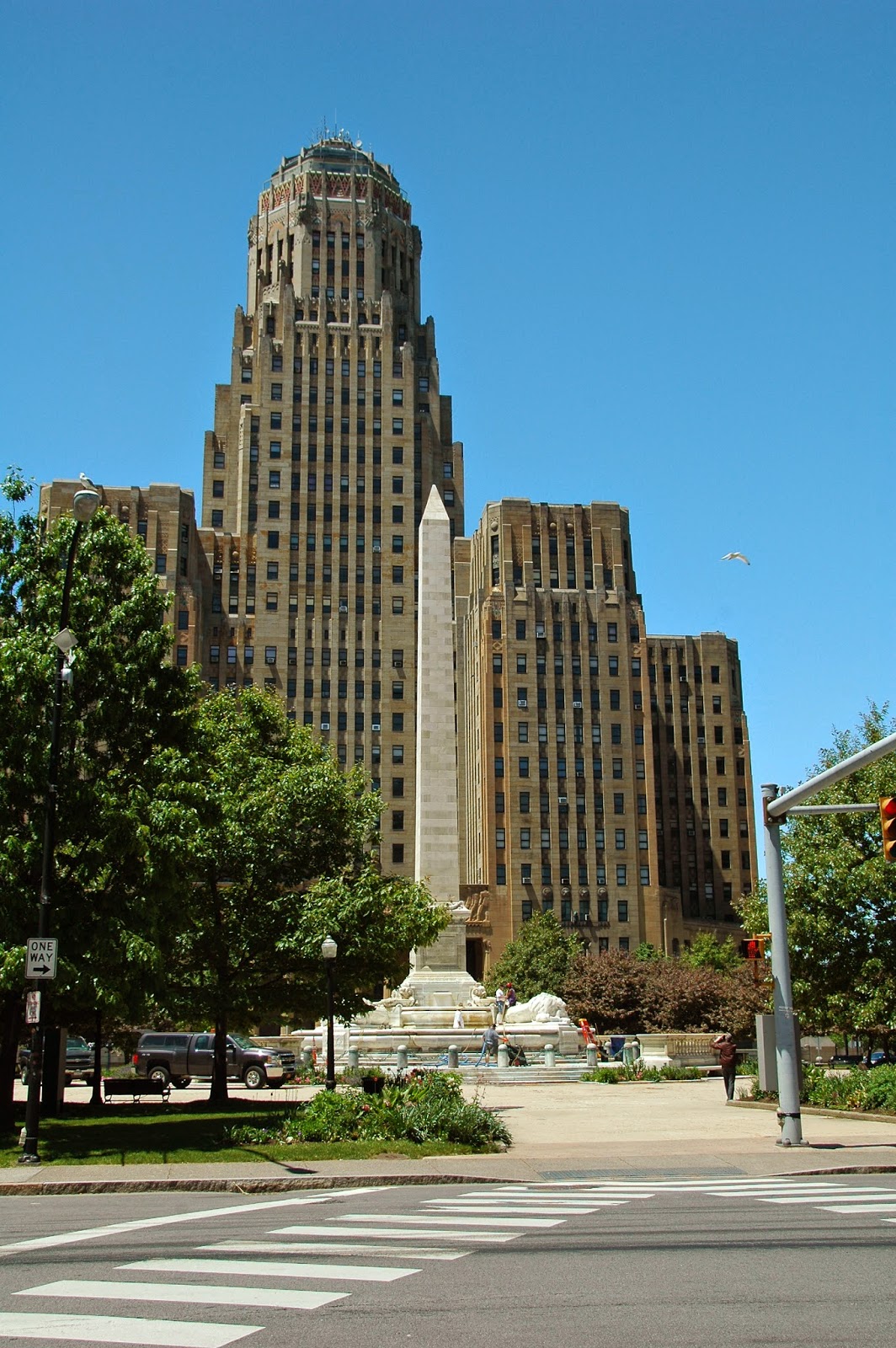
Buffalo Streetscape:  Downtown Buffalo is filled with great buildings.  The photo is of the Buffalo City Hall, an art deco masterpiece that is on the National Register of Historic Places.  And it’s surrounded by buildings that are equally striking.  They bespeak of a time when Buffalo was among the leading cities in the country.

But the sidewalks of Buffalo are oddly quiet.  The occasional pedestrians appear lonely among the tall buildings.  And they can jaywalk with ease because of the paucity of cars.  A fellow CNU attendee expressed it well.  “It’s as if we’ve come upon the abandoned city of a great civilization.  But we aren’t the first to arrive.  Others arrived before us and are now slowly beginning to repopulate the buildings.” 

Buffalo Weather:  Buffalo is well-known for its weather, particularly the “lake effect” snowfalls of wintertime.  On the opening evening, I chatted with a member of the local host committee and asked about the snow.  He acknowledged that it gets deep, but also noted that Buffalo knows how to deal with snow, so the city still functions well on most days.

Besides, he noted, “No one stays home when it snows heavily.  Those are the nights when you have to be at the pub with your friends, watching the snow pile up.”  That seemed a fine measure of civic life.

Buffalo Skyway: The outgoing CNU president and CEO, former Milwaukee mayor John Norquist, has been using his political capital to advocate for the removal of urban freeways where surface boulevards can provide the same traffic function.  Norquist argues that conversion to boulevards would eliminate community dividers, improving civic life and bumping property values.

In the Bay Area, removal of the Embarcadero Freeway and replacement of the Central Freeway with Octavia Avenue are examples of the kind of urban transformations that Norquist is seeking.

(In the North Bay, I’d suggest that Highway 12 east from Santa Rosa toward Bennett Valley is another freeway segment where the community would be better served by a boulevard.  And also perhaps Highway 29 through Napa.)

Given that background, it was interesting that the opening night function was held at First Niagara Center, immediately adjoining the Buffalo Skyway.  The Skyway is among the prime targets of urbanists who argue that the flyover of the Erie Canal accomplishes little except sapping the life of the land beneath it.

I walked to First Niagara Center with a group of conference attendees.  As we approached the building, I noted a sign on the surface street beneath the Skyway, “Watch for Falling Debris”.  Looking up, the Skyway was the only possible source of debris.  Yup, I can imagine that constantly looking for hubcaps falling from the freeway fifty feet above is a damper on urban street life.  We hurried inside.

More moments will follow in the next post.

Greetings

Blog readership jumped with my last post.  A really big jump.   And darned if I know why.  I checked several possibilities, but none proved out.  Perhaps it was only because I included “CNU 22” in the title.  To be safe, I again included CNU 22 in this title.  And will continue to do so for the next few posts.

But regardless of why the new readers arrived, you’re welcome.  I hope you stay around.  I’ve been described as an urban generalist, touching at various times on land-use, density, traffic, transit, municipal finances, climate change, travel, and any other aspect of urbanism that catches my attention.  And I often try, with varying levels of success, to apply the information to my home territory, the counties that are arrayed around the north end of San Francisco Bay.

If you have any questions or comments, let me know.

Milestone

Early in the history of this blog, I noted when readership passed 1,000, 5,000, and then 10,000 pageviews.  Those milestones seemed to add validity to my early efforts, but I eventually decided that I needn’t note every landmark.

However, I passed 100,000 early this week and couldn’t let that milestone pass unnoted.  (I probably would have passed 100,000 even without the readership jump, but the new folks assured that I moved past the threshold with good velocity.)

Thanks to all the readers who have been part of the 100,000.  Thanks for coming back three times a week and for becoming part of the conversation.

Schedule Notes

The first couple of downtown/ballpark outings are nearly upon us.  Dates and places are below.  If you wish to join the outings, let me know.  We can coordinate on meeting places, etc.

San Rafael: Friday, June 13 – Pittsburg Mettle at San Rafael Pacifics, first pitch 7:05pm
Alameda: Sunday, June 15 – Sacramento Spikes at Neptune Beach Pearl, first pitch 3:00pm

As always, your questions or comments will be appreciated.  Please comment below or email me.  And thanks for reading. - Dave Alden (davealden53@comcast.net)