Showing posts with label CNU 22. Show all posts

Wednesday, October 8, 2014

Urbanism and Senior Living: Shedding the Extra Bedrooms

In recent weeks, I’ve been writing about the intersection of urbanism and senior living.  Thus far, I’ve largely focused on the forms that senior living can take in urban settings and the steps needed to encourage downtown senior options.

But I’ve also written that many seniors, even if they find walkable urban life appealing, are nonetheless stuck in drivable suburbia because there are few suitable urban options or because they can’t sell their current homes at a price adequate to support a move downtown.

Today, I’ll begin writing about how to bring touches of urbanism to those living their final years in drivable suburbia.

I don’t recall the speaker, but there was a particularly insightful moment on the subject of senior living at CNU 22, the most recent annual meeting of the Congress for the New Urbanism.  The speaker was digging into the statistics showing that many seniors prefer to “age in place”.

The aging in place sentiment is generally understood to mean that seniors wish to remain in the homes where they raised their families.  This understanding has launched many businesses focused on modifying homes with grab bars, providing essential in-home services, and otherwise facilitating seniors remaining in their long-time homes.

But as the speaker dug more deeply into the statistics, he found that many seniors weren’t necessarily thinking about the homes as the “places” where they insisted on “aging”.  Instead, they didn’t want to leave behind the neighbors with whom they had long friendships, the coffee shops where they spent Saturday mornings, or the butchers who cut their Christmas prime ribs.  Perhaps not all, but many seniors no longer cared about the five bedrooms and quarter-acre of grass where they’d raised their families.  They didn’t want to leave their neighborhoods.   Their neighborhood was their “place”.

Of course, in the American version of land use, there are rarely alternative homes within large-lot single-family neighborhoods that are suited to the elder years, so it’s not surprising that the seniors were unable to express their preference for neighborhood over home.  But it’s nonetheless a preference that should be recognized.

Of course, the problem with the preference is home size.  Even if seniors no longer have an interest in dusting and vacuuming 2,500 square feet of house, most neighborhoods don’t offer reasonable alternatives.

However, there are people trying to rectify that deficiency.  In classrooms at the New Jersey Institute of Technology, students are looking for ways to more gracefully accommodate aging.  One idea is to construct duplexes configured so the second unit can be rented out in the early years of marriage, occupied during the child-rearing decades, and then again rented out during the later years of life.

On a similar track, Witold Rybczynski wrote in his book “City Life” about his role in developing Grow Homes, narrow, shared-wall homes that are sold with the upper floors open and unfinished.  The intended buyers are young married couples who can divide and finish the upper stories to suit as their families grow and their specific needs become evident.

Of course, Grow Homes, as their name implies, are more suited to expanding families, but the flexibility to reinvent the upper stories can also meet senior needs, from convalescent rooms to apartments for caretakers to living accommodations for other seniors, creating a “naturally-occurring retirement community” or NORC as I described in a recent post.

Although not widespread, with most of the 10,000 units near Montreal where they were invented, Grow Homes have received wide acclaim.

Also in “City Life”, Rybczynski wrote about the town of Mariemont, Ohio, where the walkable core includes apartments suitable for young couples, small-lot single-family homes for child-rearing, and eldercare facilities, all of which combine into a place where one can live an entire life.  (Before someone else offers this fact, I’ll note that Mariemont was originally intended as whites-only, proving only that our forebearers were better at urban planning than at social justice.)

Accessory Dwelling Units (ADUs), commonly called “granny flats”, can also widen the range of housing options in a suburban neighborhood.  Whether stand-alone units adjoining primary houses or additions to existing homes, such as flats above garages, ADUs can provide a place where empty-nesters can make more suitable homes for their later years.  I’ve heard of seniors who have moved into a newly-added ADU and then rented their former homes to a young family.  (Personally, I once spent 18 months living comfortably in an ADU over a garage in a suburban neighborhood.)

The biggest impediment to ADUs is often impact fees.  Much like small downtown units, as described in my previous post, ADUs can have impact fees that exceed their true impacts, as unenlightened cities try desperately to balance books teetering precariously from the failed suburban experiment.

Lastly, I’ll refer back to an idea I offered in the spring, about reconfiguring under-used neighborhood parks to add, among other elements, small blocks of residential apartments.  At the time, my goal was to raise resources to make the parks more relevant to contemporary life, but a side effect would be creating places for elders, who no longer want their outsized homes, to remain in their long-time neighborhoods.

Adding smaller residential units to a suburban neighborhood doesn’t make it urban.  But it’s one small step in the right direction.  Having defined that step, I’ll write in my next post about adding non-driving mobility to suburbia.

As always, your questions or comments will be appreciated.  Please comment below or email me.  And thanks for reading. - Dave Alden (davealden53@comcast.net)

Monday, July 28, 2014

CNU 22: The Redemption of Ebenezer Howard

A couple of posts back, in my effort to educate a commenter about the breadth of urbanist study, I noted that Ebenezer Howard was a difficult person to place in the history of urbanism.  Although never a professional planner, Howard nonetheless made significant contributions.  But at the same time, he became known, at least in some circles, as the father of suburbia.  He’s a contradictory figure who deserves a closer look.

My initial introduction to Howard was largely negative.  It may be that my early readings about urbanism, perhaps highlighted by James Howard Kunstler, weren’t in the mainstream, but my initial impressions of Howard and his book “Garden Cities of To-morrow: Experiments in Urban Planning” were derogatory.  But over time, I learned that the reality was more complex.

Howard (1850-1928) was career stenographer who spent much of his leisure time considering the problems of the city.  As did others of the same era, he decided that the urban problems were insurmountable.

In place of city life, he proposed mixed demographic towns a train ride away from the urban cores.  His towns were to be moderately dense, walkable communities, permanently separated from the city by dedicated agricultural preserves.  He believed that his garden cities would be healthier places for people to live, largely because of a renewed connection to nature.

Initially, his ideas were implemented much as he had envisioned.  Hampstead Heath, north of London, was developed in line with the concepts he laid out, as were many of the streetcar suburbs in the U.S.  (I have a cousin who recently lived contentedly in Hampstead Heath for several years.  I regret that I was unable to visit her during those years.)

But with the end of World War II, nearly two decades after Howard’s death, his concepts began to be distorted.  Levittown on Long Island is generally considered the death knell for Howard’s garden cities, with Levittown’s absence of walkability, transit orientation, and agricultural buffers.  Despite the lack of historical precedent (the fact that causes StrongTowns to describe suburbia as an “experiment”), the Levittown configuration quickly spread and became the default land-use form for much of the U.S.

And with that spread, the reputation of Ebenezer Howard declined, at least among the authors with whom I began my urbanist readings.

My first hint that Howard’s reputation might not be beyond redemption came in Ross Chapin’s book “Pocket Neighborhoods”.  Chapin made a good argument that his small, clustered homes with common grounds and communal buildings were consistent, albeit on a small scale, with Howard’s ideal.

But it was at CNU 22, the annual meeting of the Congress for the New Urbanism held in Buffalo in early June, that the reputation of Ebenezer Howard was fully expunged of guilt for Levittown and its spawn. 

First, Andres Duany, in partnership with Professor Emily Talen, proposed a unified theory of urbanism based on Howard’s “Garden Cities of To-morrow”.  He also noted that Howard’s masterwork, unlike any other book on urbanism of which Duany knew, has never been out of print since its initial publishing.

I’m still not sure I accept the Duany/Talen unified theory.  In particular, the effort to align it with a unified theory of economics seems a dubious pairing.  I’d like to think that urbanism deserves a better partner than the “dismal science”.   But it was nonetheless significant that Duany and Talen harkened all the way back to Howard to find a complete urbanist strategy that they found worth of emulation.

An even more significant endorsement of Howard at CNU 22 came from architect Robert A.M. Stern who used the conference to launch his most recent book “Paradise Planned: The Garden Suburb and the Modern City”.  (It was an odd book to push at a conference.  At 14 pounds, it was presumably of interest only to the attendees who didn’t need to check bags on their way home.)

Stern and his co-authors trace the garden suburb concept throughout history, including Howard in the lineage, and try to prove that the garden suburb still has a role in the modern world, particularly if configured more along the Howard lines than the Levittown model.

Ultimately, it was my personal knowledge of organizations that gave me a framework for grasping Howard.  As many of us know who have worked with organizations, whether public, private, or non-profit, sometimes we toss out proposals that seem inspired and on-point, only to have others, well-intended but confused, distort the implementation until we regret having raised the idea.  It’s the nature of organizations.

My final decision is to view Howard in that light.  He was truly concerned about the urban form and put forth ideas that were worthy and have stood the test of time.   Perhaps we can criticize him for his naiveté for failing to foresee that his ideas might be corrupted into a less-beneficent form, but that’s a criticism that can, with equal justification, be leveled at many of us.

At the bottom line, Howard was a dilettante, but a dilettante who put forth ideas that have stood the test of time.  I can only wish that some of us do as half as well.

As always, your questions or comments will be appreciated.  Please comment below or email me.  And thanks for reading. - Dave Alden (davealden53@comcast.net)

Monday, June 23, 2014

CNU 22: The State of Planning on Both Sides of the Atlantic

For now, this will be my last post about CNU 22, the 22nd annual meeting of the Congress for the New Urbanism that was conducted in Buffalo earlier this month.  After today, I’ll move closer to home and write about subjects of more immediate importance to the North Bay.  But the topics that were discussed at CNU 22 will help set the future of urbanism throughout the U.S, including the North Bay, so I’ll return to CNU 22 multiple times as the summer progresses.

Today, I’ll focus on a subject that arose several times during the course of CNU 22, the reaction of the planning community on both sides of the Atlantic to the planning failures of the decades after World War II.

The subject first arose during a presentation the night that CNU 22 opened.  In laying the background for a “unified theory of urbanism”, Andres Duany spoke about how English planners responded to the failures of most “new towns”, the communities that were built for veterans returning from World War II. Only a handful of new towns became viable communities.  The others quickly became undesirable backwaters or even slums.

In Duany’s opinion, the English planning community responded to the failure of the new town concept by becoming distrustful of every proposed project.  In their timidity, they found security only in delays of project approvals, often through repeated requests for additional information or further studies.

Duany told a story, almost certainly exaggerated and perhaps apocryphal, about meeting with a young English planner to complain about the years that had already been taken to review a project for which approvals were still not in sight.

In Duany’s version, the young planner tremulously asked, “Well, Mr. Duany, how long do you think project approvals should take?”

To which Duany responded “I don’t know, but perhaps less time than it took to defeat Hitler?”

Although I haven’t yet found a way to watch an episode, BBC Two created a series called “The Planners”, which takes a reality television approach to following real life land-use actions in England.  From the plot synopses and other on-line comments, the presentation of English land-use approvals seems much as Duany describes it.  Indeed, it’s significant that the show was renamed to “Permission Impossible” for its second season.

With Duany having broached the subject of planner nervousness, it seemed that the floodgates had been breached.  Over the course of CNU 22, several other speakers painted a picture of the state of U.S. planning that was much the same as the image Duany provided of the English.  A reactionary, checkmark-all-the-boxes approach that is focused on process almost to the exclusion of good results.

Some may cheer this planning caution, supposing that it may result in better projects.  I disagree, believing that the same or better results can be achieved on a more expedited schedule.

But more importantly, slower processing disadvantages the fine-grained walkable urban projects that best meet the needs of our cities.

To give one hypothetical example, the national developer of a 250,000 square-foot shopping center has far more sticking power than the local developer of 6,000 square feet of storefront retail with a dozen upstairs apartments.  If both projects are subjected to extended entitlement processes, the shopping center developer is more likely to reach the finish line, which isn’t the result for which we should be hoping.

So, in an ironic twist, planners, dismayed by the failures of drivable suburban development, are fostering timorous, reactive entitlement processes that favor drivable suburban development.  If it wasn’t such an unfortunate result, it’d be laughable

There is one last perspective to ponder.  If drivable suburban development was a sufficient failure to create a generation of shell-shocked planners, how do we prevent a similar result if walkable urbanism doesn’t hit all its objectives?

The best answer was provided by outgoing CNU board chair, Professor Ellen Dunham-Jones of Georgia Tech.   She highlighted the need to keep urbanism fresh, to learn from missteps, and to use the annual meetings as an opportunity to learn from each other, not to have dicta handed down.  In her phrase, CNU is a “forum, not a formula”.   Her words are wise.

A few months back, I wrote about historic preservation versus urbanism and a handful of upcoming Petaluma demolition applications that were providing interesting test cases.  In my next post, I’ll check back on those situations.

As always, your questions or comments will be appreciated.  Please comment below or email me.  And thanks for reading. - Dave Alden (davealden53@comcast.net)

Friday, June 20, 2014

CNU 22: Bay Area Takes Top Awards

My last few posts have been about CNU 22, the 22nd annual meeting of the Congress for the New Urbanism, which was held earlier this month.  Today, I’ll turn to the Charter Awards, the recognition that CNU gives to the best urbanist efforts of the year.  

Among the strengths of CNU are the freedom to be flexible and the willingness of its members to take advantage of that flexibility.  Those strengths are appropriate to an organization leading the way in re-imagining a form of land use that was neglected for too long.

 The annual CNU Charter Awards are a fine example of the flexibility and self-initiative.  Each year, a Jury Chair is selected from among the more eminent members.  The Jury Chair is then given full discretion to pick the other members of his jury and even to realign the award categories if he wishes.

For the 2014 awards, the Jury Chair was Jeff Speck who wrote “Walkable City”, one of the most influential urbanist books of 2013.  For the 2014 awards, Speck took advantage of the CNU freedoms, appointing a distinguished panel, including Brent Toderian and Elizabeth Plater-Zyberk, both of whom have been mentioned often in this blog, and also redesignating many of the award categories to conform to his perspective on urbanism.

The San Francisco Bay Area thrived under the revised categories.  Faced with two strong projects between which they couldn’t decide, the jury awarded dual Grand Prizes.  Both winners had strong ties to the Bay Area.

The first project was Center Station, a newly-opened 157-unit affordable housing transit-oriented development (TOD) adjoining the Union City BART station.  In announcing the award, Speck noted that the project had everything, “TOD, affordability, great public spaces indoors and out, LEED Platinum, hidden parking, community gardens, social services, recreation, and public art, all wrapped up in a lively, contemporary package.”  Center Station was designed by David Baker Architects of San Francisco.

(I’ll be scheduling a BART trip to Union City to look at Center Station.  If anyone wishes to join me, let me know.  We can make it a field trip.)

The other Grand Prize winner was the newly adopted form-based code for Cincinnati, Ohio.  (For newer readers, a form-based code focuses on building shapes along a “transect” from rural settings to urban cores.  It’s an alternative to use-based codes which propagated after World War II and helped facilitate sprawl.)

In the aftermath of the post World War II suburban exodus, Cincinnati was left with a wealth of interesting but under-used buildings.  A zoning code was needed that would allow the city to re-establish itself effectively and efficiently as the demographic tides began moving back toward cities.  A form-based code met that need.

The planning firm that worked with Cincinnati was Opticos Design of Berkeley, considered among the leaders in form-based codes.  It was a return to the award platform for Opticos, who received a Charter Award in 2013 for their work on a Richmond planning project.

Opticos is also known in the North Bay, having been the consultant on the Station Area Master Plan that was adopted a year ago by the City of Petaluma.  (The writer served on the Citizens’ Advisory Committee for that planning effort, so had the opportunity to work with the outstanding Opticos staff.)

But the most interesting decision of the 2014 Charter Awards may have for Best Regional Plan.  The jury choose not to give an award this year, finding that the submitted entries were all either too idealistic to be implemented or too weak to have a meaningful impact.  Speck suggested that politics were to blame of the lack of meaningful regional plans, an observation that I suspect has much validity.

Not selecting an award winner was a bold decision to make.  If a CNU member submits a non-winning project in a category in which an award is made, he can reasonably convince himself that his project was fine, but had the ill fortune to bump into a better project.

But if the non-winning project is in a category for which the jury decides that none of the projects were worthy of an award, there is no rationalization.  The applicant is confronted with the reality that a jury of his fellow members judged that his project failed to meet the minimum standard for an award-worthy project.

I don’t know of any backlash against Speck or the jury for their decision.  But I respect the integrity that lay behind it.

Before Speck left the stage, he announced that Elizabeth Plater-Zyberk would be the Jury Chair for next year.  He expressed the hope that some of his innovations would remain in place, but with the acknowledgment that CNU tradition of flexibility would allow Plater-Zyberk to take the awards in any direction she wishes.  It was a sign of a progressive organization and mindset.

My next post will stay with CNU 22 one more time, examining some of the insights that were offered about the state of the planning profession.

As always, your questions or comments will be appreciated.  Please comment below or email me.  And thanks for reading. - Dave Alden (davealden53@comcast.net)

Wednesday, June 18, 2014

CNU 22: Unfairly Sniping at Those Who Highlight the Need for Hard Decisions

The 70th anniversary of D-Day, the landing of the Allied troops in Normandy, was a couple of weeks ago.  It was one more opportunity to marvel at the fortitude of the young men who jumped into the surf and waded toward the shore as bullets flew and friends fell.

But even as the attention of 1944 turned toward Normandy, the world was filled with other injustices and obscenities.  Elsewhere in France, the citizens suffered under Nazi rule.  In Germany, the concentrations camps continued their ghastly business.  And in Russia, still an erstwhile ally for another year, the autocracy that was to throw the world into four decades of cold war was strengthening its grip.

And yet, despite those continuing tragedies elsewhere in the world, few second-guessed the strategic decision of Eisenhower, Montgomery, and the other Allied commanders or the political judgment of Roosevelt, Churchill, and the other Allied leaders to focus on Normandy.

It was understood that the liberation of Europe had to start somewhere.  That to attack at multiple locations would be a foolish waste of resources and lives.

So if Eisenhower, Roosevelt, and the others choose Normandy to be that place, then the free world would accept that judgment and await updates from the beaches.

Undoubtedly, there were naysayers and critics of strategy in the days before June 6, 1944, but they were quickly forgotten in the days after the landing, as the forces of history showed the irrelevance of their supercilious chatter.

This short historical detour had unexpected relevance CNU 22, the 22nd annual meeting of the Congress for the New Urbanism.  A call for strategic use of resources, similar to the Eisenhower/Roosevelt decisions although without the free world immediately hanging in the balance, unexpectedly came under attack.

A day before the 70th anniversary of D-Day, Jeff Speck took the CNU 22 stage and spoke about the need to build more walkable communities.  Near the end of this talk, Speck noted that our communities, although walkability retrofits are needed in many locations, lack the resources to tackle all possible walkability improvements at one time.

Therefore, community leaders must make tough decisions about where and how to deploy the limited resources for the greatest initial benefit, with the goal that the increasing prosperity from better functioning communities can flow to more and more civic needs.

Speck calls this resource allocation “urban triage”.  Urban triage is the walkable urban equivalent of focusing military forces on the Atlantic Ocean beaches of Normandy rather than simultaneously dispatching divisions to the Mediterranean and Baltic Seas.

(Lest anyone misunderstand my analogy, I’m not suggesting that Speck is the modern equivalent of Roosevelt or Eisenhower.  Instead, Speck is calling for our Mayors, City Councils, and City Managers to be the Roosevelts and Eisenhowers of our time, to make the tough decisions about the allocation of scarce resources to the places where those resources can do the most good.

Speck is also calling upon us to be good citizens, to participate in discussions about resource allocations, and then to accept the decisions with grace and not to respond with facile and distracting sideline critiques.)

However, the strategic wisdom of Speck’s urban triage was quickly overwhelmed by a flood of vitriol as first Buffalo News columnist Colin Dabkowski and then City Labs writer Mark Byrnes twisted the concept of urban triage to pretend that that is an urbanist justification for allocating resources to more affluent neighborhoods.

Urban triage is nothing of the sort.  It is nothing more than how Speck defines it, the allocation of resources to where they can do the most good.

It is true that sometimes, perhaps more times than we’d like, the resource allocation is directed to more well-to-do neighborhoods.  But the reasons behind those allocation results have nothing to do with urbanist philosophy and everything to do with the political and financial realities of our world.

Today, some of the neighborhoods where a few resources can make a big difference are affluent neighborhoods.  But many of those neighborhoods weren’t as well-to-do two decades ago when urbanists began pointing to the coming demographic move toward urban lifestyles.  Had the resources been immediately dispatched to support walkability, they would have been going into less-affluent neighborhoods, which urbanists would have cheered.

But instead, we chose at a government level to ignore the urbanist call.  But even as we did so, the market followed the predictions of the urbanists and private money moved into the neighborhoods at which the urbanists were pointing.

Urbanists never called for money to flow into affluent neighborhoods.  They called for money to flow into potentially walkable neighborhoods and those neighborhoods became more affluent during the decades that the urbanists’ calls went unheeded.

And then there’s the reality that construction financing is more easily secured for ideas with which lenders feel comfortable.  Byrnes specifically notes the story of a Buffalo urbanist developer who tried to succeed with affordable housing but was forced by marketplace realities to turn his focus downtown.  That financial reality harms the less-affluent neighborhoods, but is unrelated to urbanism.

To twist these facts of our political and financial world into an indictment of urbanism is little more than killing the messenger.

Charles Marohn of Strong Towns also responded to the controversy with a spirited and effective defense of the urban triage concept, including the observation that sometimes the neighborhoods that are in need of urban interventions are productive places whose resources are being diverted to support financially unsustainable sprawl elsewhere.  Marohn called for the resources to remain at home, especially when they can serve critical urban needs.

In your time permits, I suggest also reading the comments under the Marohn article.  Dabkowski, perhaps seeing the wisdom of those who disagreed with him, tried to claim a victory because he had spurred discussion.

Once again, Dabkowski was trying desperately to pound a square peg into a round hole.  Sprawl proponents aren’t interested in discussions, they’re interested in easy answers, even if the answers are disastrously wrong.

Climate change a concern?  Let pseudo-scientists use arbitrary and capricious endpoints to make statistically invalid arguments that the earth is actually cooling and then dismiss climate change.

Perhaps Strong Towns is making a good case that sprawl is undermining municipal finances?  Listen to someone rant about government inefficiency and decide that the problem is the government workers, not the land-use model.

Wondering if the urbanists are right about demographics trending toward a more urban world?  Let a local columnist deride urbanists as elitists and go back to sleep.

Dabkowski played into the hands of those who want simple answers without concern for accuracy.  There is no worthiness in that approach.  All there is another delay in the progress of the inevitable.

Urbanists want to bring the benefits of urbanism to all, just as the Allies wanted to free all of Europe from tyranny, but urbanists rightly insist that the effort must focus on the urbanist equivalent of the beaches of Normandy.  Imputing false motivations to the tough decisions is unjust.

As always, your questions or comments will be appreciated.  Please comment below or email me.  And thanks for reading. - Dave Alden (davealden53@comcast.net)

Monday, June 16, 2014

CNU 22: Best Moments from the Plenary Sessions

My recent posts have been about CNU 22, the 22nd annual meeting of the Congress for the New Urbanism.  CNU 22 was held in Buffalo, New York earlier this month.  (The homes in the photo are a walkable distance from downtown Buffalo.)  Continuing the theme of the last two posts (here and here), this post will also highlight the CNU 22 moments that were particularly insightful or inspiring.  In the next post, I’ll begin pulling back and looking at the bigger picture.

From attendance at two CNU annual meetings, I can observe that CNU consistently finds exceptional plenary speakers.  At CNU 21, the list included Andres Duany, Chuck Marohn, and Richard Louv.  And the list at CNU 22 was just as strong.  Some of the best moments follow.

Urbanism needs to be the rule: Ken Greenberg, long-time urbanism consultant and former Director of Urban Design and Architecture for the City of Toronto, noted the progress that urbanism has made since the founding of CNU.  He cited the number of great projects that have been developed.

But he then noted that those projects are often the exceptions in communities that continue to work from a drivable suburban template.  He challenged his audience to work toward changing good urbanism from the exception to the rule.

Victims of demographics: Jennifer Keesmaat, Chief Planner for the City of Toronto, reminded the listeners of the demographic lessons that are evident in the marketplace, the desire of the coming generations to live more urban, less auto-centric lifestyles.  She put the message bluntly.  In her opinion, “Cities that don’t attract echo boomers will disappear.”

“Disappear” is presumably an overstatement, but “fail to prosper” is certainly likely.  For those living in communities pursuing economic development strategies that don’t include urbanism and attracting the young generations, which includes many North Bay communities, the message should give pause.

Finding new and different ways to make the argument: Jeff Speck spoke at one of the plenary sessions that was open to the public, an innovation that I found inspired.  There were many local citizens and students who didn’t belong to CNU but nonetheless took the opportunity to listen to the author of “Walkable City”.

Speck began by noting that much of the audience had likely read his book and perhaps also listened to him speak on at least one occasion.  But he didn’t see a problem in that.  As he noted, winning converts, even to a good cause, takes multiple arguments with different shadings to overcome different objections.

Speck said that he was consistently learning new and better ways to make his argument for walkability and he challenged the audience to listen to him with the intention of improving and honing our arguments also.  The resulting skills of persuasion might be essential in the debate over our future.

Transit for all: If urbanism has a rock star, it’s Enrique Penalosa, the former mayor of Bogota, Columbia.  His innovations in Bogota changed the urbanism discussion in Latin American and his passion for city planning continues to stir audiences wherever he speaks.

Nor did Penalosa disappoint in Buffalo, including the use of his most well-known quote, “An advanced city is not a place where the poor move about in cars, rather it's where even the rich use public transportation.”  The audience rose in a standing ovation when he finished.

In my next post, I’ll write about how criticisms of CNU prove that the movement is gaining traction.

As always, your questions or comments will be appreciated.  Please comment below or email me.  And thanks for reading. - Dave Alden (davealden53@comcast.net)

Wednesday, June 11, 2014

CNU 22: Only to Urbanists Would Buffalo Be Better than Dallas

In my last post, I began my report from CNU 22, the 22nd annual meeting of the Congress for the New Urbanism.  Today, I’ll offer some moments from the conference.  Not detailed analysis, but just moments.  Snippets of conversation or observations that give a flavor to what it’s like to hang out for five days with urbanists, looking at the world through urbanist-tinted glasses.

Buffalo versus Dallas: CNU 23 will be held in Dallas, a choice that many CNU members found odd because of the pervasive suburban slant of Texas.  The destination will be in sharp contrast to Buffalo with its proud history of urban glory and its current efforts to recapture some of that glory.

But CNU folks understood than much of the world would find Dallas the more desirable destination.  I rode in from the airport with a CNU member from Dallas who expressed it best, “Only to urbanists would Buffalo be better than Dallas.”

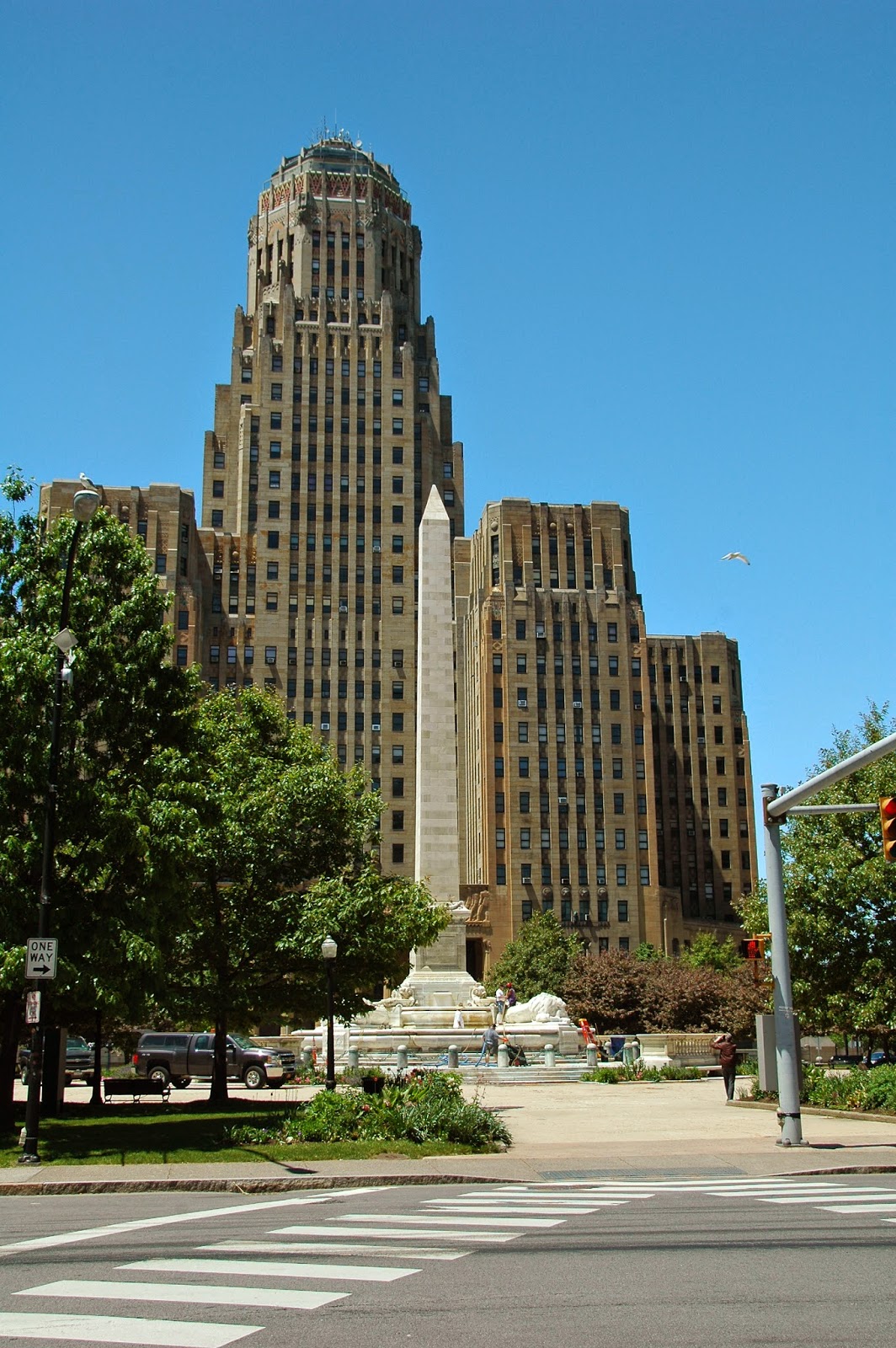
Buffalo Streetscape:  Downtown Buffalo is filled with great buildings.  The photo is of the Buffalo City Hall, an art deco masterpiece that is on the National Register of Historic Places.  And it’s surrounded by buildings that are equally striking.  They bespeak of a time when Buffalo was among the leading cities in the country.

But the sidewalks of Buffalo are oddly quiet.  The occasional pedestrians appear lonely among the tall buildings.  And they can jaywalk with ease because of the paucity of cars.  A fellow CNU attendee expressed it well.  “It’s as if we’ve come upon the abandoned city of a great civilization.  But we aren’t the first to arrive.  Others arrived before us and are now slowly beginning to repopulate the buildings.” 

Buffalo Weather:  Buffalo is well-known for its weather, particularly the “lake effect” snowfalls of wintertime.  On the opening evening, I chatted with a member of the local host committee and asked about the snow.  He acknowledged that it gets deep, but also noted that Buffalo knows how to deal with snow, so the city still functions well on most days.

Besides, he noted, “No one stays home when it snows heavily.  Those are the nights when you have to be at the pub with your friends, watching the snow pile up.”  That seemed a fine measure of civic life.

Buffalo Skyway: The outgoing CNU president and CEO, former Milwaukee mayor John Norquist, has been using his political capital to advocate for the removal of urban freeways where surface boulevards can provide the same traffic function.  Norquist argues that conversion to boulevards would eliminate community dividers, improving civic life and bumping property values.

In the Bay Area, removal of the Embarcadero Freeway and replacement of the Central Freeway with Octavia Avenue are examples of the kind of urban transformations that Norquist is seeking.

(In the North Bay, I’d suggest that Highway 12 east from Santa Rosa toward Bennett Valley is another freeway segment where the community would be better served by a boulevard.  And also perhaps Highway 29 through Napa.)

Given that background, it was interesting that the opening night function was held at First Niagara Center, immediately adjoining the Buffalo Skyway.  The Skyway is among the prime targets of urbanists who argue that the flyover of the Erie Canal accomplishes little except sapping the life of the land beneath it.

I walked to First Niagara Center with a group of conference attendees.  As we approached the building, I noted a sign on the surface street beneath the Skyway, “Watch for Falling Debris”.  Looking up, the Skyway was the only possible source of debris.  Yup, I can imagine that constantly looking for hubcaps falling from the freeway fifty feet above is a damper on urban street life.  We hurried inside.

More moments will follow in the next post.

Greetings

Blog readership jumped with my last post.  A really big jump.   And darned if I know why.  I checked several possibilities, but none proved out.  Perhaps it was only because I included “CNU 22” in the title.  To be safe, I again included CNU 22 in this title.  And will continue to do so for the next few posts.

But regardless of why the new readers arrived, you’re welcome.  I hope you stay around.  I’ve been described as an urban generalist, touching at various times on land-use, density, traffic, transit, municipal finances, climate change, travel, and any other aspect of urbanism that catches my attention.  And I often try, with varying levels of success, to apply the information to my home territory, the counties that are arrayed around the north end of San Francisco Bay.

If you have any questions or comments, let me know.

Milestone

Early in the history of this blog, I noted when readership passed 1,000, 5,000, and then 10,000 pageviews.  Those milestones seemed to add validity to my early efforts, but I eventually decided that I needn’t note every landmark.

However, I passed 100,000 early this week and couldn’t let that milestone pass unnoted.  (I probably would have passed 100,000 even without the readership jump, but the new folks assured that I moved past the threshold with good velocity.)

Thanks to all the readers who have been part of the 100,000.  Thanks for coming back three times a week and for becoming part of the conversation.

Schedule Notes

The first couple of downtown/ballpark outings are nearly upon us.  Dates and places are below.  If you wish to join the outings, let me know.  We can coordinate on meeting places, etc.

San Rafael: Friday, June 13 – Pittsburg Mettle at San Rafael Pacifics, first pitch 7:05pm
Alameda: Sunday, June 15 – Sacramento Spikes at Neptune Beach Pearl, first pitch 3:00pm

As always, your questions or comments will be appreciated.  Please comment below or email me.  And thanks for reading. - Dave Alden (davealden53@comcast.net)

Monday, June 9, 2014

CNU 22: Shuffling Home from Buffalo

I recently wrote that I’d be traveling to the 22nd annual meeting of the Congress for the New Urbanism, familiarly known as CNU 22.  I’ve now returned from CNU 22, this year held in Buffalo, New York, re-inspired by the challenges and promises of urbanism.

Over the next few weeks and months, I’ll be writing about CNU 22.  Not with every post, but regularly.

Starting in my next post, I`ll offer a smattering of brief moments from CNU 22, the quips, bon mots, and quirky observations through which I’ll try to impart the feeling of attending a congress.

Later on, as I decipher my forty pages of dubiously-legible notes, I’ll dig deeper into individual topics that caught my attention, particularly those that have applicability to the North Bay.

For today, I want to touch only upon only few key points.

First is a matter of terminology.  From its beginning, this blog has added the tag of “new urbanism” to every post.  Within the texts of the posts themselves, I usually shortened my usage to “urbanism”, but the tag still contained the modifier “new”, with new urbanism signifying the attempt to apply to our contemporary world the successful elements of urbanism from earlier times.

But one of the themes of CNU 22 was that we may have gone too far in the identification of multiple strains of urbanism.  Lean urbanism.  Tactical urbanism.  Eco urbanism.  Landscape urbanism.  And many more, including new urbanism.  While each type of urbanism has valid insights to offer, the suggestion was made that we should focus on the “urbanism” that is common to all of us rather than on the modifiers that may seem to divide us.

 I concurred with the suggestion.  Starting with this post, my tag will become the single-word “urbanism”.  It seems to cut to the heart of the matter.

Next, listening to the experiences of many speakers led me to ponder my own urbanist activities.  By my nature, I’m most comfortable at a keyboard, tossing out ideas in the hope that a reader will grab an idea of personal interest and make something of it.

But changes aren’t made by being comfortable.  Plus, while I garner many nods of concurrence, there have been few examples of readers taking an idea between their teeth and running with it.

So I’ll begin putting more effort into implementing some of the ideas that I offer.  Not every idea, there’s not enough time in my day for that level of involvement, but some of the ideas.

Coincidentally, even before I departed for Buffalo, several activities were progressing to a point where my personal involvement was justified.  So my philosophical insight lined up well with circumstances.  Details about some of these Petaluma initiatives will be forthcoming in future weeks.  None will be world-changing in themselves, but the world is often best modified in small increments.

Lastly, the words of several speakers motivated me to remake a point that I’ve try to argue before, but never as well as I might have hoped.

Some supporters of drivable suburbia have tried to argue that urbanism is the movement of people back into urban centers.  The argument allows them to point to every example of gentrification dispute, infrastructure overloading, or transit deficiency as a failure of urbanism.

But it’s a straw man argument that they’re making.  People are moving into urban areas because of demographics.  Increasingly, the jobs are in urban areas.  Plus, the millennial generation is interested in lifestyles that are less car-dependent, preferring to spend their income on the newest tech devices, not car payments and parking.

Urbanism isn’t about the move; it’s about accommodating the move efficiently and effectively.  So the issues highlighted by urbanist opponents, the hiccups over gentrification, infrastructure, and transit, aren’t the failure of urbanism, they’re the failure of the community to recognize the need for urbanism and to implement it.

And that’s a failure that I’ll continue trying to help us overcome.

As always, your questions or comments will be appreciated.  Please comment below or email me.  And thanks for reading. - Dave Alden (davealden53@comcast.net)

Monday, May 26, 2014

Great Public Spaces Needn’t Be Owned by the Public

Most well-used public spaces are owned by the public.  When I talk with others of creating more energized public places in the North Bay, the initial assumptions are publicly-owned parks and downtown plazas.

Much of the reason for the assumption is that privately-owned public spaces in recent times are often dismal places.

As has been documented by William Whyte and others who have looked at the plazas of Manhattan, people rarely linger in most plazas owned by private corporations.  The problem is that the corporations were induced to provide public spaces in exchange for additional building height.  But having provided the spaces, they had no interest in maintaining a plaza which people actually used.  So they sought design solutions that would make the plazas as dreary and unfriendly as possible.  As a result, few folks find enough enjoyment to hang around.

Here in the Bay Area, the plaza in front of the Bank of America Building in San Francisco is an example of an unfriendly public space.

But there can be well-designed and well-used public places that are privately-owned.  Corporations that followed the concepts put forth by Whyte have often energized their plazas.  Examples in Manhattan include the CBS Building and Rockefeller Center.

Here in the North Bay, although not as fully energized as some may have hoped, Theatre Square Plaza is an example of a privately owned public plaza that offers some vitality.

Yet one more example, this one again in the state of New York, is Larkin Square in Buffalo.

The Project for Public Spaces, an organization that is well-aligned with the work of Whyte, interviewed the Zemsky family who own Larkin Square.  Having revitalized their obsolete industrial buildings and finding that they didn’t need as much parking as they had anticipated, the family began looking for other uses for the land that remained.  Trying to build a place that they would themselves enjoy and learning from the usage as the public space evolved, Larkin Square was the result.

The lunchtime office worker crowd, fed by a restaurant in the square, is typical of many better public spaces, but where Larkin Square excels is in the evening, when food trucks and free music can attract crowds of more than 1,000 people.

As Leslie Zemsky notes, the family couldn’t always justify the costs for Larkin Square based on the projected bottom line, but they were sure that building the square as an engaged public space would provide benefits to the family.  And they were right.

In describing the success of Larkin Square, the Project for Public Spaces notes their eleven steps for building great public spaces.  I’ve linked the eleven steps before, but they’re worth reviewing again relative to Larkin Square.  The concept of triangulation, the idea that site features can be configured such that strangers are induced to begin conversations, is particularly intriguing.

I’m writing about Larkin Square because the Congress for the New Urbanism will meet in Buffalo this year.  The 22nd annual conference, better known as CNU 22, will begin in Buffalo in a few days.  Having enjoyed and learned much at CNU 21 in Salt Lake City last year, I’ll be in Buffalo this year.  And with the conference closing party in Larkin Square, I’ll have a chance to look around the square myself. 

Based on the CNU 21 experience, I expect to rub shoulders for five days with inspirational urbanists and to return with lots to share, much of which will quickly find its way into this space.

As always, your questions or comments will be appreciated.  Please comment below or email me.  And thanks for reading. - Dave Alden (davealden53@comcast.net)