Showing posts with label parks. Show all posts

Friday, February 12, 2016

Cutting Edge May Be Cool, but Not the Best Use of Resources

In my last post, I wrote about how the High Line project in New York City is affecting the conversation about parks in North Bay cities. Some citizens suggest that North Bay cities should be capable of High Line-type projects.  However, the suggestion ignores the uniqueness of both the High Line setting and the deep pockets that were available in Manhattan.  The suggestion also overlooks that North Bay cities are facilitating park improvements that, when measured on a cost per resident basis, aren’t dissimilar from the High Line.

But it’s not only in the small to medium-sized cities where the High Line has undermined rational conversation about park priorities.  Metropolises, which might actually have the resources to chase after the High Line chimera, have also been influenced.  Below, I’ll offer three examples of big city projects that are trying to follow in the footprints of the High Line but which, although I’m sure I’d enjoy visiting the resulting parks, could well become poor uses of resources.

The Garden Bridge in London would be a pedestrian/bicycle crossing of the Thames, with much of the bridge deck dedicated to various forms of greenery, including theme gardens.  After an initial flush of enthusiasm, public ardor for the bridge soon began to fade as costs climbed, security rules were established, and periodic closures for corporate events were suggested as a way to balance the books.

In New York City, a proposed $130 million garden park on piers over the Hudson River has been dubbed “Treasure Island” by citizens.  (If the link doesn’t work, this Google search should have the article as its first result.)  The public response seems uncertain and the funding source isn’t obvious.

Lastly, with an idea that has dual parentage in the High Line and the closing of Times Square to cars, a New York City architecture firm is proposing the conversion of forty blocks of Broadway into a garden belt for pedestrians and bicyclists only.

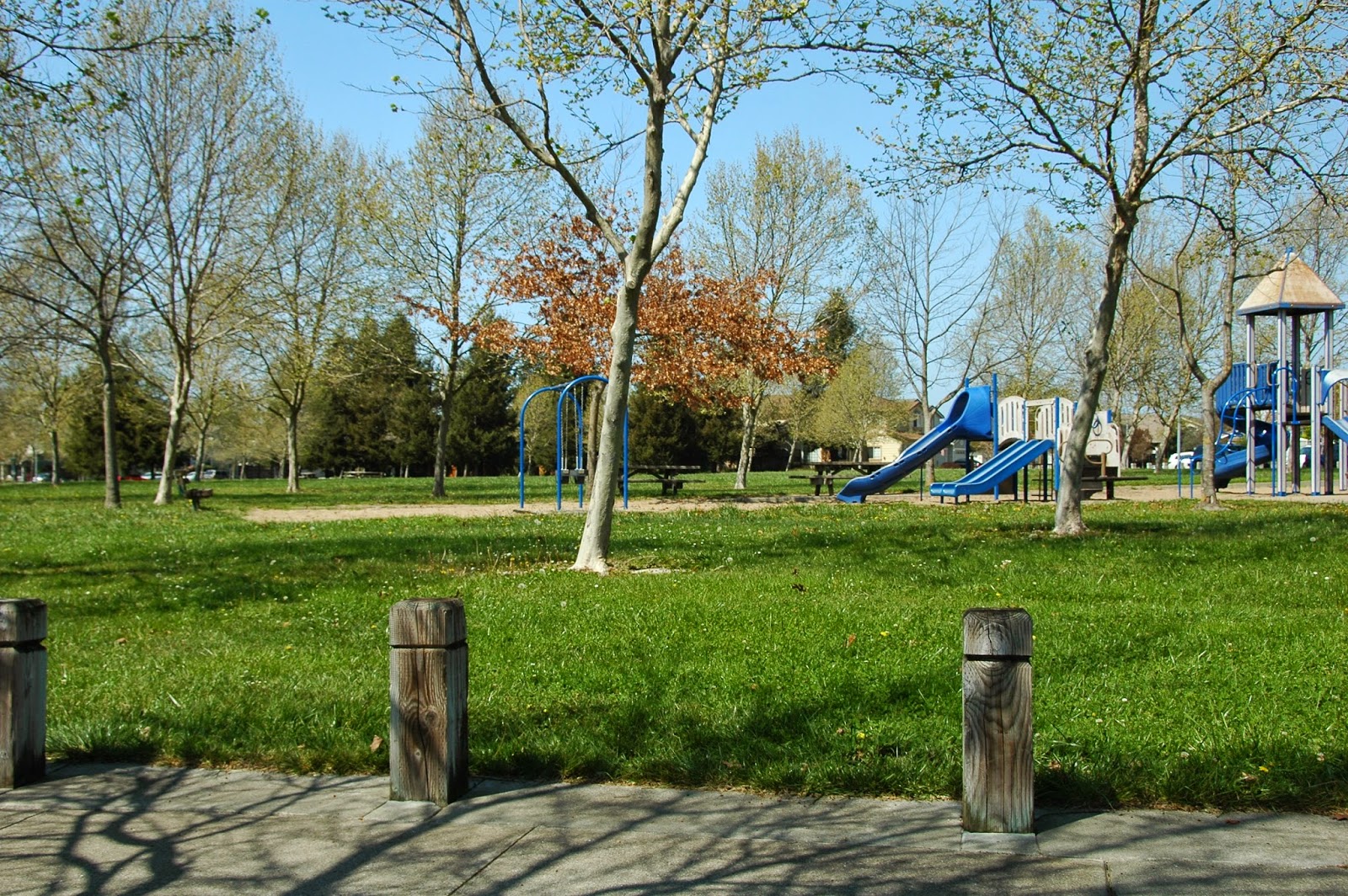
I think all three of the ideas would create enjoyable places, but I’m not convinced that any would be a good use of funds.  As a comparison, consider South Cove Park on the Hudson River side of Manhattan, near the tip of the island and adjoining Battery Park.  (All the photos are from South Cove Park.)

South Cove Park is a more conventional park, although still expensive because it’s occupying valuable real estate and because construction is always expensive in Manhattan.  Although not cutting edge like the High Line, it’s comfortable, well-used, and seemingly well-loved.  Also, it’s now part of the Big U of parks intended to help protect Manhattan from the surge of climate change-enhanced storms like Sandy.

Overall, South Cove Park may seem unexciting and conventional, but seems a better and less risky model for cities to follow, whether New York City or Santa Rosa, London or Petaluma.  The High Line is fun and creative, but many fun and creative projects are better left as one-offs.

I spent the earlier years of my career in the field of hydroelectric development, at a time that the rules for the permitting of hydroelectric projects were changing greatly.  One afternoon, I chatted about the evolving rules over a beer with an attorney for the Federal Energy Regulatory Commission.  His words about those eager to take advantage of the changing regulatory environment were “Those on the cutting edge often bleed.”

The High Line was a remarkable accomplishment, but attempts of others to seek similarly remarkable outcomes may result in blood at a time we can’t afford to bleed.

For my next post, I’ll return to induced traffic.  It’s a subject on which I’ve touched many times, but remains worthy of revisiting, especially as new information comes forth.

As always, your questions or comments will be appreciated.  Please comment below or email me.  And thanks for reading. - Dave Alden (davealden53@comcast.net)

Wednesday, February 10, 2016

Not Being Seduced by the Precedent of the High Line

High Line
Perhaps because I wasn’t yet writing this blog so wasn’t yet attuned to urbanist news, or perhaps because I simply wasn’t paying attention, New York City’s High Line sneaked up on me, both figuratively and literally.

It was a sunny Saturday morning in the summer of 2010.  Several of us had arrived a day earlier for a guys’ week of minor league baseball and hanging out.  To burn time until the last members of the party arrived, we were wandering Greenwich Village and the Meatpacking District.  As we turned a corner, my cousin asked me what I knew about the structure overhead, which seemed to be a mid-air park on a former elevated railroad.

Being a dedicated and informed urbanist, I responded, “Darned if I know.”

Luckily for us, we had lunch a few days later with a niece who was a thorough New Yorker.  (Calling my niece an urbanist would be like calling a fish an advocate of gill breathing.  Despite growing up in a prototypical drivable suburb, she was born to live an urban lifestyle, later moving from New York City to London and then to Berlin where she now lives with her husband and two sons, rarely using the family car, instead using transit, walking, and bicycling to travel within her adopted city.)

After our meal, she took my cousin and me for gelatos and a walk on the High Line.  Lemon gelato has never tasted as good as it did on that day, exploring the High Line and chatting with my niece.  I only regret that I’d left my camera in my hotel room.

I love the High Line and am thrilled that it exists as an example of creative urbanism.

At the same time, I often cringe at how the High Line has distorted the conversation about what’s possible in towns that aren’t New York City.

Several folks have asked me why we can’t do High Line equivalents in North Bay cities.  I generally offer two responses, which may seem mutually exclusive but are both valid, “You’re underestimating the unique circumstances of the High Line” and “How do you know we’re not doing North Bay High Lines?”

On the first, a comment I’ve heard is that what drove the High Line was the vision, with the remainder of the process quickly falling into place once the vision was found.

That suggestion is nonsense.  Yes, the High Line vision was startling and audacious.  All hail the vision.  But the visionaries also had perhaps the best rolodex in the world for civic improvements.  And they rode that rolodex hard, being willing to put other aspects of their life on hold while doing the fundraising.

Thomas Edison said that invention is one percent inspiration and 99 percent perspiration.  If one replaces “inspiration” with “vision”, the same equation can be applied to cutting edge parks.  And the folks behind the High Line showed their willingness to perspire with their tireless fundraising work.

Here in the North Bay, I’ve heard a few ideas that, if not High Line equivalents, are creative and intriguing.  But very few folks have rolodexes the equivalent of the High Line team and even fewer are willing to truly perspire.

Instead, we have folks willing to say “Here’s the vision.  Now someone else can implement.”  It’s an approach that neither understands the reality of the High Line nor can be successful.

On my second point about whether we might already be doing High Lines in the North Bay, it’s instructive to look at some numbers.

The cost of the first two completed High Line phases was $152 million.  The population of New York City is 8.4 million.  Thus, the High Line phases cost $18.10 per city resident.  Obviously, that doesn’t mean that everyone paid that amount.  Instead, much of the total came from large contributions and numerous grants.  But cost per person is a still a good yardstick of the size of a project relative to its community.

Walnut Park in Petaluma
Recently, the Petaluma Service Alliance, a collaboration of seven Petaluma services clubs, completed a facelift to the 130-year-old Walnut Park at the south edge of downtown Petaluma.

(Note: As a member of the Petaluma Recreation Music and Park Commission, I had a role in vetting the Service Alliance work.  There was occasional testiness on both sides during the process, largely as the result of organizational structures that have since been addressed.  I still believe that the facelift could have been even better than it was, but also respect the efforts of the Service Alliance.)

The cash fundraising goal for the project was $122,000.  Including the value of contributed materials and labor, plus the cost of the Parks employees who participated in the construction, it’s possible that the total value of the project may have been close to $250,000.

For the 58,000 people in Petaluma, that would be a cost per person of $4.30.

The cost per person is well less that for the High Line project, but if there were four Walnut Park-type projects, the total would start coming close.  And there are currently two other citizen-driven Petaluma park improvement projects moving toward implementation.  If one more can be added to that tally, Petaluma comes close to matching the High Line as measured by investment per person.

I expect that other North Bay cities can tell similar stories.

At the bottom line, the High Line was a unique opportunity in a unique setting.  Transplanting the idea elsewhere such as the North Bay is likely a dubious idea.  Nor are there many people willing put forth the level of effort expended by the High Line team.

But, if we change how we measure park improvements, the North Bay may still be getting High Line equivalent enhancements.  As the Rolling Stones sang, “You can't always get what you want, but if you try sometimes well you just might find you get what you need.”

The North Bay isn’t the only place where the lessons of the High Line have been misinterpreted.  Metropolises have also fallen under its false sway.  I’ll share some stories in my next post.

As always, your questions or comments will be appreciated.  Please comment below or email me.  And thanks for reading. - Dave Alden (davealden53@comcast.net)

Wednesday, March 11, 2015

Casting Shadows on Urbanism

Two posts ago, I introduced an argument put forth by renowned baseball analyst Bill James, who also comments with acuity and insight on any other subject that interests him.  In his non-baseball role, he contended in his book “Solid Fool’s Gold” that if infinite value is assigned to any single element of a complex decision, the resulting decision will be distorted.

As James describes it, any two values, no matter how individually worthy on their own, will eventually come into conflict.  Whether those values are honesty and modesty, cleanliness and punctuality, generosity and thriftiness, or any number of other combinations, there will be some set of circumstances that brings them into conflict.  When that conflict occurs, having the flexibility to balance competing objectives is essential.  And giving infinite weight to one of the values eliminates that flexibility.

In James’ monograph on the subject, he challenged the TSA airline safety measures implemented after 9/11.  He also noted the changing approach to the criminal justice system under the Earl Warren Supreme Court.

I thought his argument had merit and immediately applied it to a balancing of traffic congestion versus youth sports that recently occurred in Petaluma.

But then a possible better example came to my attention just a few miles south.  Although subsequent information seemed to undermine the value of the example, the story still contains lessons.

The tale begins in 1984 with the approval by San Francisco voters of Proposition K, the “Sunlight Ordinance”.  Under the terms of the ordinance, as interpreted and implemented by the San Francisco Planning Department, any proposed development that would shade any portion of a city park, no matter how minor the shading, requires a finding by the Park and Recreation Commission that “the shadow is determined to be insignificant or not adverse to the use of the park”.

Accordingly, the Commission recently denied a proposed affordable housing project that would shade 0.07 percent of an adjoining park.  0.07 percent!   It seemed a perfect example of a single value being assigned infinite value and resulting in a flawed result.

But then other information became evident, as might have been expected given the 30-year lag between the adoption and the first denial.  It seems that the Parks and Recreation Commission had regularly found shadows to be insignificant and/or not adverse, not tripping up a single project with that hurdle until this decision.

As a result of the long string of decisions, the Commission was coming under fire.  On this specific project in the Mission District, the neighbors were particularly adamant in their opposition and the applicant, based on other land-use activities, was considered odious by many so the Commission decided to finally flex their authority under the thirty-year-old ordinance.

So, it seems that the Mission District example had more to do with old-fashioned politics than mis-weighted decision elements.  However, it still provides an insight into how a poorly constructed entitlement model can lead to flawed decisions.

In the past, I’ve expressed a concern that historic preservation, as much as I enjoy historic settings and bemoan the loss of some buildings that I never had a chance to experience, can sometimes be given a weight that inhibits good planning and good social policy.

Also, I once lived in a county that had a very strict sunlight protection ordinance, although the focus of the rule was the access of sunlight to photovoltaic arrays, not to parks.  As I recall, single-family homes were allowed to cast no shade on neighboring lots beyond which would be cast by existing trees and by a hypothetical eight-foot fence at the property line.  The shading potential was to be calculated for the hour before and after solar noon on the shortest day of the year.  And that standard was absolute, with no exceptions for “insignificant or not adverse” impacts.

Applying the standard required astronomical calculating skills, three-dimensional geometry, and assumptions about how much shade a 70-foot pine tree actually cast.  All were interesting exercises.

And as much I approved the preservation of solar access for alternative energy generation, I wasn’t sure if the effect of spacing houses further apart, inhibiting walkability, was truly good public policy.

So even if the Mission District example didn’t quite make the point it first seemed, it and the other examples noted above still offer good lessons about how an entitlement process can go awry if we don’t allow competing objectives to be reasonably balanced.

And urbanism in particular would suffer under a flawed entitlement model.

It’s been about a year and a half since I wrote about the City Repair concept, a way of mobilizing neighborhoods to add character and function to their communities beyond what city hall can do.  It’s time for an update, which I’ll provide in my next post.  The results are mostly unimpressive, but there has been one unexpected success.

As always, your questions or comments will be appreciated.  Please comment below or email me.  And thanks for reading. - Dave Alden (davealden53@comcast.net)

Wednesday, October 8, 2014

Urbanism and Senior Living: Shedding the Extra Bedrooms

In recent weeks, I’ve been writing about the intersection of urbanism and senior living.  Thus far, I’ve largely focused on the forms that senior living can take in urban settings and the steps needed to encourage downtown senior options.

But I’ve also written that many seniors, even if they find walkable urban life appealing, are nonetheless stuck in drivable suburbia because there are few suitable urban options or because they can’t sell their current homes at a price adequate to support a move downtown.

Today, I’ll begin writing about how to bring touches of urbanism to those living their final years in drivable suburbia.

I don’t recall the speaker, but there was a particularly insightful moment on the subject of senior living at CNU 22, the most recent annual meeting of the Congress for the New Urbanism.  The speaker was digging into the statistics showing that many seniors prefer to “age in place”.

The aging in place sentiment is generally understood to mean that seniors wish to remain in the homes where they raised their families.  This understanding has launched many businesses focused on modifying homes with grab bars, providing essential in-home services, and otherwise facilitating seniors remaining in their long-time homes.

But as the speaker dug more deeply into the statistics, he found that many seniors weren’t necessarily thinking about the homes as the “places” where they insisted on “aging”.  Instead, they didn’t want to leave behind the neighbors with whom they had long friendships, the coffee shops where they spent Saturday mornings, or the butchers who cut their Christmas prime ribs.  Perhaps not all, but many seniors no longer cared about the five bedrooms and quarter-acre of grass where they’d raised their families.  They didn’t want to leave their neighborhoods.   Their neighborhood was their “place”.

Of course, in the American version of land use, there are rarely alternative homes within large-lot single-family neighborhoods that are suited to the elder years, so it’s not surprising that the seniors were unable to express their preference for neighborhood over home.  But it’s nonetheless a preference that should be recognized.

Of course, the problem with the preference is home size.  Even if seniors no longer have an interest in dusting and vacuuming 2,500 square feet of house, most neighborhoods don’t offer reasonable alternatives.

However, there are people trying to rectify that deficiency.  In classrooms at the New Jersey Institute of Technology, students are looking for ways to more gracefully accommodate aging.  One idea is to construct duplexes configured so the second unit can be rented out in the early years of marriage, occupied during the child-rearing decades, and then again rented out during the later years of life.

On a similar track, Witold Rybczynski wrote in his book “City Life” about his role in developing Grow Homes, narrow, shared-wall homes that are sold with the upper floors open and unfinished.  The intended buyers are young married couples who can divide and finish the upper stories to suit as their families grow and their specific needs become evident.

Of course, Grow Homes, as their name implies, are more suited to expanding families, but the flexibility to reinvent the upper stories can also meet senior needs, from convalescent rooms to apartments for caretakers to living accommodations for other seniors, creating a “naturally-occurring retirement community” or NORC as I described in a recent post.

Although not widespread, with most of the 10,000 units near Montreal where they were invented, Grow Homes have received wide acclaim.

Also in “City Life”, Rybczynski wrote about the town of Mariemont, Ohio, where the walkable core includes apartments suitable for young couples, small-lot single-family homes for child-rearing, and eldercare facilities, all of which combine into a place where one can live an entire life.  (Before someone else offers this fact, I’ll note that Mariemont was originally intended as whites-only, proving only that our forebearers were better at urban planning than at social justice.)

Accessory Dwelling Units (ADUs), commonly called “granny flats”, can also widen the range of housing options in a suburban neighborhood.  Whether stand-alone units adjoining primary houses or additions to existing homes, such as flats above garages, ADUs can provide a place where empty-nesters can make more suitable homes for their later years.  I’ve heard of seniors who have moved into a newly-added ADU and then rented their former homes to a young family.  (Personally, I once spent 18 months living comfortably in an ADU over a garage in a suburban neighborhood.)

The biggest impediment to ADUs is often impact fees.  Much like small downtown units, as described in my previous post, ADUs can have impact fees that exceed their true impacts, as unenlightened cities try desperately to balance books teetering precariously from the failed suburban experiment.

Lastly, I’ll refer back to an idea I offered in the spring, about reconfiguring under-used neighborhood parks to add, among other elements, small blocks of residential apartments.  At the time, my goal was to raise resources to make the parks more relevant to contemporary life, but a side effect would be creating places for elders, who no longer want their outsized homes, to remain in their long-time neighborhoods.

Adding smaller residential units to a suburban neighborhood doesn’t make it urban.  But it’s one small step in the right direction.  Having defined that step, I’ll write in my next post about adding non-driving mobility to suburbia.

As always, your questions or comments will be appreciated.  Please comment below or email me.  And thanks for reading. - Dave Alden (davealden53@comcast.net)

Monday, May 5, 2014

Summing Up on Neighborhood Parks – Part 3

After cogitating on neighborhood parks for weeks, I have a concept to propose, a concept that may surprise many.  And that’s fine.  Many ideas, some of which turn out to be far-sighted, elicit that initial response.

I’ve recently written several posts about parks, particularly the disappointingly low usage of neighborhood parks, the smaller parks that offer mostly open grass with few amenities and little parking and that are primarily intended to serve the surrounding single-family neighborhoods.


Now, it’s time to offer some thoughts about what might be done with neighborhood parks.

My ideas shouldn’t be considered a screed against neighborhood parks or parks in general.  Indeed, my thinking is the reverse.  Much like encouraging a talented friend stuck in a dead-end job to look for a better opportunity, I’d like to find a way for neighborhood parks to become better used and more essential to the functioning of their communities.

Nor should my ideas be considered the end of the discussion.  Much as many of us have come to urbanism by incremental steps and insights, my hope is that the thoughts I offer here can serve as stepping stones on the path to the best and most practical solutions.

Lastly, I’ll refrain from mentioning parks by name.  There were a number of parks that flitted through my brain as I wrote, some in Petaluma and some in communities far from the North Bay.  But to mention specific parks would risk getting bogged down in details and defenses.  Instead, I encourage readers to explore their own memory banks for neighborhood parks and to plop the template I propose onto those parks.

Here’s the primary idea.  If a neighborhood park is big enough, which probably means at least 3 to 3.5 acres, let’s consider adding a small multi-family building near one end of the park.

This shouldn’t be a standard multi-family box, but something with a particular character.  I’m thinking at least two stories and possibly three.  And fairly small in footprint, perhaps as little as 8,000 square feet.  With three stories, that would provide up to perhaps 15 to 20 residential units ranging in size from 600 to 2,000 square feet.

With the multi-story height, the building would become the focal point of the neighborhood, attracting attention toward the local “downtown”.

The range in unit size would attract a range of tenants, although a particular target would be the seniors who spent much of their lives in the neighborhood.

“Aging in place” is a popular mantra among those active in senior living.  But polls have shown that many seniors want to age in place not because they have a particular attachment to the home in which they raised their families, but because they want to maintain long-time friendships and to continue shopping in the stores they know.  For those seniors, selling the family home and moving into a comfortable apartment a block away might work perfectly.  For seniors who still hope to host family Thanksgiving dinners, 1,500 square feet might be perfect, while others, perhaps widowed, might be most happy in 800 square feet.

If some of the apartments were even smaller, perhaps little more than micro-apartments, they might also attract young and single teachers or police officers who are just beginning their working lives.

With a good mix of apartment sizes, I could see a dynamic community arising.

I’d also argue for at least two of the ground floor units to be configured for retail use.  Perhaps the retail use wouldn’t be financially reasonable at first, so the building owner would be allowed to rent the spaces for residential use in the early years.  But my hope would be that the spaces would eventually house coffee shops where neighborhoods would congregate on Saturday mornings and delis where harried parents could buy ready-to-serve meals after a late day at work.

Also, as Leghorn Park in Petaluma is possibly showing us, there can be symbiosis between retail and park uses.  We’re ultimately a social species.  We’re more likely to have a lingering cup of coffee in an outside cafĂ© if we’re overlooking a park full of laughing and playing children.

Also, provision should be made for adjoining bus stops.  They might not be used at first, but would allow plan for a future when a homeowner could buy a cup of coffee and then take the bus to the local rail station.

Parking would be a challenge.  Podium parking would be ideal, but financial realities would likely push toward tuck-under parking.

Now, let’s pull our focus back and look at site planning.  I noted that the multi-family building site should be near, but not at, one end of the park.  This configuration would separate small areas of the park from the remainder of the park.  For these small plots, I’d propose community gardens or other biologically productive uses.

A couple of years ago I wrote about a development in Davis called Village Homes.  I didn’t like the construction quality of the homes, but I thought there was much to emulate in the land plan, particularly the use of small parcels for community vineyards and fruit orchards.  It’s this kind of use that I’d propose for the small parcels separated from the rest of the park.

And in the larger part of the remaining park, I’d take hints from successful parks, such as Leghorn and McNear Parks in Petaluma, which offer a multitude of recreational opportunities.  It won’t be reasonable to assume that those multi-use successes can be endlessly cloned, but adding a few more recreational amenities to neighborhood parks would seem reasonable.  Basketball and bocce ball courts would be my top two suggestions, with sand volleyball close behind.  Of course, play equipment would remain as would grass areas for simple games of catch or three-flies-up.

Some may be asking how a city could afford these new improvements.  The answer is that a city need only spend a little seed money.

Let’s assume that a city proposes a new zone which allows multi-family housing to be integrated into an existing park and then conducts the process, including public involvement, to apply the new zone to an existing neighborhood park.   (Yes, I understand that public involvement would be filled with fireworks.  Many new ideas, no matter how well-founded, are greeted with skepticism.)  It’s even possible that grant funds would be available to defray most city expenses for this part of the development process.

The goal would be to present developers with a site where the development would be “by-right”, with the only remaining hurdle being site design and architectural approval.

For a multi-family site that is nearly entitled, a value per unit of $25,000 is often reasonable.  But this concept would require a different architectural and leasing approach.  If we use $10,000 per unit and assume 18 units, that would give us $180,000 in development value.  If instead of taking all cash, a city requires a developer to install the vineyard, fruit orchard, raised beds for community gardening, and/or sports courts, a developer might still bid perhaps $50,000 for the right to build and to own the apartments.

But a city would also collect impact fees from the new development, which may total close to $500,000.  Overall, a city could pocket something like a half-million dollars and get a park that would better suit the needs of its citizens.  Against the extent of the likely deficits looming before many North Bay cities, a half-million dollars may not be much, but it’d be a step in the right direction.  And it would move a neighborhood in a positive direction.

I expect that this idea is neither perfect nor likely to be well-received in most neighborhoods.  Indeed, I expect that a fair number of neighbors would be aghast.  But I like how it works on a number of levels.  Your input would be valued.  Ready, aim, fire.

As always, your questions or comments will be appreciated.  Please comment below or email me.  And thanks for reading. - Dave Alden (davealden53@comcast.net)

Friday, May 2, 2014

Summing Up on Neighborhood Parks – Part 2

In my previous post, I began responding to questions and comments made about earlier posts on park usage.  I’ll finish up with a few more responses before moving onto musings about alternative ideas for neighborhood parks in my next post.

To reiterate one point, parks matter to urbanists because walkability matters.  Even in settings that are more drivable suburban than walkable urban, improving walkability is a worthwhile goal.  And having parks as inviting, well-used places helps walkability.

From a regular reader who’s active in neighborhood affairsCommunity gardens came up at a recent town hall meeting.  One neighborhood mentioned the lack of community gardens.  Home gardening is one of my recently-found obsessions.  If a neighborhood feels the need for more gardens, I would like to help them with their vision.

McNear Park has a community garden, but I don’t know if other parks have community gardens.  It certainly seems a concept worth expanding.  I’m familiar with at least one local neighborhood park with land that hasn’t been developed because of a lack of funds and need.  A community garden would seem a reasonable option.  I’ll fold the idea into the suggestions in my next post.

From Justin Bollock in Petaluma Patch: I live close to Eagle Park and enjoy going there as an alternative to the very busy Leghorn Park.  I also agree with the benefit of daily interaction with nature.  Sometimes I will take an alternate route home just to drive by the park, even though I don't stop to enjoy it.

I think the primary driving force behind the decline in park usage by what I'll call "non adult-led groups" is the fact that parents don't feel as safe letting their kids out of the house without supervision as they used to.  That being said, my boys call Eagle Park "our park" and I am very grateful for it!!

For several years, my wife and I lived a short block from Eagle Park.  To this day, my wife calls it “Mollie Park” after one of our dogs, a stolid old Golden Retriever, who liked nothing more than doing a barrel roll into the grass of Eagle Park.

And I appreciate that Eagle Park can be a less hectic experience than Leghorn Park.  However, when I see a park sitting underused, I feel as I do when I visit a favorite restaurant on a Friday evening and find it nearly empty.   “Wow, we’ll get great service” is quickly followed by “Uhh, I hope they can stay in business.”

That’s not to imply that there are any thoughts of Petaluma closing parks.  Nothing of the sort is being considered.  But financial times remain tough for almost all North Bay cities.  Barring new taxes, tough decisions may need to be made in the future and I would expect that busy, well-used parks will be further from the chopping block.

Regarding safety, Justin is correct that parents seem more concerned about safety today than in the past.  However, statistics don’t bear out the concern, particularly with regard to the most frequent worry about abduction.  (As a recent speaker noted at a meeting in Santa Rosa, a child is equally likely to be struck by lightning as to be abducted by a stranger.)  Ironically, the greatest risk to a kid today is a vehicular accident during the walk to the park, hence the “Twenty is Plenty” argument.

An email from regular reader Steve Kirk:  Living near McNear Park, I access it daily and find it well-used and well-loved by the neighborhood.  I don't know why one park is successful and another not, but I suspect that contrivance plays a role.  By that I mean people feel comfortable in larger, more mature park-like environments than in spaces simply pretending to be "parks."

A multiplicity of uses and consequent critical mass is probably another key reason some parks are more successful than others. I use McNear Park to play catch with my daughter, throw the ball for my dog, play tennis in the courts, and sometimes use one or more of the picnic tables.  We no longer have a plot in the community garden, but when we did, I had to be there almost daily to water, pull weeds, and try to figure out why my plot was always more disheveled and less productive than the others.  That fairly large piece of green gets well used in many ways.  If you visit on any summer weekend day, you'll find literally hundreds of people filling the picnic end of the park.

One last thought: Built-in suburban "parklets" have the same underlying existential deadness that permeates the rest of those artificial auto-centric "communities."  If there's no place to comfortably and enjoyably walk, it's difficult to create a space that's comfortable and enjoyable to congregate.

Steve mirrors my thinking on many points.

Lastly, regular reader Dan Lyke, in a comment to my previous post, offered perceptive insights that were worthy of being excerpted hereIf you're middle-class without children, going to a park is a novelty.  If you're homeless, a park is a place you go when you don't have a home to hang out in.  Neither of those circumstances have the park as a place you'd want to regularly use. …

The park closest to where I live is Wickersham Park.  The communal uses for that park are things that people can't do in their own spaces. The kids are there hanging out because they can't talk freely or sneak in the occasional kiss at home.  …

We've built a number of neighborhood parks to be unsuitable for gatherings because we don't want noise, packs of teenagers, or whatever in our neighborhoods.  But if parks aren’t for communal gatherings, then they're just less convenient versions of our back yards.  At 20 homes per acre, these parks might be useful, but at 8 homes per acre, they're just inconvenient space.

Dan reminds me why I like having readers who look at the world through different lenses than I do.  They point out ideas that I’ve overlooked.

In my next post, I’ll try to combine everything I’ve learned thus far into ideas for making parks more useful.  My ideas won’t be perfect and ready for implementation.  They’ll only be intended to continue the conversation.  Urbanism is often a process, not a destination.

As always, your questions or comments will be appreciated.  Please comment below or email me.  And thanks for reading. - Dave Alden (davealden53@comcast.net)

Wednesday, April 30, 2014

Summing Up on Neighborhood Parks – Part 1

In recent posts, I’ve written about public parks in Petaluma.  As an urbanist, I care that parks are vital places, adding to the life of a neighborhood and a community.

To summarize the discussion thus far, I periodically observe five specific parks in my role on the Petaluma Recreation, Music, and Park Commission.  As spring approached, I expected to see more and more folks using “my parks”.  But I was instead disappointed in the small number of users.

So I began collecting data.  It wasn’t a rigorous scientific study.  I just began counting heads, taking notes, sharing the data, and looking for insights that would enlighten me.  Nor did I have a pre-determined conclusion.  As always, I was content to see where the data would lead.

Also, any insights, whether in earlier or future posts, only apply to a couple of categories of parks, not to the full panoply of park types.  In an earlier post, I described four types of parks.  Further observation had led me to add a fifth.

The first three types, natural parks largely used for hiking and mountain biking, parks for organized sports, and downtown plazas, are all interesting, but aren’t the subject of these observations.

My only focus was my last two types, neighborhood parks, which are typically large expanses of grass with limited recreational amenities and no parking except curbside, and what I’ll call multi-use parks, which are similar to neighborhood parks, but with more recreational amenities and off-street parking.

In my most recent post on parks, I suggested that neighborhood parks may be the result of flawed thinking about how we live, a type of falsehood that I described as “self-myths”.  The post elicited an unusual level of response, both on the sites where I publish and through email.  To keep the dialogue going, I’ll begin reproducing some of the comments below, with responses.  (Names are only provided where their use was made public or approved by the writer.  And some of comments have been edited down, although with the argument and voice preserved.)  Your continued participation in the discussion is welcome.

The first two comments were similar and can be addressed in a joint response.

 From “Unknown” on the “Where Do We Go from Here” site: “I think you underestimate the value of parks by using a fixed time as your system of measure.  What does the park look like at 7:00am when the family dog needs walking, a standing run or walk is scheduled, or an impromptu evening stroll happens?”

From a private email: “Your reasoning and your data collection both seem flawed to me.  I don't think a snapshot at a given time of day for a brief period of time really gets at what a park provides to the people that use it.  Do traffic engineers base their design for traffic lights on a single slice of a day?  I think they survey a given street for a full day and probably on multiple days of the week before reaching conclusions about traffic flow.  It might be better to spend a full day at the park and count the total number of people that spend time during that full day to get an idea of the variety of people that use the park, and the variety of activities they engage in while there.  The cumulative number gets closer to the truth of what kind of difference a park makes in peoples' lives.”

As a side note, I find it ironic to have traffic engineering suggested as a good model for determining anything.  Traffic engineering, because of the traffic study format not the individuals, has shared the responsibility for drivable suburbia.

For too long, we sized roads for peak periods.  Given a conflict between another travel lane for the afternoon traffic peak and a wider sidewalk that might accommodate a sidewalk cafĂ©, we chose the travel lane, with the primary goal of flushing people from the city to the suburbs.

It’s only recently that we’ve begun to accept traffic congestion as acceptable in urban cores.  Any suggestion that traffic engineering is a good model for park assessment triggers a visceral response from me.

With that rant concluded, there are several responses to be made.

I agree that total daily usage would be another valid measure of park usage.  But as long as a reasonable time is selected for instantaneous park tallies, either method is valid.  Indeed, there is likely a relatively fixed ratio between the two.

And I’ll argue that an instantaneous measure is better suited to how the human mind processes the data.  We can perceive how a small handful people in a large park at a particular moment would look.  But we can’t construct a mental image of a total number how a greater number of daily users might look.  Indeed, using daily total may lead us to overestimate impacts, both good and ill.

Using traffic counts as an example, most of us can probably conjure an image of what a street with three cars per minute at peak hour might look like.  It feels like a light traffic volume.  But a thousand cars per day sounds more ominous.  In fact, the two may well refer to the same street.  It’s more difficult to visualize daily totals and that visualization difficulty may lead us to false conclusions.

If you’re trying to decide whether to preserve a park, or to build a new street, daily totals would likely be useful.  But if the only goal is comparing the usefulness of existing parks, instantaneous data is likely more insightful.

So, that gets back to the question of whether early Sunday afternoon was a good time to take instantaneous counts.  I thought it was, but was willing to take more counts at other times.  The data follows:

Park Type:
Neighborhood
Neighborhood
Multi-Use
Multi-Use
Day of Week
Median Time
Five Neighborhood Parks (per park) (1)
Eagle Park
Leghorn Park
McNear Park
Sunday
12:30pm
6.4
---
---
---
Sunday
12:30pm
4.0
0
>100
---
Sunday
12:30pm
1.6
2
75
50
Saturday
5:00pm
3.2
4
30
>90
Sunday
4:30pm
14.0 (2)
4
>100
>80
Monday
5:00pm
9.4
4
>75
44
Monday
7:00pm
1.0
4
10
15
Tuesday
1:30pm
2.0 (3)
4
11
3

Notes:
(1)    No deceit is intended in the lumping together of my five parks or in leaving them nameless.  I have a personal relationship with the parks and don’t want to make them or their neighborhoods feel badly.  Plus some of the early data was combined and the underlying data is no longer available.
(2)    This unusually high data point, although still far short of Leghorn and McNear, was driven by a 40-person family picnic at one of the five parks.  Seeing that much activity nearly brought tears to my eyes.  But it remained an outlier.
(3)    This data point was the driven solely by a ten-person outing of developmentally-disabled young adults, which is a fine park use.  But the group was about to leave as I arrived.  If I’d been five minutes later, I would have recorded all five of my parks as empty.

Some may be tempted to try further parsing the data.  I suggest that you don’t.  Every park is unique in its area, catchment range, features, and adjoining land uses.  It’s good data, but can’t be pushed too far.   Objective conclusions would be an over-reach, although subjective conclusions can be made.

And my subjective conclusion is that my earlier finding that multi-use parks garner significantly higher use remains valid.  That doesn’t mean that neighborhood parks don’t fill a need, only that they don’t provide as much benefit as they might.  And that will be a topic on which I’ll continue, responding to more comments and suggesting a revised model in my next few posts.

Before closing, I should refer back to Unknown’s comments about strolling, jogging, and dog walking.  All are legitimate recreational activities.   But the first two more frequently use sidewalks and trails.  They may pass through a park, but truly don’t need a park.  Regarding dogs, I walk several.  Their needs are a few trees, the occasional front lawn, and other people and dogs to watch.  A well-maintained and well-used sidewalk often better meets their needs than a neighborhood park.

As always, your questions or comments will be appreciated.  Please comment below or email me.  And thanks for reading. - Dave Alden (davealden53@comcast.net)