Showing posts with label Congress for the New Urbanism. Show all posts

Wednesday, January 20, 2016

Putting My Money Where My Pen Is

Buffalo, site of 2014 CNU Congress
Local update: The first of three StrongTowns/Urban3 public meetings was held last evening in Santa Rosa.  The room was nearly filled for Chuck Marohn’s current version of the StrongTowns Curbside Chat.  Thanks go to all from the North Bay folks who made the effort to attend, especially those who responded to the urgings of this blog.

Seats are still available for the remaining two meetings, at which Urban3 will elucidate lessons from the Santa Rosa property tax data, followed by StrongTowns and Urban3 jointly talking about next steps.  RSVPs may still be made through the link provided on this page.

After this week this complete, we’ll have the task of putting to use the newly gained knowledge.

Today, I’ll return to a topic that I’d hoped to cover during the final week of 2015, before the upcoming StrongTowns/Urban3 meetings snatched my attention away.

As Chuck Marohn noted last evening, the best thing anyone can do to promote sustainable municipal finances through urbanism is to talk with friends and neighbors.  The second best thing is to participate financially, through memberships or donations, with the organizations doing advocacy.

I believe in doing both, especially when the organizations provide content that I regularly quote in this space.

So on New Year’s Eve, I began new memberships, renewed old memberships, or made donations to the following organizations.

StrongTowns: It would have been awkward to start this list anywhere other than with StrongTowns.  I may not agree with every detail of the StrongTowns philosophy (as noted here), but I’m convinced that they are largely on the right track.  They’re also building a solid community of proponents.  For new converts to urbanism, I’d suggest starting with StrongTowns, while also maintaining the intellectual freedom to differ on occasional points.

Congress for the New Urbanism: It was tough to downgrade the CNU to second spot on this list.  They were the first organization to which I felt an urbanist affinity.  And my travels to the annual CNU Congresses have become a highlight of my urbanist life, a position it will retain for awhile with the 2016 and 2017 destinations of Detroit and Seattle, the first a city that I want to see after the fall and the latter a former home and still favored place.

But StrongTowns provides a more embracing community of followers, which should be an essential element of an urbanist organization.  I enjoy the breadth of folks who attend a CNU Congress, but have more in common with the StrongTowns members.

Those who listened to the end of the Chuck Marohn/James Kunstler podcast I recently linked heard a conversation about CNU.  I think it was Marohn who suggested that CNU is now in the midst of an existential crisis.  Having been founded to put urbanism back in the city planning toolkit, having succeeded at that goal, and now realizing that the next step is making urbanism the dominant paradigm, CNU is facing the question of whether they’re the right organization for this next step.  I hope they survive.  The urbanist world would be less vibrant without CNU.

SPUR: SPUR is an urban planning organization with deep roots in San Francisco.  Some of their research has impacted the North Bay, such as their study of transit connectivity, but their focus has remained primarily San Francisco.  However, with studies showing that the financial strength of outlying communities depend on the strength of the cities at their core, supporting SPUR seemed important to a North Bay urbanist.  Also, SPUR recently opening an Oakland office showed that they were moving toward a more regional perspective.

Greenbelt Alliance: When I recently wrote that there are multiple goals that urbanism can pursue, one that didn’t make the top of my list but is nonetheless important is green space preservation.  (And like the other goals of urbanism, it also finds that density is a reasonable path to that goal, with more dense development patterns requiring less encroachment into open space.)

The Greenbelt Alliance is the leading Bay Area voice for green space preservation.  Having also made common cause with the regional director for Greenbelt Alliance on several issues, giving a year-end donation to the Greenbelt Alliance was an obvious step.

Smart Growth America: I’ll conclude with Smart Growth America, which tackles a number of urbanist issues from transportation to downtown revitalization.  I have less personal involvement or commitment with SGA than with the other organizations, but their causes are my causes, so they have my financial support.

I haven’t written this with the goal of encouraging you to follow in my membership and donation footsteps.  But if your heart aligns with mine in favoring urbanism as a route to solve multiple modern-day issues from climate change to municipal finances, perhaps you should identify and support the organizations that best align with your vision.

Next time, I’ll write about riverside public art in Petaluma.

As always, your questions or comments will be appreciated.  Please comment below or email me.  And thanks for reading. - Dave Alden (davealden53@comcast.net)

Monday, May 11, 2015

Stories from CNU 23: Sixty-Eight Percent versus Four Percent

I’ve previously written that I recently attended the 23rd annual meeting of the Congress for the New Urbanism.  As was also true of the previous CNU conferences I attended, CNU 23 was filled with moments of illuminating insight.

Today, I’ll begin offering a few of those gems of urbanist thinking, along with a bit of elucidation as required.  It’s a path that I’ll follow for several posts.

Sixty-Eight Percent versus Four Percent:  I don’t recall who first noted the 68 percent versus 4 percent dichotomy, but it doesn’t matter.  It seemed that every other speaker had his or her own version of the statistic which pointed to the same issue, which is that 68 percent of the American public report that they would like to live in a walkable setting, yet only 4 percent of the current housing stock has a WalkScore of 80 or above.

Admittedly, there are a number of holes that one can poke in the statistic.  Perhaps some of the respondents expressed a preference for walkability along with a desire for a three-car garage or a home on a cul-de-sac, both of which can inhibit walkability.  Perhaps the WalkScore threshold of 80 was set too high.  (I live in a home with a WalkScore of 63.  My walkable retail options are limited, but schools for all grades from K through 12 are within short walks.  For a family with children, my home would be a great walkable solution.)

On the other hand, one could argue that the desire for affordable housing could actually go higher if the financial savings that should accrue to walkable settings weren’t being redirected by government policies that favor sprawl.

Regardless of the arguments that can be made about the exact numbers, with a spread of 68 percent versus 4 percent, it’s obvious that there’s huge disconnect between the housing that most people want and the housing that they’re being offered.  That disconnect was much of the focus of CNU 23.

Respect for Jane Jacobs:  I’ve previously written about how much respect the urbanist community has for Jane Jacobs.  She’s not the font of all urbanist thinking, but her seminal work “The Death and Life of Great American Cities” was a key step in getting urban thinking back on track after a series of unfortunate missteps.

An example of this respect was given by a Dallas civic leader who held introduce the speaker at the first plenary session for CNU 23.

Years earlier, the civic leader had organized an annual series of program on revitalizing downtown Dallas.  Securing high-quality speakers was one of her tasks.  One year, she put a full-court press on Jane Jacobs, flying several times to Toronto to implore Jacobs to attend.

When Jacobs finally agreed, the organizer turned her attention to Christopher Alexander, author of “A Pattern Language” which is considered a key document in the understanding the design details of good urbanism.  At first, Alexander demurred, claiming other commitments and work obligations.

The organizer then told Alexander that Jane Jacobs has agreed to participate.  After a long pause, Alexander replied “I’d walk to Dallas to meet Jane Jacobs.”  It must have been a fine program.

Poorly Assembled Mixed-Use: A key element of urbanism is mixed-use, by which urbanists mean walkable mixed-use, with the disparate elements of life located in adequate proximity that cars aren’t needed for many daily tasks.  One of the acknowledged founders of the New Urbanism, Andres Duany, noted how important the walkable term is by noting that “Sprawl is also mixed-use, poorly assembled mixed-use.”

Before closing, I should make a note about the Dallas transit system.  The system isn’t quite as cohesive as it might be, with some unfortunately long walks to transit stops, but it does provide effective service for many trips.  Using a bus ride and the Orange Line rail system, I was able to travel to and from my arrival airport for only $2.50 each way.  And the downtown walk to my hotel was only three short blocks.  I’ve love similar convenience and pricing in other cities.

However, for those of a certain age, the route back to the airport could be unsettling.  The Orange Line train passes right behind the former Texas School Book Depository, with its sixth floor museum, and then stops at the Parkland Medical Center.  If those locations don’t touch a nerve, ask your parents.  Or your grandparents.

In my next post, I’ll continue with stories from CNU 23.

As always, your questions or comments will be appreciated.  Please comment below or email me.  And thanks for reading. - Dave Alden (davealden53@comcast.net)
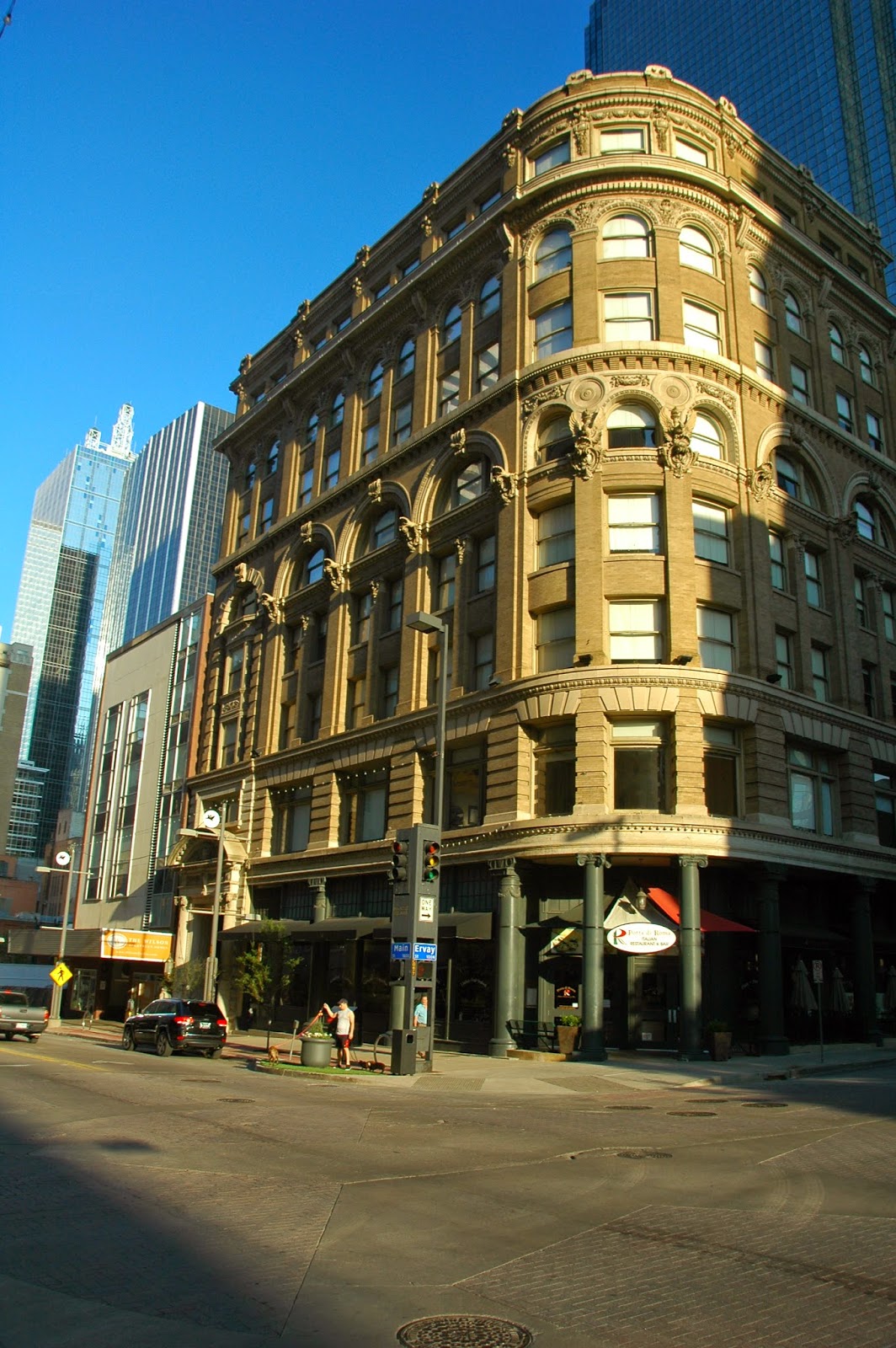
Monday, May 4, 2015

CNU 23: First Impressions

I’ve recently returned from the 23rd annual meeting of the Congress for the New Urbanism.  As always, I return wearied by the long days crammed with information and insights, but full of enthusiasm and new ideas that I’m eager to bring to bear on North Bay land-use issues.

My plan is for CNU 23 to dominate this blog over the next few weeks, but not to the exclusion of North Bay thinking.  I’ll try to walk the fine line between sharing my experiences and keeping an eye on local stuff.

Today, I’ll begin my thoughts from CNU 23.  Next week, I’ll offer a sampling of the best individual comments from the Congress, followed in later weeks by deeper explorations of the content.  But for today, I’ll write only about the theme that struck me most forcibly at CNU 23.

In the past, I’ve found the use of the word “Congress” to describe the group as a slightly curious, although acceptable, word choice.  In my thinking, I was using the “assembly” definition of “congress”.  But in a re-education that began with the first session I attended, I was educated that “Congress” had been selection intended in the more legislative sense.

A CNU Congress is intended as a place where the best and most insightful thinkers about land-use planning can gather to exchange perspectives, to seek common ground, and to consider compromises that give the best syntheses for contemporary urbanism.

(In a humorous note that was made several times during CNU 23, it was remembered that some of CNU founders thought that four Congresses should be sufficient to reconcile any differences and to settle on a single approach to urbanism.  Twenty-three Congresses have now been completed, the next two are already being planned for Detroit and Seattle, and the end of the Congresses is no longer discussed.)

My enhanced education began with Professor Emily Talen talking about the four disparate philosophies that have fed urbanism over the past century and continue to play roles today.  Her terms for the four streams were incremental urbanism, regional planning, zoning, and garden cities.  She traced the roots of each stream and then described the role that each has assumed in contemporary urbanism, including the tensions that remain between them.

This new and more profound understanding of the past and future of urbanism isn’t necessarily a comfortable place to be.  Talen’s vision of urbanism, although it includes bedrock principles, isn’t of a single formulation that can universally applied, but of a philosophy that must constantly evolve as new information is brought to the table and as new situations are faced.

My personal example of this thinking is the connection between climate change and urbanism.  Going back to the founding of CNU, and in my own experience as recently as 2011 when this blog was started, climate change has had a role in the urbanist conversation, but wasn’t necessarily the central factor.

This relationship between urbanism and climate change is now quickly changing, with climate change becoming perhaps the strongest argument for new urbanism.

In the abstract, I’m comfortable with this continual evolution although I find the constant sense of motion to be unsettling at times.

Following Talen, Andres Duany connected this on-going evolution to the CNU membership tallies.  As he described it, the membership total of CNU remains stable at about 3,000 people despite an annual influx of 500 new members.

Duany’s explanation is that 500 people also depart each year, many because of a difficulty of accepting the continual tension between the different urbanist streams.  His belief is that many of the former CNU members have instead joined groups that focus on single aspects of urbanism, such as complete streets or public places.

Duany doesn’t bemoan those who have moved on, but celebrates CNU as the place where cutting edge thinking continues to happen.

I look forward to sharing more about CNU 23 in the coming weeks.

Schedule Reminders

I have two calendar reminders today.

As described in my last post, the agenda for the upcoming meeting of the Petaluma Transit Advisory Committee touches upon aspects of transit funding and regional coordination beyond where the committee agendas often go.  As the committee chair, I can promise discussions that will give grist for further thought.  If this sounds interesting, please join us.  The meeting will be Thursday, May 7 at 4:00pm in the City Council Chambers at City Hall, 11 English Street.

Also, the regular monthly meeting of Petaluma Urban Chat will be Tuesday, May 12, 5:30pm at the Aqus CafĂ©, 2nd and H Streets.  I’m awaiting a couple of final confirmations so can’t yet announce the subject, but am planning a topic that I think will interest many.  For now, please put the meeting on your calendar and then look for more details two posts hence.

My next post will come from my recent travels.  My route to Dallas, where CNU 23 was held and where the photo of the public art was taken, was circuitous.  On my way to the Big D, I attended a family wedding in West Virginia, took advantage of a spare day to watch a ballgame in and to wander the downtown of Morgantown, and joined an old friend for an early evening tour of Pittsburgh.  The next post will describe a public plaza in Pittsburgh that caught my attention, although not necessarily in the way the designer intended.

As always, your questions or comments will be appreciated.  Please comment below or email me.  And thanks for reading. - Dave Alden (davealden53@comcast.net)

Monday, April 20, 2015

Urbanism and Gatherings of Food Trucks

I attended my first annual meeting of the Congress for the New Urbanism back in 2013.  CNU 21 was held at the Grand America Hotel in Salt Lake City, a massive and ornate hotel that tried to evoke an earlier and more elegant era of American hostelries.

Thus, I was surprised when the late morning session on first day of the conference ended with the announcement that lunch was available in a parking lot across the street from the hotel.  But all was soon clear.  Every midday for the duration of the conference, a collection of food trucks would assemble in the empty parking lot and we would lunch on a wide range of available cuisines while lounging on the grassy landscape islands.

The pizzas were good, but the star, at least to my taste buds, was the fried calamari.  I’ve never had better calamari than in a parking lot in the high desert near the foot of the Wasatch Range, hundreds of miles from any ocean.  I suspect the key was the paper thin slices of lemons that were fried and served with the calamari.

The convention center for CNU 22 in Buffalo didn’t have a location suitable for lunchtime food trucks, but the closing party was held at a privately-owned public space, Larkin Square, where the dining options were again food trucks.  I enjoyed a falafel while chatting about the finances of urban redevelopment with a Buffalo-area developer.

I don’t know the plans for the upcoming CNU 23 in Dallas, but expect that food trucks will again play a role.

I have that expectation because urbanism and food trucks make great companions.   Having progressed far from the time when they served sandwiches of processed meat on white bread and lukewarm coffee at construction sites, food trucks today are often near the cutting edge of culinary experiences.

And the mobility of food trucks allows them to serve neighborhoods that are evolving, but aren’t yet at the point where brick-and-mortar restaurateurs are willing to risk their savings on leasehold improvements.

Plus, food trucks can provide an ever-changing range of sometimes exotic culinary experiences, an important factor in neighborhoods that position themselves as trendy.

With the food truck culture taking root, the next step in its evolution has become semi-permanent locations where food trucks can rotate in and out, serving people who dine at communal tables and creating a community among the patrons.

In San Francisco, SoMa Streat Food Park was among the first to try to food truck park concept and found great success on 11th Street under the 101 freeway.

Emboldened by the success, the founder began to consider a second location in the Mission Bay area, between AT&T Park and the UCSF Mission Bay campus.  Mission Bay is a rapidly developing neighborhood, driven by the nearby tech industry, UCSF campus, and proximity to downtown.  The buildings may be fresh and new, but the street life is lagging.

The SoMa Streat owner broached his Mission Bay idea cautiously, expecting pushback from the newly-settled residents.  He was wrong.  The Mission Bay community was excited by the possibility, offering to give him their blessing before he was ready.  The residents saw the food park concept as a way to kick start the urban vitality of their new neighborhood.

After observing this trend from my vantage point in the North Bay, I’ve been trying to fold the idea into the Urban Chat plan for the possible reuse of the Fairgrounds in Petaluma.  The concept that resulted was a public plaza that could serve as a farmers’ market in the morning before transitioning to a food truck gathering place as the day wore on.

But the execution of that idea, even if it survives the many steps in the upcoming City/Fair Board negotiations, is at least a dozen years away.

But perhaps Petaluma needn’t wait that long for a food truck gathering spot.  Local resident Charles Hildreth has already met with Petaluma Planning about converting an unused area behind the AutoZone store on E. Washington Street into a food truck park.  His working name for the project is The Block.

I’m thrilled by the proposal.  I’ve long argued that the aging industrial area bounded by E. Washington, the Petaluma River, and the railroad tracks is a remarkable but underused Petaluma asset.  In “The Death and Life of Great American Cities”, Jane Jacobs writes of the need for older, low-rent buildings where start-up businesses can focus on their ideas without worrying about rosewood paneled walls.    The industrial area is Petaluma’s best stock of buildings that meet that description.  And it’s only a short walk from the soon-to-opened SMART train station.

I unsuccessfully suggested that updated thinking about the industrial area be folded into the Station Area Master Plan on the other side of E. Washington Street.  That suggestion may have failed, but the food truck park may become another way to give a boost to the underused industrial district.

As of this writing, I’ve been unsuccessful in reaching Hildreth, but am hopeful of having him participate in an upcoming Urban Chat meeting.

Look in this space for further details.  And go partake of a food truck meal today.  If you haven’t done so recently, you might be surprised.

Next time, I’ll offer some thoughts about the East D Street neighborhood of Petaluma, a fine little neighborhood that may soon be pushed to become even better.

As always, your questions or comments will be appreciated.  Please comment below or email me.  And thanks for reading. - Dave Alden (davealden53@comcast.net)

Monday, June 3, 2013

Congress for the New Urbanism, CNU 21

There are many organizations promoting new urbanism.  Smart Growth America, StrongTowns, and Reconnecting America immediately come to mind.  And that’s barely scratching the surface.

But the organization that first came to my attention, and that continues to hold a primary place in my thinking, is the Congress for the New Urbanism (CNU).  Its founders were among the leading lights in the early days of new urbanism and its “Charter for the New Urbanism” was the early manifesto.  Perhaps not up there with Martin Luther nailing his theses to the church door, but on the same list.

Shortly after I began this blog, a friend reinforced my interest in CNU and suggested that I attend a CNU meeting.  I didn’t give adequate weight to his advice and missed a CNU transportation conference last year in Long Beach that seemed to have been fascinating.

Unwilling to repeat the mistake, I returned late last evening from Salt Lake City where I attended the annual CNU meeting, CNU 21.  My friend was right.  It was inspirational.  And I met lots of great folks.

One blog post is inadequate to convey the breadth and depth of the meeting.  Instead, CNU 21 will be covered, explicitly and implicitly, in this space for long time.  But to whet your appetite for the urbanism buffet at which I feasted and am now eager to share, here is a partial list of memories and highlights:

·       The first morning, I found myself in the breakfast buffet line behind Ellen Dunham-Jones, the CNU Chair.  Dunham-Jones often jokes that she already has the urbanist name for the rock band she wants to lead in her next life.  I’d forgotten the name, so asked for a reminder.  It was the Underperforming Asphalt, a developer term for a parking lot that needs to be upgraded to a higher and better use.

To reinforce her rock dreams, she then did an air guitar rendition of the opening riff of a Talking Heads song.  As far as air guitar performances go, it was fairly sedate.  But one must remember that it was a breakfast buffet line.

·       Andres Duany, a seminal figure and now the aging lion of the urbanism movement, was in fine form for his plenary speech.  He argued that the American environmental movement had gone down a flawed path that, while successful for many years, was now running out of ideas.  He suggested that urbanism could be the savior of environmentalism.

When the CNU president tried to come onto the stage to tell Duany to wind up his speech, Duany asked for a show of hands of who in the audience wanted him to stop.  No one raised a hand.  The president accepted his defeat and returned to his seat.

·       Opticos, the consultant who helped develop the Petaluma Station Area plan, was honored with a CNU Charter Award.  The award was for work they’d done in Richmond, but the award spoke to the skill that went into the Petaluma plan.  For those who remember the Opticos team from the Petaluma meetings, the team members who were in Salt Lake City to accept the award were Dan Parolek, Ed Starkie, and Lisa Wise.

·       I watched the Charter Award while sipping on Wasatch Beers Polygamy Porter, subtitled “Why have just one?”  Salt Lake City has a surprising number of brew pubs.  I was consistently impressed by their quality.  I also noted, and several other folks confirmed, that, although the flavor was full, the alcohol content was surprisingly low.  (The Polygamy Porter is at only 4.0 %.)  The Salt Lake City brewing approach results in beers that can be enjoyed all evening with no ill effects in the morning, which is good for urbanism.  Many CNU folks did rigorous testing.

·       Charles Marohn, who did a video conversation with Petaluma Urban Chat in February, delivered the closing plenary.  It was much the same presentation that he shared with Urban Chat, with the addition of a several strong closing points.  The attendees gave him a standing ovation.

·       Last is a remembered picture of the closing party, held in a public space in the middle of a street in the Granary District of Salt Lake City.  (More about the location at another time.)  Duany, dressed in a vent-less cream-colored dinner jacket, was smoking a large cigar and looking with satisfaction over the gathering in which his career has had such a major effect. It was an image that will linger.

Perhaps the only downside of CNU 21 was the realization that I’ve been writing this urbanism blog for 18 months despite huge holes in my knowledge.  I think I’ve consistently tried to delineate the limits of my understanding.  But CNU 21 was a reminder to double and redouble my caution on that point.

For now, my primary goal at this point is to do justice to the knowledge that I gained last week.  And to figure out how to get to Buffalo in 2014 for CNU 22.

As always, your questions or comments will be appreciated.  Please comment below or email me.  And thanks for reading. - Dave Alden (davealden53@comcast.net)

Monday, September 24, 2012

CNU Transportation Summit

Sometimes I can kick myself.  Sometimes a marvelous opportunity is right in front of me and I overlook it.

At one time, I was considering a long weekend trip to Los Angeles.  I would have taken the Amtrak Coast Starlight into Union Station.  In Los Angeles, I would have used Metro to explore the urban area, south to Long Beach, east to Pasadena, west to Santa Monica.  And I would have caught a couple of ballgames before taking Amtrak back home.

But there were other events on my calendar and the plan drifted away.  Which was fine until I realized what I’d missed.  During the time I would have been in Los Angeles, the Congress for the New Urbanism was holding their Transportation Summit in Long Beach.  In a city that I would have been visiting anyway, I could have been attending a marvelous motivating three days.  My oversight remains a source of chagrin.

Instead, I was reduced to reading the enthusiastic tweets coming from Long Beach.  And the best I can do for you is to provide the best of those tweets.

Please note, not having attended, I can’t provide the data behind the statements below.  And some of the statements probably go beyond what the backup might justify.  But just being around people who believe the following quotes to be true would have been energizing, even if they were overstating their case.

Where I can, I’ve provided the speaker for the quotes.  But, the nature of Twitter being what it is, many of the quotes were tweeted without attribution.

Here goes:

"We have crushed the ability of children to move about in their own world."

“While fully fifty percent of children walked to school in 1969, fewer than fifteen percent do now.”

 “When you design your communities around cars, you get more cars. When you design around people, you get more people."

Peter Lagerwey: "100 million Americans don't drive. We can no longer ignore one-third of our population."

“How do we get mothers, sisters, and daughters to feel safe on bikes in cities?”

 “We should not be building ANY new automobile infrastructure."

“Driving is heavily subsidized.  Bike riders overpay to support roads by $250 per year; someone who drives underpays by $3,000 per year.”

“Who remembers the election when we decided streets should be designed for cars?  Nobody remembers, because it never happened!”

 “Hey, America.  Where's your class action lawsuit against 85 years of failed traffic engineering and millions of lives lost or ruined?”

Suja Lowenthal:  “Design streets and places for the most vulnerable users and you're truly making a place that's for everyone.”

“Transportation taxes are almost always about roads, roads, highways, and roads."

The plenary speaker was Mark Gorton, successful financial manager and founder of the website Rethinking the Automobile.  Among the gems in his speech were: “When the world is broken, reasonable people who say something's wrong sound ‘unreasonable’.”  “Restore human-oriented towns, strengthen and humanize downtown cores, and maximize livability.”  “We've accepted the mindset that the car is supposed to be dominant."  And “Transportation policies are subsidizing the destruction of our cities.”

Admittedly, some of those quotes go beyond what I believe or what I’ve been convinced is true.  But one doesn’t go to a conference to have one beliefs reaffirmed.  One goes to be challenged with new ideas.  I’m sorry I missed my opportunity to be challenged, but I’m already thinking about Pittsburgh in 2014.

As always, your questions or comments will be appreciated.  Please comment below or email me.  And thanks for reading. - Dave Alden (davealden53@comcast.net)