Showing posts with label Jane Jacobs. Show all posts

Friday, May 6, 2016

Jane Jacobs as Developer

Jacobs' Greenwich Village home
In my previous post, when I identified Jane Jacobs’ 100th birthday as my topic for today, I wrote that I might have missed the milestone except for a timely reminder from a correspondent.

I was wrong.  It would have been impossible to have missed the Jacobs commemoration.  The many insightful analyses of Jacobs’ impact on land planning would have grabbed the attention of anyone with even the least interest in the future of cities.

Nor was the Jacobs coverage limited to land-use wonks.  On Jacobs’ May 4 birthday, the Google search page graphic was a collage of Jacobs’ accomplishments, with her round face and round glasses under the Washington Square Park Arch, a landmark she preserved from the predations of her long-time antagonist Robert Moses.  I’ve often enjoyed the Google graphics, but never before wanted to frame one.

On the same day, Jacobs competed with Stars Wars Day (“May the Fourth be with you”) as a top trending topic on Twitter.

It was exciting to see how much of a mainstream figure Jacobs has become.

Among the land-use websites, the articles I found most interesting, all in CityLab, included Janette Sadik-Khan and Seth Solomonow writing about the need to continue the direction set by Jacobs in deemphasizing cars,  the concern of Kristen Capps that many invoke selected excerpts from Jacobs’ writings to oppose land-use changes that Jacobs would have likely supported, a reminder by Roberta Brandes Gratz that Jacobs was at heart an empiricist, not a prescriptivist, and that we need to retain the same perspective, and a concern by Richard Florida that Jacobs’ last published book, “Dark Age Ahead”, rejected by many as the pessimism of a woman in her declining years, was instead an insightful and accurate look ahead to social issues that have arisen since her death.

But the most remarkable revelation of the week was from Ben Yakas of the Gothamist.  Yakas reported a claim by one of Jacobs’s son that Jacobs helped Bob Dylan pen a protest song about Robert Moses, in the process teaching Dylan how to write protest songs.  Although it’s fun to think about Jacobs having put Dylan on the path to “Blowin’ in the Wind”, I’ll wait for Dylan to weigh in before believing it.

Through it all however, I found myself thinking back often to a story I first encountered in the Anthony Flint book “Wrestling with Moses” on the battles between Jacobs and Moses.

As Flint tells the story, after Jacobs and her allies beat back an attempt by New York City to do extensive demolition and redevelopment in her Greenwich Village neighborhood, Jacobs still had to acknowledge that the City was correct that her neighborhood was less dense than needed for a strong city.

 So Jacobs helped reassemble her team as the West Village Committee.  The Committee then set about the task of doing neighborhood-based and publicly-organized infill.  It was a model to which many urban neighborhoods likely aspire, but few can reach because of the organizational and financial challenges.

How did it turn out?  Not particularly well.  After long delays in assembling the right team of consultants, securing city approvals, and nailing down the financing, compromises had to be made in the architecture, including simplified roof lines and fewer windows, causing one architectural critic to describe the buildings as having “unrelieved plainness” and “basic dreariness”.  Also, the rents had to be set higher than hoped, frustrating many who had hoped to find new homes.

If a private developer had been in charge, the neighborhood would have been up in arms, complaining about the developer’s “greed” and lack of concern for the neighborhood.  And rhetoric seemed only slightly toned down when it was a neighborhood association, including Jacobs, doing the development.

Regular readers will know that I’m more sympathetic to developers than much of the population.  It’s not that I think all developers are great guys.  Some are despicable human beings who care only about the corporate bottom line, without a concern about the community they’re changing.  But many are decent people, trying to stay in business while also doing projects that conform to community goals.  Unfortunately, I must regularly cross swords with those who are too willing to put all developers in the first group and to readily believe the worst of all of them.

Thus, I’m perversely tickled that Jane Jacobs, who devoted so much of her life to improving the frameworks of communities, was tagged at one point of her life as a ne’er-do-well developer.  It proves my point that development is more complex and misunderstood than commonly perceived.

Of course, none of this is meant as a criticism of Jacobs.  I’m sure she did the best she could with the West Village Committee effort.  It’s just that she entered a field where almost everyone, rightly or wrongly, ends somewhat besmirched.  And that reality is more about us than about Jacobs.

 As an element of their commemoration of Jacobs’ 100th birthday, StrongTowns assembled an Urban Planner’s Oath, a compelling blend of Jacobs’ urban philosophies with the StrongTowns credo.  I like the Oath, but find myself troubled on one point.  I’ll cogitate for a couple of days and then share my thinking when I next write.

As always, your questions or comments will be appreciated.  Please comment below or email me.  And thanks for reading. - Dave Alden (davealden53@comcast.net)

Monday, December 21, 2015

Unintelligible Caterwauling Embraces Urbanism

Today’s post was planned to be about the “missing middle housing” in my neighborhood, the incremental housing units that add residents, thereby supporting walkability, without detracting from the feel of the neighborhood.  Unfortunately, a rainstorm arrived ahead of schedule, before I could collect the final photos I planned to share.  I’m not complaining about the rain, only its hasty onset.

In the absence of the photos, I’ll juggle my schedule and write instead about opera.  It may seem an odd fit for an urbanist blog, but all will soon be clear.

My sister loves opera.  One of her great joys in life is spending a Saturday in an ornate downtown theatre, watching a simulcast from the Metropolitan Opera House in New York City.

Personally, I don’t get it.  I find enjoyment in most forms of music, often having a broad range of music playing as I write these posts, from jazz to blues to rock to classical.  (My December playlist is a farrago of holiday music ranging from Ralph Vaughan Williams to Bing Crosby to Jethro Tull to Big, Bad Voodoo Daddy to the Puppini Sisters.)  But opera leaves me cold, most often sounding like unintelligible caterwauling even when in English.

I’m not making fun of those who enjoy opera, such as my sister.  I’m sure there’s value in opera.  I’ve known too many folks who loved opera and whose judgments I otherwise trusted.   They surely couldn’t have all been wrong.  It’s probably just that, much like with cricket, I don’t choose to spend the time educating myself to find the value in opera.   I’d rather ponder land use.

However, I may need to temper my thinking on opera because it and urbanism are about to meet.

I’ve written too often in this space about Robert Moses and Jane Jacobs to tally the mentions.   But this is my review of “The Power Broker”, Robert Caro’s master work about the decades that Moses wielded power in New York City, often unscrupulously, transforming the city to accommodate the automobile.

This is my review of “The Death and Life of Great American Cities”, Jacobs’ master work on how walkable urban neighborhoods work, written in her New York City home, shown above, at the same time that Moses was dominating the city.

And this is my review of “Wrestling with Moses”, Anthony Flint’s account of the clashes between Moses and Jacobs over plans of Moses that would have trampled New York City neighborhoods held dear by Jacobs.

(Note: All three posts were written in the early days of this blog, so give an opportunity to judge if my compositional capabilities have improved.  Personally, I find that my writing style and my ability to conceive and articulate complex, nuanced thoughts have both improved, but neither as much as I would wish.  Self-improvement is hard.)

The Flint book documents battles of titanic wills, a kind of stories that often attracts opera and now has.

As described by Sarah Goodyear in CityLab, a creative team with histories of past successes is developing an opera, “A Marvelous Order”, based on the conflict between Moses and Jacobs.  A preview is planned for the spring, with a full run then scheduled for a theatre in Brooklyn.

The structure of the opera is a love triangle with Moses and Jacobs both vying for the affection of New York City, although with the two figures not as towering ideals, but as real people.

However, the team seems to have more affection and respect for Jacobs.  As described by the director, “It’s more interesting artistically to see them both as human beings with strengths and weaknesses.  We are figuring out how to do it with Moses more easily.  Jacobs is more difficult.  She is just so darn right, so much.”

If the concept intrigues you, watching the video embedded in the CityLab article would be worth your time.  However, the operatic singing still doesn’t work for me.  I know it’s in English, but it still comes across as unintelligible caterwauling to me.

Given my apathy toward the art form, I won’t be booking a flight to Brooklyn to see “A Marvelous Order”.  But if the opera is successful enough to tour, or to offer a simulcast, I’ll partake, especially if I have a chance to review the libretto in advance so I’ll have a clue what’s being said.

Even if I never see “A Marvelous Order”, it still makes me smile to think that urbanist battles are now thought worthy of the operatic stage.  It’s proof that others see the value in the questions that matter to me and hopefully also to you.

In my next post, weather permitting, I’ll return to missing middle housing.  And if the weather doesn’t permit, I’ll figure out something else.

As always, your questions or comments will be appreciated.  Please comment below or email me.  And thanks for reading. - Dave Alden (davealden53@comcast.net)

Monday, May 11, 2015

Stories from CNU 23: Sixty-Eight Percent versus Four Percent

I’ve previously written that I recently attended the 23rd annual meeting of the Congress for the New Urbanism.  As was also true of the previous CNU conferences I attended, CNU 23 was filled with moments of illuminating insight.

Today, I’ll begin offering a few of those gems of urbanist thinking, along with a bit of elucidation as required.  It’s a path that I’ll follow for several posts.

Sixty-Eight Percent versus Four Percent:  I don’t recall who first noted the 68 percent versus 4 percent dichotomy, but it doesn’t matter.  It seemed that every other speaker had his or her own version of the statistic which pointed to the same issue, which is that 68 percent of the American public report that they would like to live in a walkable setting, yet only 4 percent of the current housing stock has a WalkScore of 80 or above.

Admittedly, there are a number of holes that one can poke in the statistic.  Perhaps some of the respondents expressed a preference for walkability along with a desire for a three-car garage or a home on a cul-de-sac, both of which can inhibit walkability.  Perhaps the WalkScore threshold of 80 was set too high.  (I live in a home with a WalkScore of 63.  My walkable retail options are limited, but schools for all grades from K through 12 are within short walks.  For a family with children, my home would be a great walkable solution.)

On the other hand, one could argue that the desire for affordable housing could actually go higher if the financial savings that should accrue to walkable settings weren’t being redirected by government policies that favor sprawl.

Regardless of the arguments that can be made about the exact numbers, with a spread of 68 percent versus 4 percent, it’s obvious that there’s huge disconnect between the housing that most people want and the housing that they’re being offered.  That disconnect was much of the focus of CNU 23.

Respect for Jane Jacobs:  I’ve previously written about how much respect the urbanist community has for Jane Jacobs.  She’s not the font of all urbanist thinking, but her seminal work “The Death and Life of Great American Cities” was a key step in getting urban thinking back on track after a series of unfortunate missteps.

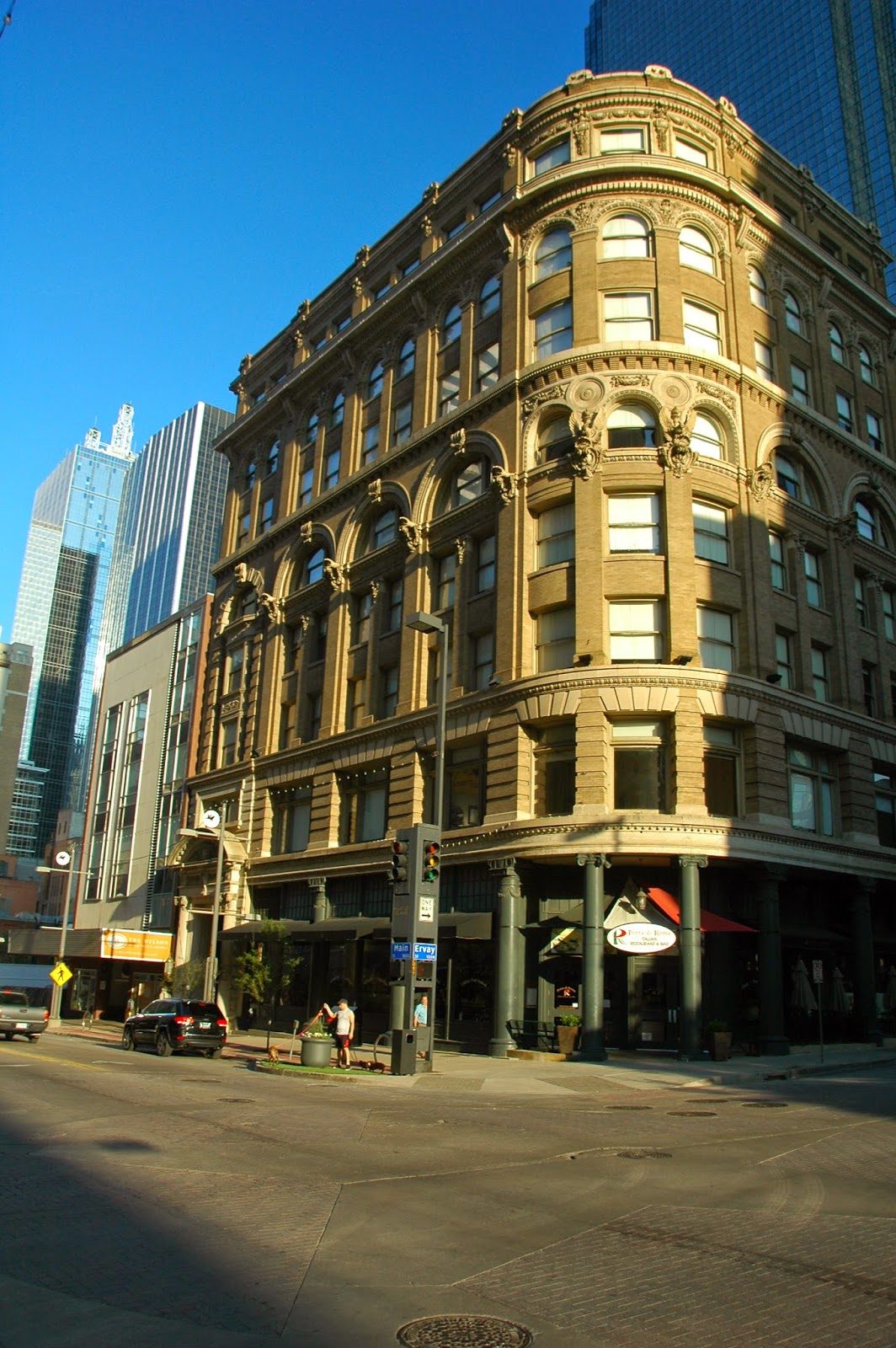
An example of this respect was given by a Dallas civic leader who held introduce the speaker at the first plenary session for CNU 23.

Years earlier, the civic leader had organized an annual series of program on revitalizing downtown Dallas.  Securing high-quality speakers was one of her tasks.  One year, she put a full-court press on Jane Jacobs, flying several times to Toronto to implore Jacobs to attend.

When Jacobs finally agreed, the organizer turned her attention to Christopher Alexander, author of “A Pattern Language” which is considered a key document in the understanding the design details of good urbanism.  At first, Alexander demurred, claiming other commitments and work obligations.

The organizer then told Alexander that Jane Jacobs has agreed to participate.  After a long pause, Alexander replied “I’d walk to Dallas to meet Jane Jacobs.”  It must have been a fine program.

Poorly Assembled Mixed-Use: A key element of urbanism is mixed-use, by which urbanists mean walkable mixed-use, with the disparate elements of life located in adequate proximity that cars aren’t needed for many daily tasks.  One of the acknowledged founders of the New Urbanism, Andres Duany, noted how important the walkable term is by noting that “Sprawl is also mixed-use, poorly assembled mixed-use.”

Before closing, I should make a note about the Dallas transit system.  The system isn’t quite as cohesive as it might be, with some unfortunately long walks to transit stops, but it does provide effective service for many trips.  Using a bus ride and the Orange Line rail system, I was able to travel to and from my arrival airport for only $2.50 each way.  And the downtown walk to my hotel was only three short blocks.  I’ve love similar convenience and pricing in other cities.

However, for those of a certain age, the route back to the airport could be unsettling.  The Orange Line train passes right behind the former Texas School Book Depository, with its sixth floor museum, and then stops at the Parkland Medical Center.  If those locations don’t touch a nerve, ask your parents.  Or your grandparents.

In my next post, I’ll continue with stories from CNU 23.

As always, your questions or comments will be appreciated.  Please comment below or email me.  And thanks for reading. - Dave Alden (davealden53@comcast.net)
Monday, April 20, 2015

Urbanism and Gatherings of Food Trucks

I attended my first annual meeting of the Congress for the New Urbanism back in 2013.  CNU 21 was held at the Grand America Hotel in Salt Lake City, a massive and ornate hotel that tried to evoke an earlier and more elegant era of American hostelries.

Thus, I was surprised when the late morning session on first day of the conference ended with the announcement that lunch was available in a parking lot across the street from the hotel.  But all was soon clear.  Every midday for the duration of the conference, a collection of food trucks would assemble in the empty parking lot and we would lunch on a wide range of available cuisines while lounging on the grassy landscape islands.

The pizzas were good, but the star, at least to my taste buds, was the fried calamari.  I’ve never had better calamari than in a parking lot in the high desert near the foot of the Wasatch Range, hundreds of miles from any ocean.  I suspect the key was the paper thin slices of lemons that were fried and served with the calamari.

The convention center for CNU 22 in Buffalo didn’t have a location suitable for lunchtime food trucks, but the closing party was held at a privately-owned public space, Larkin Square, where the dining options were again food trucks.  I enjoyed a falafel while chatting about the finances of urban redevelopment with a Buffalo-area developer.

I don’t know the plans for the upcoming CNU 23 in Dallas, but expect that food trucks will again play a role.

I have that expectation because urbanism and food trucks make great companions.   Having progressed far from the time when they served sandwiches of processed meat on white bread and lukewarm coffee at construction sites, food trucks today are often near the cutting edge of culinary experiences.

And the mobility of food trucks allows them to serve neighborhoods that are evolving, but aren’t yet at the point where brick-and-mortar restaurateurs are willing to risk their savings on leasehold improvements.

Plus, food trucks can provide an ever-changing range of sometimes exotic culinary experiences, an important factor in neighborhoods that position themselves as trendy.

With the food truck culture taking root, the next step in its evolution has become semi-permanent locations where food trucks can rotate in and out, serving people who dine at communal tables and creating a community among the patrons.

In San Francisco, SoMa Streat Food Park was among the first to try to food truck park concept and found great success on 11th Street under the 101 freeway.

Emboldened by the success, the founder began to consider a second location in the Mission Bay area, between AT&T Park and the UCSF Mission Bay campus.  Mission Bay is a rapidly developing neighborhood, driven by the nearby tech industry, UCSF campus, and proximity to downtown.  The buildings may be fresh and new, but the street life is lagging.

The SoMa Streat owner broached his Mission Bay idea cautiously, expecting pushback from the newly-settled residents.  He was wrong.  The Mission Bay community was excited by the possibility, offering to give him their blessing before he was ready.  The residents saw the food park concept as a way to kick start the urban vitality of their new neighborhood.

After observing this trend from my vantage point in the North Bay, I’ve been trying to fold the idea into the Urban Chat plan for the possible reuse of the Fairgrounds in Petaluma.  The concept that resulted was a public plaza that could serve as a farmers’ market in the morning before transitioning to a food truck gathering place as the day wore on.

But the execution of that idea, even if it survives the many steps in the upcoming City/Fair Board negotiations, is at least a dozen years away.

But perhaps Petaluma needn’t wait that long for a food truck gathering spot.  Local resident Charles Hildreth has already met with Petaluma Planning about converting an unused area behind the AutoZone store on E. Washington Street into a food truck park.  His working name for the project is The Block.

I’m thrilled by the proposal.  I’ve long argued that the aging industrial area bounded by E. Washington, the Petaluma River, and the railroad tracks is a remarkable but underused Petaluma asset.  In “The Death and Life of Great American Cities”, Jane Jacobs writes of the need for older, low-rent buildings where start-up businesses can focus on their ideas without worrying about rosewood paneled walls.    The industrial area is Petaluma’s best stock of buildings that meet that description.  And it’s only a short walk from the soon-to-opened SMART train station.

I unsuccessfully suggested that updated thinking about the industrial area be folded into the Station Area Master Plan on the other side of E. Washington Street.  That suggestion may have failed, but the food truck park may become another way to give a boost to the underused industrial district.

As of this writing, I’ve been unsuccessful in reaching Hildreth, but am hopeful of having him participate in an upcoming Urban Chat meeting.

Look in this space for further details.  And go partake of a food truck meal today.  If you haven’t done so recently, you might be surprised.

Next time, I’ll offer some thoughts about the East D Street neighborhood of Petaluma, a fine little neighborhood that may soon be pushed to become even better.

As always, your questions or comments will be appreciated.  Please comment below or email me.  And thanks for reading. - Dave Alden (davealden53@comcast.net)

Wednesday, March 4, 2015

Induced Traffic Comes in Different Flavors

On several earlier occasions, I’ve written about the phenomenon of induced traffic.  In one post, I used a hypothetical Yosemite campground to illustrate the theory.  Several months before that, I yielded the floor to walkability expert Jeff Speck for a video explanation of induced traffic.

But for those who aren’t yet familiar with the concept, I’ll offer this short explanation.  Drivers have a limited tolerance for congestion.  When they encounter congestion above their tolerance, they find another route, defer their trip to another time, or redirect themselves to a less congested destination.

Therefore, when new traffic capacity is provided, perhaps through the construction of additional travel lanes, drivers who were previously avoiding trips began again to take those trips.  The result is that congestion, after an initial drop, soon returns the same level that it had before the construction, even in the absence of new development creating new trips.

This is a non-intuitive result that conflicts with our instinctive expectation that additional traffic capacity should result in reduced congestion.  But if we seriously consider our own travel decisions, deferring trips when possible to avoid congestion, the validity of the theory soon becomes clear.

This is also where I mention Robert Moses, who grabbed the reins of New York City public works and held them for more than four decades through the middle of the 20th century.  Moses was known for claiming that just one more expressway, freeway, or bridge would make New York City traffic flow freely forever.  He passed away still believing the argument, having failed, despite forty years of contrary examples, to have realized the error in his thinking.

Luckily for us, the lesson that eluded Moses has finally been grasped in the years since his passing.  As I’ve previously written, California is changing its environmental assessment rules to reflect the reality of induced traffic.  And there is a wealth of research and writing spreading the story of induced traffic.

Writing in City Lab, Eric Jaffe offers a simple graph showing the induced traffic effect.  And he notes that the only solutions that can seriously address the phenomenon are transit, transit-oriented development, and congestion pricing.

In Wired, Adam Mann also takes a look at induced traffic, reporting the work of researchers who note that the reverse of induced traffic is also true, that reducing travel lanes doesn’t necessarily cause additional congestion.  (Referring back again to Robert Moses, those who have studied the tussles between Moses and pioneering urbanist Jane Jacobs, may recall their fight over Moses’ plan to run an expressway through Washington Park, claiming that the failure to do so would result in gridlock.  Jacobs won the battle, Washington Park was preserved, and congestion didn’t noticeably change.  It should have been a lesson to Moses, but he wasn’t good at lessons.)

Mann also reports the warning that induced traffic may only be true over a limited range of traffic conditions, although the range likely covers most real world situations.  If a city were to take a two-lane Main Street and convert it to a ten-lane thoroughfare, it’s likely that congestion would be slow to return.  But it’s also likely that the downtown would have been destroyed.

Into this increasing understanding of induced traffic, Adam Millard-Ball, a professor at the University of California, Santa Cruz, notes that, even before considering induced traffic, many of the trip projections for new development may be flawed.

Writing in Access, the transportation journal of the University of California, Millard-Ball reports on his research into the trip generation rates reported by the Institute of Transportation Engineers, the bible on which most traffic studies are based.  He finds that the ITE numbers are consistently and significantly higher than the actual traffic generation results.

He points to several possible causes for the discrepancies.  ITE standards call for only successful projects to be measured, ignoring that a percentage of land development projects fall short of full success and therefore generate less traffic.  Also, the ITE only reports absolute trip numbers when marginal rates would give a better picture in many situations.  As an example, a new grocery store in an underserved portion of town might result in fewer vehicle miles traveled as shoppers can drive fewer miles to serve their needs, but the ITE manual only reports the absolute number of trips.

Combining the growing understanding of induced traffic and the Millard-Ball insights on the ITE numbers, yields a paradoxical view of a possible land development.  A hypothetical developer could be obligated to pay for traffic improvements based on ITE rates.  But when the project stumbles, fewer trips are generated.  However, induced traffic quickly claims the unused new capacity, resulting in congestion being the same as before the project.  The public now complains that city hall failed to require sufficient traffic improvements of the developer, even when the reality is that he was probably docked for too many improvements.

It’s a tangled mess, which only serves to reinforce the need, as noted by Jaffe, for congestion pricing, better transit, and transit-oriented development.

And to add one final twist, most of the analyses look at lane capacity as being the traffic improvement being claimed by induced traffic study.  But other traffic improvements could apparently also be subject to the same phenomenon.

Here in Petaluma, the intersection of E. Washington Street and S. McDowell Boulevard is the busiest intersection in town and is often heavily congested.  There are frequent public calls for improved signal timing, including a recent article in the Argus Courier noting the concerns about the intersection and reporting the comments of City staff on the signal timing options.

I have two comments on the story.  First, I know the City staff quoted and believe that they’re truly doing their best to improve the intersection.  But even more importantly, the traffic signals would be subject to the possibility of induced traffic.  Even in the unlikely event that a change could magically add 20 percent more capacity to the intersection, induced trips would soon claim that capacity, returning traffic congestion to its current level.

There are no easy answers.

Next time, I’ll add another insight to the E. Washington Street and S. McDowell Boulevard intersection challenge, an insight that has broad applicability and tells us much about how we view traffic.

As always, your questions or comments will be appreciated.  Please comment below or email me.  And thanks for reading. - Dave Alden (davealden53@comcast.net)

Wednesday, February 11, 2015

Intro to Urbanism, Part Ten: Summing Up, Further Reading, and an Example Life

One of my favorite college memories, at least among those I can share publicly, is from my senior year.  I was in the living room of my student apartment, reclining in a beanbag chair, enjoying an Oly, and listening as I copied a vinyl album onto reel-to-reel tape.  (Did I mention it was the 70s?)

It was late in the school year.  Only a couple of weeks later, my roommate and I would be disturbed from studying for finals by the sound of students marching on our street, celebrating the fall of Saigon.  (Did I mention it was Berkeley?)

The record I was copying was “Flavours” by the Guess Who.  The album came late in the history of the Guess Who and foreshadowed their later rebirth as Bachman Turner Overdrive.  The earlier pop sound of the band was being replaced by a deeper, darker bass-oriented sound.  The song that was playing was “Long Gone”.  The few lyrics, that were more in the nature of tortured aphorisms in a low register, felt like they had to fight their way to the surface through the bass line, only to be immediately reabsorbed by the music.

As I was thus imbibing and listening, my roommate returned from class, tossed his books on the table, and headed to the refrigerator for his own beer.  But before popping the top, he cocked his head toward the music with a puzzled look.  “Who’s the group?”

“The Guess Who.”

“Doesn’t sound much like the Guess Who.”

Before I could a respond, the deep voice rose from the dark pool of driving bass.  “Who the hell are you to try and criticize?”

My roommate, flustered by the perfectly timed interjection, fumbled to reply.  “Well ... I ... um …”

The voice declared “You’re still learning how to form an opinion.”

Thoroughly flummoxed, my roommate sank onto the couch to drink his beer and to listen to the remainder of the album in silence.

My reel-to-reel tape player has long since slipped a belt.  It may remain in the attic, in a corner next to a dusty pile of reel-to-reel tapes including the one with “Flavours”.  Other than occasionally smiling about the time that my roommate was humiliated by a piece of vinyl, I rarely thought about the album over the years.

But then I bought the CD last fall.  And I worked it into my rotation as I was working on my New Year’s “Intro to Urbanism”.  And I soon found that “You’re still learning how to form an opinion” was haunting me.  Although in my case, it wasn’t so much forming an opinion as in expressing it effectively that was troubling.

Today is the conclusion of my New Year’s “Intro to Urbanism” series.  I’m pleased that I undertook the task.  And I don’t disown anything I wrote.  (Although I may soon take another stab at a definition.)

But I’m not satisfied with the effort.

Over the nearly 500 posts in this blog, I’ve learned how to polish a single idea and present it in a single post, most of which met my personal standards for logic and grammar.  I was selecting, polishing, and sharing a single pearl in cupped hands.  And I think I’ve succeed, at least moderately.

But the “Intro” was a different task, more so than I had realized when I blithely accepted the challenge.  It was assembling a string of pearls of matching styles.  And I underestimated how different that would be from writing single posts.

I don’t regret making the effort.  I only regret not doing better for those who follow me.  But I’m not surrendering.  I’ll work and rework what I wrote this year, with a better understanding of the task, and be ready with a new and improved “Intro” for January 2016.  I can’t allow the words from a long ago Guess Who song to haunt me again.

Summing It Up: Whatever misgiving I may have about the total product, I’ve reached the end of “Intro to Urbanism”.  After presenting my modest credentials, I offered a definition for urbanism.  (That’s the definition I may rework.)  I explained why urbanism matters, digging deeply into the finances and also touching on energy usage.  Lastly, I wrote about how public places, streets, and buildings function differently in an urbanist world.

All that remains is to provide ideas for those who are motivated to do further study.

Organizations: Although there are a great many organizations doing fine work, I find the material that speaks best to me at the Congress for the New Urbanism, StrongTowns, Smart Growth America, and Project for Public Places.  For a couple of those organizations, some of their material is behind paywalls, but the free stuff is still worth your attention.  Plus, joining is also a good idea.

Books: If you prefer to hold stuff in your hands, even if it’s an e-book, “Suburban Nation” by Andres Duany, Elizabeth Plater-Zyberk, and Jeff Speck is often cited as a starting point for modern urbanism.

“Happy City” by Charles Montgomery writes persuasively on how the drive to suburbia hasn’t made us happier.

“Walkable City” by Jeff Speck is a small gem of a book, imminently accessible yet powerful.

If you prefer to have your activism fueled by moral outrage, “The Geography of Nowhere” by James Howard Kunstler might meet your need.

Finally, “The Death and Life of Great American Cities” is the legitimate capstone of great urbanist reading lists.  The insights of Jane Jacobs ring as true today as when she wrote them over fifty years ago.

But the concepts in Jacobs’ masterworks can be complex.  I usually recommend starting elsewhere and working up to Jacobs.  However, I have a reader who, intrigued by my blog, secured a copy of Jacobs and plowed right through it.  It was something like learning to swim by leaping from the high dive.  But the reader survived just fine and has become a strong-willed advocate for urbanist causes.

Twitter: Okay, there’s a lot of superfluous fluff on Twitter, but there’s also a lot of great stuff if you can be discerning.  I’d start my urbanist follow list with Chuck Marohn of StrongTowns (@clmarohn), Brent Toderian, former chief planner for Vancouver, B.C. (@BrentToderian), and Jeff Speck (@JeffSpeckAICP).  If you check in just once a day and follow a link provided by just one of these folks, you’ll soon learn much.  I promise.

This Blog: I won’t put myself anywhere near the level of the organizations, authors, and Twitter folks I’ve listed above.  But I try to highlight some of the best stuff they offer, sometimes connecting it to real world examples in the North Bay.  Plus I appreciate readers.  They’re my only compensation.  If you want to receive an email every time I publish a new blog, drop me an email at my address below.  Or just check in regularly.

Example Life: One last thing.  Some may have followed the “Intro” thinking that the theories were interesting, but that most people didn’t really want to live in an urbanist world.  To those folks, let me tell you about a recent conversation I had.

Over the holidays, I chatted with a lovely niece I rarely see.  She, her husband, and her two young sons were visiting from their new home in Berlin, Germany.  Our schedules overlapped for a short time on Boxing Day.

The two make an affluent couple.  The husband is unwinding from a fifteen-year career in international banking and is plotting his next moves.  My niece has been a successful graphic designer in New York City and London, and is now working to establish herself in Berlin.

So where and how do they live?  Quite happily in a 1,100 square-foot home on the sixth and top floor of a new building in a busy Berlin neighborhood.  They own a car, with twin car seats strapped in back, but find that most of their daily lives can be most easily accomplished on foot or on the extensive transit system.  And on the occasions when the car is the best option for an outing, they report that traffic is quite manageable because so many people are using transit or walking.

Nor is this their first time living a relatively urban lifestyle.  Their lives in New York City and London were similar.

My niece and her husband aren’t unique.  They’re typical of the coming generation.  And if we want our cities to thrive as the new generations take charge, we need to be paying attention.

Thanks for hanging around for the “Intro to Urbanism”.  Hopefully I’ve given you a good start toward understanding urbanism.  And hopefully you can build upon that start before a deep, disembodied voice accuses you of not knowing how to form an opinion.

Next time, I’ll share a recent program from Canadian television on the public health and mobility benefits of urbanism.

As always, your questions or comments will be appreciated.  Please comment below or email me.  And thanks for reading. - Dave Alden (davealden53@comcast.net)

Friday, January 2, 2015

Looking Back and Looking Ahead

(Note to regular readers: With a New Year dawning, it seemed a good time to play with the appearance of this blog.  What you see today is a work in progress.  I’ll continue to fiddle over the next week or so.  Your comments would be appreciated.)

In my last post, I presented my urbanist resolution for 2015.  I vowed to dig more deeply into the reasons why suburbia is failing and why urbanism is part of the solution.  I understand that most readers of this blog don’t need the further explanation, but I’ll be prepared for the skeptics who may wander through.

Pondering my resolution for 2015 induced me to revisit my urbanist resolutions of years past.  Doing so was insightful.  My first resolution in this blog was for New Years 2013.  I’d recently been called an urban generalist and I resolved to embrace the description.

I think I’ve succeeded as I’ve continued to probe a wide breadth of urbanist topics.  Indeed, I think a strength of urbanism is that it has so many facets and seems a remedy to so many challenges.  In my effort to remain a generalist, it sometimes feels as if I’m walking a fine line between being an urbanist renaissance man and being an urbanist with an attention disorder, but I’m okay with tiptoeing.

For New Years 2014, I laid out a number of goals, from writing better to becoming more active in the community to doing more advance study of urbanist destinations before traveling.  I can’t claim to have fully succeeded at any of the resolutions, but nor do I think I’ve failed at any.  Instead, they remain a comprehensive checklist which I can continue to monitor as long as this blog continues.

Of course, urbanist resolutions are only as important as the changes one hopes to induce.   The New Year’s Day issue of the weekly Petaluma newspaper provided a remainder of the progress that urbanism has made and the challenges that remain ahead.

On the front page of the Argus Courier is an article about the automated vehicle locating (AVL) system that will be implemented on Petaluma Transit buses during 2015.  The article notes with approbation the improvements that the AVL system will bring to the passenger experience, from real time information about bus locations to better management of transit center connections.

But as a member of the Petaluma Transit Advisory Committee, I know that the AVL can have deliver even broader benefits, such as improved data about passenger loading and off-loading locations, allowing the transit staff to respond more quickly with schedule adjustments to meet the changing needs of the community.

A transit system that can compete with cars is an essential component of urbanism.  The AVL system will help Petaluma Transit provide that competition.

Elsewhere in the newspaper is a story on the approaching opening of the Big Easy, a jazz club on a downtown alley that is intended to evoke the era of the 20s and 30s.  Urbanism needn’t include gin joints, but a gin joint emulation makes a lot more sense on a downtown alley than in a suburban strip mall.  It’s great to see creative uses coming to downtown Petaluma.

But just when those two stories make it seem that urbanism is making good progress in the North Bay, there’s an Argus Courier article, reprinted from the North Bay Business Journal, about Deer Creek Village, a new shopping center on the east side of Petaluma.  In the first sentence, the project is described as “Petaluma’s premier mixed-use infill center.”

I’m forced to agree with the “infill” description.  Deer Creek does occupy a tract of land that had been left vacant as development occurred around it.  But I’d prefer that “infill” be saved for small parcels in more downtown locations, where the infill can buttress walkability and lead to truly walkable urban places.

However, my real objection is to “mixed-use”.  Perhaps Deer Creek Village meets that zoning code definition of mixed-use, but only because the zoning code is hopelessly deficient on the point.  Jane Jacobs, who did so much to highlight the benefits of mixed-use, described it as combination of uses intended to provide active users and watchful eyes on the sidewalks for many hours of the day.  A shopping center, especially one that doesn’t include any residential uses, can’t possibly meet that standard of mixed-use.

A world in which Deer Creek Village can be described as “mixed-use” is a world in which urbanist resolutions are still desperately needed.

Luckily, there’s always hope.  In the words of Jacob Riis who highlighted the social needs of New York City at the dawn of the 20th century, “When nothing seems to help, I go look at a stone-cutter hammering away at his rock perhaps a hundred times without as much as a crack showing in it. Yet at the hundred and first blow it will split in two, and I know it was not that blow that did it, but all that had gone before."  It’s a fine image for 21st century urbanists to keep in mind.

Several weeks ago, I reported a suggestion that I occasionally offer a helping hand to those who are interested in urbanism, but may need a reminder of the basics.  Although unworthy of providing of a comprehensive introduction to urbanism, I can provide a summary of the subject as I view it.  A multi-part introduction to my personal view of urbanism will start in my next post.

As always, your questions or comments will be appreciated.  Please comment below or email me.  And thanks for reading. - Dave Alden (davealden53@comcast.net)

Friday, December 12, 2014

Promoting Fine-Grained Urbanism

A few years back, I became acquainted with a Sacramento architect who was working as a project manager for a land development company.  Over lunch one day, he told me about selecting architects for conceptual designs on an adjoining pair of sites owned by his company.

The development company focused on less prosperous neighborhoods, trying to spur economic rebirth through well-conceived infill projects and then prospering from the revitalization.

The two parcels were in a neighborhood that had once been prosperous, but had fallen on hard times.   He and his firm were hopeful that the two building projects, which would be on lots for which the previous structures had long been demolished, would help spur better times.

When the project manager and I had lunch, his two architects were just beginning work.  But my lunch companion had made an unusual decision.  He had refused to advise either architect of the other’s identity, so neither knew who was working next door.

The two consulting architects were discomfited by his decision, and perplexed.  They were continuing to argue that the two concepts needed to be prepared in tandem, so the two buildings could work together in harmony.  But the project manager held firm.  He had specified broad parameters for the two buildings, including the height and massing consistent with the zoning code and the developer’s market perceptions, the use of brick for the exterior surface, and the floor elevations for the upper stories.  But he wanted two independent designs, so wouldn’t introduce the two architects.

There was a valid reason for his surprising decision.  His goal was a fine-grained, organic urbanism that would benefit the neighborhood over the long-term.

He perceived a future, perhaps fifty years hence, when one of the buildings might feel dated and worn, while its next-door neighbor, because of a different architectural approach, still retained vitality.  The owner of the less successful building, emboldened by the continued success of his neighbor, would be motivated to invest in a remodel, allowing the neighborhood to bootstrap its way into the future.

The project manager was willing to sacrifice a bit of coherency between the buildings on the day they opened for the long-term economic health of the neighborhood.

This concept of developing in the smallest possible chunks has long been identified as a desirable approach for community economic health.  Jane Jacobs’ described it as “fine-grained” in her masterwork “The Death and Life of Great American Cities”.  More recently, and with far fewer credentials, I described it as “organic” in my thoughts on the redevelopment of the former Candlestick Park.

But regardless of the name applied or the credibility of the writer, it’s the right concept for cities.

Unfortunately, cities too often implicitly encourage the reverse.  Infrastructure requirements of the 21st century, which are often transferred from cities to developers in the absence of alternative funding possibilities, force developers to build larger developments to recoup their costs.

To save on architectural fees and to reduce construction costs because it’s cheaper to build the same building twice than to build two different buildings, larger developments tend toward more uniformity.

Permitting processes such as CEQA (California Environmental Quality Act) don’t necessarily scale with the project size, but are often less expensive per acre, or per residential unit, for larger projects.

Because the public salivates over the number of construction jobs that could be temporarily created, projects of 20 acres often get public support while the half-acre projects that are likely more important to the long-term health of the community are ignored.

Having a developer intentionally reduce the scale of his projects, making them more fine-grained, was unusual, remarkable, and laudable.

Unfortunately, soon after the project manager and I had lunch, the economy downshifted another gear, the projects were terminated, and the adjoining lots remained vacant, one more gap in a neighborhood that already had too many.

But the idea remained sound.  Whether one calls it fine-grained or organic, small infill projects are the best way for a community to grow.

Next time, I’ll describe the most recent meeting of Petaluma Urban Chat about the possible reuse of the Sonoma Marin Fairgrounds.

As always, your questions or comments will be appreciated.  Please comment below or email me.  And thanks for reading. - Dave Alden (davealden53@comcast.net)

Monday, May 19, 2014

Promoting Public Safety through Land-Use Design

I’ve previously written about UrbanPlan, a program of the Urban Land Institute which introduces students to the complexities and trade-offs of land-use decisions.  ULI recently updated the UrbanPlan package to include additional elements, such as green roofs, and new voices, such as aging-in-place advocates, to add to the complex balancing required of the students.

For many UrbanPlan participants, it’s their first exposure to a problem without a single right answer.  Working within a team, trying to balance multiple desirable but incompatible objectives, is a fine lesson for the working world.

I recently participated in my first mock city council under the new rules.  As always, I was impressed by the students.  Most had tried diligently to learn and to apply the lessons that UrbanPlan offered.

However, there was one point that struck me, and not for the first time, during the presentations.  It touched upon an issue of land-use theory that was inappropriate for a mock city council, but worthy of discussion here.

Within the fictional UrbanPlan setting, one of the buildings can have space dedicated to community uses.  A list of possible community needs is provided in the UrbanPlan package.  One of the possible uses is a police substation.  A couple of teams said that they planned to include a police substation to make their proposed neighborhood “safe”.

The problem is that police aren’t the best path to safely.  But site design is.

I intend no disrespect to the police.  In adequate numbers, they can provide deterrence.  But most municipal budgets don’t have the financial resources to sustain those numbers.  So instead police most often function in a responsive mode, reacting when a crime is reported.  A neighborhood police substation may shorten the response time, but only after a crime has been reported, which isn’t a definition of a safe neighborhood.

On the other hand, site design has the capacity to prevent the crime from occurring, providing the deterrence that’s otherwise unaffordable.  That deterrence, often called “eyes on the street”, can be provided through multiple elements of site design.  Residential units upstairs from retail in commercial neighborhoods.  Smaller setbacks between homes and sidewalks.  Accessory dwelling units allowing more sets of eyes to live on a street.  Walkable destinations so more people are likely to be on the sidewalks.  Well-used parks.

The role of site design in minimizing crime is well-known.  In “Happy City”, Charles Montgomery writes of lower crime rates in public housing where site design encourages gathering in courtyards.  More than fifty years ago in “The Death and Life of Great American Cities”, Jane Jacobs wrote how busy and active sidewalks made for safer neighborhoods.

Jacobs also noted that the expanses of grass around public housing towers, the lawns that idealists thought would be used for games and picnics, instead became the domain of miscreants, emboldened by the lack of nearby watchful eyes.  Eventually, public housing residents came to despise the grass, yearning for the small stores that had once provided eyes on the street but had been razed to make way for the towers and lawns.

Many communities understand the problem with the absence of eyes, encouraging the formation of “neighborhood watches”.   But the watches are a poor substitute for the eyes of people who have a reason to be on the street and who would provide a deterrence that no neighborhood watch can match.

Imagine designing residential streets to a 45 mph standard and then imposing a 20 mph speed limit.  No matter how law-abiding a driver wants to be, it’d be harder not to let the speedometer creep upwards.  It would take an Orwellian flotilla of traffic enforcement officers to keep the traffic close to 20 mph.  So we don’t build 20 mph streets to a 45 mph standard.  Instead, we build 20 mph streets with narrower lanes and smaller radius curves, so drivers naturally drive at speeds close to 20 mph.  It’s only common sense.

But it’s a common sense that we’ve usually failed to translate into our land use planning.  We’re taken the eyes that could have provided deterrence and instead put them into family rooms at the rear of homes or in cars hurrying through neighborhoods and shielded from streetlife by tinted glass.  We’ve encouraged land-use patterns that are inherently less safe and then we’ve tried to add safety after the fact.

Fortunately, the UrbanPlan toolkit includes building types that can help return eyes to the street.  (I’d prefer more vertical mixed-use options, but perhaps that omission can be addressed in the next update.)  But the students, many because they don’t see examples in their own worlds, don’t grasp the crime-prevention power that they have.

However, I’m hopeful.  Urbanism is slowly making inroads.  Perhaps in another decade or two, the public safety aspects of good urban design will become evident to all.

And when that happens, perhaps a site planner on an UrbanPlan team will say “We considered a police substation for the restored historic building, but had designed our land-use plan to reduce crime, so instead included a community childcare center.”  That’ll be a good day.

As always, your questions or comments will be appreciated.  Please comment below or email me.  And thanks for reading. - Dave Alden (davealden53@comcast.net)
Wednesday, February 5, 2014

Embracing Interesting Times

Many years ago, I belonged to a golf club in a Central Oregon town.  The course had a solid pedigree, with the layout for the first nine holes having been done by famed Northwest golf architect Chandler Egan.

But the course hadn’t been maintained well over the years.  The grass had been mowed and the bunkers raked, but the long-term needs had been neglected.  As is typical of golf courses, even in semi-arid places like Central Oregon, trees had grown, altering the strategic elements planned by the architect.  What had once been a tight driving hole became a hole for which the only reasonable play was a long iron off the tee.  The risk-reward balance had toppled sideways.

Most of the membership understood that the course had slipped.  The board made plans for a major remodel, one that would restrict golf play for more than a year.  As nine holes and then the other nine holes were remodeled, the members could only play the open nine, plus a few makeshift holes that the maintenance staff would create in waste areas.

Most of the membership accepted the trade-off, finding the prospects of a better course to be worth more than the loss of a golf season.

But there were some, largely the elderly members of the club, who objected.  They argued that, at their age, they had only a few golf seasons remaining to them.  They contended that it would be more fair to wait until their generation was gone before undertaking the remodel.

Even setting aside the fact that this was the generation largely responsible for the decline of the course, it was a flawed argument.  If the board waited until the current geriatric golfers had passed away, there would be a new group of seniors making the same argument.  There would never be a right time to upgrade the golf course.

Although I was among the younger members, I could empathize with the older golfers.  I was the engineer for a new golf course being planned on the other side of town.  Within a couple of years, I’d be moving my membership to the new course.  Much like the older golfers, I’d lose a golf season in exchange for only a short time of play on the remodeled course.

Nonetheless, I believed in the concept of the greater good.  The golf course remodel was needed for the coming generations of club members, whose benefits outweighed the inconveniences to a few of us.  Along with the majority, I voted for the remodel and the work began.

This story offers an urbanism lesson.  Urbanist development often disrupts the pattern and rhythm of existing neighborhoods.  Many neighbors object to that disruption, arguing that they deserve to live out their lifetimes with their neighborhoods as they’ve known and loved them.  The neighbors of the Maria Drive Apartments in Petaluma, a project I described in my previous post, are only the most recent among of many examples.

Those who are discomfited by the approach of urbanism may offer arguments about privacy, protecting existing businesses, traffic, or noise, often making valid points, but the underlying argument for many is a simple “Leave us alone.”

As I was with the senior golfers at the Oregon golf club, I can sympathize.  But the concept of the greater good still applies.  Sometimes we must accept changes to our comfortable status quo for the good of the community.

This isn’t to say that every mixed-use or higher density project is a good idea.  Some are clunkers.  But, for the long-term good of the community, it’s necessary to be open to the idea that sometimes neighborhoods must be disrupted.

This brings me around to the phrase “May you live in interesting times.”  (This phrase is often, although probably inaccurately, known as the Chinese curse.)  The underlying assumption behind the curse is that most of us would prefer to live in placid times.

At least for myself, I don’t believe that the assumption is true.  I don’t wish to live through a major war.  But neither would I want to live in a completely uneventful time.  I’m happy to be alive as we come to grips with the how our land use patterns must change to protect the climate and to better live within our means.  And I’m thrilled to be taking part in the conversation.

I embrace interesting times, as long as they aren’t too interesting.  I hope that others will come to feel the same, even if the nature of those interesting times is the conversion of a long-time neighborhood into a more urbanist configuration.


Clarifications

My last post, on the proposed Maria Drive Apartments, ran longer than I had expected.  In my rush to bring it to a belated conclusion, I omitted a couple of points that I had intended to make.  I’ll make the tardy insertions below.

Unit Count:  A primary objection by the neighbors to the project as currently proposed is the unit count.  They believed that 144 units would bring too much traffic to the existing streets.  The City Council directed the developer to consider a lesser unit count.

When the developer returned to the Council, he complied with other Council requests, but argued that 144 units were essential for financial feasibility.  The Council accepted his response and approved the project at 144 units.

Against that backdrop, I’ll argue that the unit count should have been greater than 144.  Subject to a detailed site plan, I’ll suggest that a density of 40 to 50 units per acre is reasonable for the site.  For a 5.85 acre parcel, that results in a unit count of 225 to 300.  Let’s call it 250.  And added to that number would be a few retail or office spaces.

However, 250 would be an ultimate unit count, including the redevelopment of parking fields that may become superfluous over time.  At initial construction, again subject to review of a detailed site plan, perhaps 160 to 175 units would be appropriate.  And for reasons noted below, the traffic generation for these units might be similar to the traffic projected for the 144 units now proposed.

There are at least two reasons that a greater unit count might be necessary.  First, walkable urban development works best when the uses are sufficiently close that walking is more convenient than driving.  To reach that threshold, density is required.  Second, a more urbanist configuration would likely be more expensive for the developer.  Additional units may be required for financial feasibility.

Unit size: When I suggest a more urbanist focus for the site, one of my targets is the owner description of the project as “luxury apartments”.  I understand why developers prefer to constrain projects within a narrow demographic band.  It simplifies construction and leasing.

But the sorting that results from the narrow demographic target has at least two undesirable effects.  First, it reinforces the “us versus them” mentality that already pervades too much of our world.  Second, it removes some of the fine-grain that Jane Jacobs argued was necessary for periodic regeneration.

Therefore, I’d prefer that the Maria Drive apartments include a broader range of housing options, perhaps even including a few micro-units.  As a benefit to the neighbors, the smaller units, especially the micro-units, would generate less traffic than the larger units.

If we create a place where attorneys use the same dumpsters as gardeners and where the children of accountants play with the children of laborers, we just might be building a better world.

Update: As anticipated, on Monday evening the Petaluma City Council gave the continued go-ahead to the project as currently proposed.  Four Councilmembers endorsed the project at the currently proposed density.  Two others suggested that a lower density would be preferred.  None argued for a more intense, urbanist configuration.  The lesson of embracing interesting times is still underway.

As always, your questions or comments will be appreciated.  Please comment below or email me.  And thanks for reading. - Dave Alden (davealden53@comcast.net)