Showing posts with label senior living. Show all posts

Monday, June 13, 2016

Taking the Next Step - Opportunities to Make a Difference during the Week of June 12

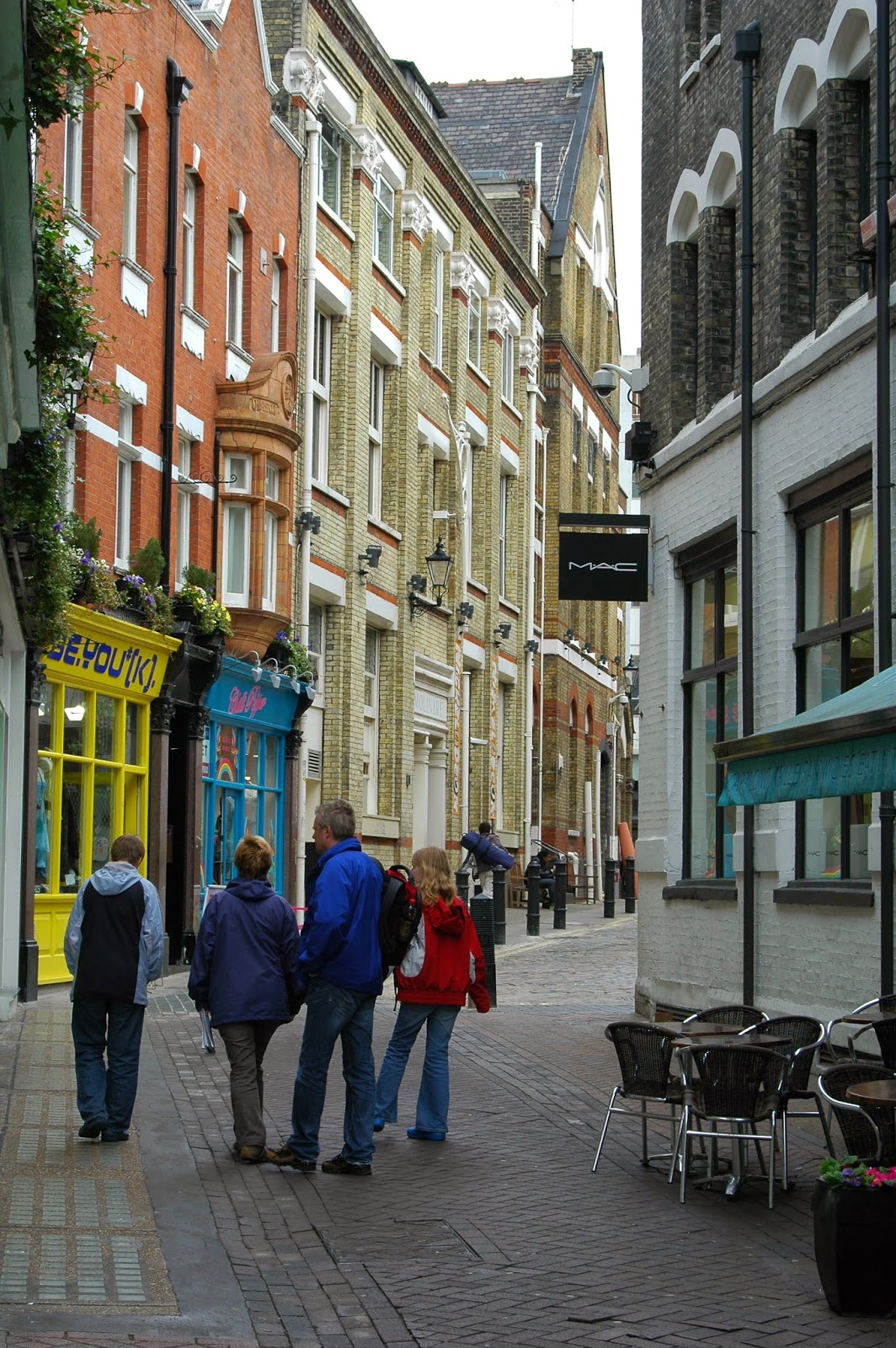
Walkability in the Soho District of London
I’ve returned from CNU 24, the annual gathering of the Congress for the New Urbanism.  As always, the conference was inspirational and motivational.  I’ve come back flush with new connections, eager to broach new ideas, and primed to suggest new initiatives.

But it’d be a strategic mistake for me to step too far too quickly.  Given its often narrow base within North Bay politics, urbanism can’t be implemented in broad strokes.  Instead, urbanists must edge toward the inevitable tipping point with persistent incremental steps, finding pivotal moments to weigh in with urbanist perspectives on issues that have already found their way onto North Bay agendas.

Thus, my weekly summary of upcoming meetings and other opportunities with urbanist angles follows below.  Perhaps because we’re moving into summer, it’s a light week, but hopefully readers will find something that stirs them to action.

Upcoming Meetings

MTC/ABAG, Monday, June 13, 6:00pm, Luther Burbank Center for the Arts, 50 Mark West Springs Road, Santa Rosa – This is the Sonoma County edition of a series of meetings that have been seeking input into the Bay Area 2040 plan on growth scenarios and resulting transportation funding strategies.   I attended the Marin County meeting and, having another meeting on the same evening, will pass on this one.  But I suggest that anyone with an interest in growth and transportation in the North Bay make time to learn how MTC and ABAG have framed the issues.

Petaluma Planning Commission, Tuesday, June 14, 7:00pm (see update below), Petaluma City Hall, 11 English Street, Petaluma – The Adobe Road Winery is seeking to establish a wine-making footprint in downtown Petaluma.  But the permitting and construction steps toward that goal will be long and slow.  To make the Adobe Road name more familiar in Petaluma as the bigger project creeps ahead, the winery is seeking approval for a tasting room in the Great Petaluma Mill, at the corner of Petaluma Boulevard and B Street.

Petaluma has long been perceived as on the fringe of the Sonoma County wine scene, although the pending approval of a Petaluma Gap appellation could change that perception.  The proposed tasting room, to my knowledge only the second winery-branded tasting room in downtown Petaluma, would be another step on Petaluma’s path to the wine mainstream.

While a wine tasting room on its surface may not be urbanist, any land uses that pull people downtown, creating a sense of activity and place, is urbanist.  A wine tasting room meets that standard.

I have a pair of earlier obligations on my calendar for the evening, but will attend the hearing if time permits.

(Update – Due to a notification error, Petaluma Planning has deferred this hearing to Tuesday, June 28.)

Sonoma Marin Area Rail Transit Board, Wednesday, June 15, 1:30pm, 5401 Old Redwood Highway, Petaluma – Despite what was said during the June 1 meeting, a further discussion on Clipper isn’t on the SMART Board agenda.  Indeed, there is nothing of apparent urbanist interest on the agenda.  But with the launch of revenue service only months away, there may still be value in attending to listen to public and Board comments.

Petaluma Tree Advisory Committee, Wednesday, June 15, 3:30pm, Petaluma City Hall, 11 English Street, Petaluma – Although the topic is likely beyond their purview, an interesting subject is on the Tree Committee agenda as a result of a letter from a citizen.  The missive notes the conflict between the street tree planting encouraged by the City years ago and the sidewalk damage now resulting from the roots.  The writer asks for City assistance with sidewalk repair to avoid tree removal by financially-constrained homeowners.

(As a sidenote, I know that the current City list of approved street trees specifically avoids trees known to damage sidewalks.  But I don’t know if the same was true when the trees noted by letter writer were planted.)

The letter frames a conundrum of our contemporary world.  As either a city or as homeowners, we don’t have the resources to fix the sidewalks, largely as a result of the cost burdens resulting from the drivable suburban paradigm.  But retaining the trees is essential for urbanism because traffic is slowed by the constraining influence of trees and shade from trees are both essential elements of the walkability needed for urbanism.

The choice becomes digging deep, probably through tax increases, to repair the sidewalks so the trees can be retained or felling the trees and continuing along the path toward drivable suburbia that will impoverish us by other means.

It’s a Hobbesian choice that should be considered at the highest levels of city government, which isn’t the Tree Committee, but it may still be interesting to watch how the Tree Committee handles it.

Novato Planning Commission, Wednesday, June 15, 7:30pm, Novato City Hall, 901 Sherman Avenue, Novato – The Novato Design Review Commission will take up a proposed senior living facility on South Novato Boulevard.  The site is on a four-lane arterial, flanked by a pair of churches, and is therefore of little interest to urbanists.

Further, I’m sure that the proposed developer, Oakmont Senior Living, will do a fine job with the architecture.  I recently toured an Oakmont facility and found it light, airy, and comfortable.

But I’ve included the meeting to raise a point.  When I’m in need of senior housing, I don’t want to be put in a building fronting on a four-lane arterial and flanked by churches.  I want to be in a place where I can walk to a pub, theatre, hardware store, and bus stop.  I want to be downtown.  I regret that we don’t give the seniors of today that choice and will push whenever possible for more downtown senior living facilities so they exist when I need them.

Rail~Volution, October 10-12, Hyatt Regency, San Francisco – The leading conference on the use of rail for community building is coming to San Francisco this fall.  I’m planning on attending.

Other Involvement Opportunities

Petaluma Boulevard South – When I last issued this calendar, I noted how bikeable/walkable revisions to Petaluma Boulevard South had flickered onto and off of the Petaluma City Council agenda.  I’m still trying to discover the background of the passing mention.

However, a group of citizens was energized by the brief flicker and is organizing to bring the subject of calming Petaluma Boulevard South back to the City Council, hopefully with enough votes to support it.

If you’re interested in advocating for improvements to Petaluma Boulevard South that will make the street more friendly for non-motorists and will allow better connectivity between the residential areas southwest of the street and the retail/recreational opportunities to the northeast, let me know.  I’ll get you in touch with the forming group, of which I’ll be a member.

Lots of opportunities to get involved.  Please grab at least one and hopefully more.

When I next publish, I’ll begin telling of my experiences with CNU 24.  I’ll start with a few of my mobility experiences in the city.

As always, your questions or comments will be appreciated.  Please comment below or email me.  And thanks for reading. - Dave Alden (davealden53@comcast.net)

Wednesday, November 26, 2014

Urbanism and Senior Living: The Insights Keep Coming

With Thanksgiving Day nearly upon us, and with many folks already traveling, I’ll limit myself today to a handful of links.  But they’re good links.

About a month ago, I wrote a series of posts on urbanism and senior living, from the how senior life might be conducted downtown  to getting around without a driver’s license to walkability.  But even after those posts were put to bed, good thinking on the subject continued to arrive in my computer.

If you only have time to follow one link today, this is the one I’d recommend.  A recently opened Alzheimer’s and dementia care facility in the Netherlands has been configured like a walkable village center.  The patients, all of whom are in the advanced stages of their disease, live in bedrooms of what appear to be single-family homes, often decorated in a style consistent with earlier periods of their lives.  They have the freedom to wander, but not to leave, under the watchful eyes of attendants who double as gardeners and postal clerks.

Compared to standard U.S. residential care facilities, the Dutch village is an expensive way to care for seniors with dementia, but not impossibly so.  The monthly cost is about $8,000, compared to a more typical $5,000 to $6,000 in the U.S.  And the approach is successful, with the residents more comfortable and living longer than those under conventional care.

My wife was diagnosed three years ago with early-onset Alzheimer’s disease.  She’s coping well with the condition, with more grace that I’d likely muster, but she knows that the extent of her daily life is shrinking, with a reduced ability to travel and to interact with unfamiliar people.

I asked her for thoughts on this article.  She was immediately enthusiastic.  She has a group of on-line acquaintances, all with early-onset Alzheimer’s.  In my wife’s words, “We know we’re no longer living normal lives, but a place like this retains the illusion of a normal life and that would be important to us.  I’m not surprised that the residents live longer.”

The message for urbanists is if that protected walkable settings can be successful in the care of advanced dementia patients, then walkable urban settings, with limited cars and lots of plazas and small retail shops for daily life, can provide a comfortable home for seniors who are only beginning their final decline.

Building on the subject, Harry Grabar, writing in CityLab, notes a dual function that walkability can provide.  Walkable settings can retain seniors and their financial resources in a community.  And those same walkable settings can attract the creative millennials who will provide the next wave of economic prosperity for the community.

Writing in New York Times, Harriet Edelson notes that most seniors live beyond their years of driving, by seven years for men and ten years for women and should therefore include non-driving transportation in their retirement plans.

Lastly, Eric Dishman of Intel, in speaking to a civic club in Portland, Oregon, lists the efforts underway to find uses for technology in helping seniors age safely in place.  (His speech was interesting, but not particularly compelling, I’d check out the other links first.)  I applaud the efforts by Intel and others, but note that the place where seniors age needn’t be the suburban family home, but perhaps should be a downtown apartment in a walkable setting.

As you sit down to Thanksgiving dinner with parents or other aging family members, give a little thought to where you want them to live their final years.  And think about how urbanism can help fill a need.

Have a good holiday.

As always, your questions or comments will be appreciated.  Please comment below or email me.  And thanks for reading. - Dave Alden (davealden53@comcast.net)
Friday, October 17, 2014

Urbanism and Senior Living: The Cases For and Against Mobile Home Parks

For several years, I was on the board of a local Rebuilding Together affiliate, a non-profit organization that provides free home repairs for low-income homeowners.  Like most affiliates, our biggest event of the year was an April workday when several hundred local citizens volunteered a day of labor.

One year, a project captain invited a group of volunteers to her home for post-workday beverages.  I found myself in her kitchen, sipping a beer and chatting with a city councilmember who had worked on a project.

I assume the councilmember had worked on a mobile home because the discussion quickly turned to the role of mobile homes in our city.  His view was that mobile homes were a temporary aberration and that the long-term goal of the city should be to replace them with stick-built homes.  His principal argument was the longer life of well-maintained stick-built construction, although he also noted the horizontal spread of single-story mobile homes and the opportunity for more compact living with stick-built residences.

With that memory in mind, it was interesting to read the suggestion by Lisa Margonelli in Pacific Standard that mobile home parks might have an essential role in the housing future of all of us, particularly seniors.  She looks in depth at the Pismo Dunes mobile home park, near Pismo Beach, California.

Margonelli’s argument is that mobile home parks provide a low-cost alternative to other options, while also fostering a relationship between seniors, a supportive network that others have called a “naturally-occurring retirement community”.

I’ll use the dichotomy between the councilmember’s comments and Margonelli’s article as a starting point from which to write about the possible role of mobile home parks as senior communities and to conclude a series of posts I’ve written about urbanism and senior living.  I won’t forget urbanism and seniors and will find opportunities to add more insights on the subject, but will begin focusing elsewhere in my next post.

Margonelli makes a reasonable case for mobile homes, but I’ll add another point.  Mobile home parks encourage alternative transportation modes.  With narrow roads, frequent driveways, and a well-gridded layout, automobile drivers intuitively reduce their speed, often as low as 15 miles per hour, well below the 20 mile per hour threshold where the dominance of cars begins to wane.

Margonelli notes the use of golf carts in the Pismo Dunes, which can be a fine choice for seniors no longer capable of handling an auto.

I can add another transportation option.  A North Bay reader emailed me extolling her adult tricycle, noting the improved mobility which it has given her and including a photo of a Napa senior on a tricycle touring the damage on the morning after the recent earthquake.  An adult tricycle can be another fine alternative transportation choice within a mobile home park.

Also, walking within a mobile home park is often safer than walking on city streets.

Against the positives noted by Margonelli and by me, there is a legitimate list of concerns about mobile home parks as a housing solution, including some that touch upon the councilmember’s concerns.

Heading the list is construction quality.  Margonelli notes that quality of mobile homes has been improving.  She’s likely correct, but mobile homes still remain at the lower-end of the construction spectrum.  And it seems inevitable that they’ll remain at the lower-end.

During my time on the Rebuilding Together board, we often debated how much money to allocate toward mobile home repair.  Although we never went as far as another affiliate which limited mobile home repairs to one-third of their annual budget, we remained aware of the potential black hole of mobile home repairs.  Many years, we could have spent our entire budget on mobile homes and still left needs unmet.  Plus we found that repairs to stick-built construction were less likely to require return visits in future years.

Next, the density of most mobile home parks is insufficient to support urban uses such as stores or pubs.  (Margonelli notes that a grocery store is within walking distance of Pismo Dunes, but the store is beyond the boundary of the mobile home park and even then remains an anomaly.)  It’s the inherent nature of the single-story, non-shared-wall development to spread out, reducing the number of residents within walkable distance of businesses.

Furthermore, the nature of most mobile home parks is to be enclosed, with limited entry points and few opportunities for others to pass through a park enroute to other destinations.  But the nature of an effective urban community to be well-gridded, allowing efficient travel, which is essential for those on foot or bicycles.

Perhaps the only location is which mobile home parks don’t undermine an urban land-use configuration is where they back against any geographical feature that would have already precluded urban connections.  It’s not coincidental that Pismo Dunes backs up to an ocean beach or that many of the Petaluma mobile home parks adjoin a freeway.

But the biggest concern about mobile home parks, at least to me, is the social insulation.  I’ve been reading “The Filter Bubble” by Eli Pariser.  His thesis is that personalization of internet experiences, by which Google, Yahoo, Facebook, and others feed us articles consistent with what they’ve calculated to be our interest and values, undermines the free flow of objective information on which our democracy depends.

The internet personalization models against which he rails is evident in our every internet session.  In the last week, I’ve researched travel options in Ireland and senior living facilities in the North Bay.  Now, I can’t go anywhere on the internet without being bombarded by ads for Irish tour services and North Bay senior living options.  It feels both creepy and intrusive.

Similarly, I had a frequent commenter on Petaluma Patch who was continually offering links to anti-urbanism articles from obscure and credibility-challenged sources.  At first, I marveled at his misplaced diligence in finding these articles.

However, I came to realize that he had created a filter bubble in which the internet was feeding him anti-urban articles.  He had only to go on-line to have an article shoved in front of him which, with dubious fact and flawed logic, seemed to rebut something I had written.  And he then felt a need to accept the article as the truth and to share it.

It was a shame that the opportunity for the two of us to have a rational exchange of perspectives was undermined by the internet.

Urbanism combats the personalization trend on the internet.  I love the idea of a CEO and a mail clerk talking in the elevator of an apartment building where both live, each if one is in a penthouse when the other is in a micro-apartment.  Similarly, I like watching various demographic segments chatting in a downtown pub. 

My personal hell would be to live among folks who are like me and who think as I do.  Even as I age, I want to live among people who offer new and thought-provoking perspectives.  We already offer too few of these opportunities and mobile home parks, by their very nature, are part of the deficiency.

Summing it up, while Margonelli makes a reasonable case for mobile home parks, I favor the position of the councilmember.  As a housing solution, particularly as we move toward a more urban world, we can and should do better than mobile home parks.

By the way, nothing here is intended to disparage the residents of mobile home parks nor to criticize the choice of people who find enjoyment in their mobile homes.  Instead, it is to castigate the rest of us for creating a world in which mobile homes, with all their deficiencies, are the only option for many folks.

In my next post, I’ll write about water conservation.  Candidates for the Petaluma City Council have been talking about a moratorium on building permits while the drought persists.  I applaud the concern, but will argue that another approach would be more appropriate.

As always, your questions or comments will be appreciated.  Please comment below or email me.  And thanks for reading. - Dave Alden (davealden53@comcast.net)

Wednesday, October 15, 2014

Urbanism and Senior Living: Getting Around on Foot

A theme of this election season has been strategic decision-making around the varying approval thresholds for different forms of tax measures.  Is it better to seek a general tax measure, which requires only 50 percent plus one for approval, even if it means battling skepticism about how the revenues will be spent?   Or is better to specify the uses of the revenue, even though that would bump the approval standard to two-thirds when the electorate might not be able to muster a two-thirds majority over whether the sun will rise in the east tomorrow?

Or perhaps the 55 percent rule will apply, although that option is limited to certain types of school bond measures.  (If someone wants a legal summary of the various California approval standards, the Legislative Analyst’s Office provides one here.  The flowchart is nicely done.)

Also, during my years in Oregon, I watched the double-majority standard in action, a rule that was so perverse in its unintended consequences that the voters finally repealed it in 2008.

But what if I wrote that there was a type of infrastructure for which 100 percent voter approval was required?  It may seem surprising, but it’s nonetheless true.  In large areas of our cities and towns, sidewalk upkeep, and therefore walkability, requires 100 percent participation from property owners.

In a carryover from English common law, California homeowners are responsible for the repair and maintenance of the sidewalks in front of their homes.  Originally, English landowners were responsible for the entire roadway.  The government eventually, in the interest of commerce, assumed street repair, but the takeover didn’t progress far enough to include the sidewalks.

(The original road maintenance obligation is one reason why English towns and early American towns are often characterized by multi-story common-wall houses on narrow lots.  The narrow lots reduced the repair obligation.  Coincidentally, the narrow lots also helped communities satisfy Jeff Speck’s “interest” and “usefulness” elements of walkability.  It was only when government took over road upkeep that the lots of the middle-class began sprawling sideways, which also undermined walkability.)

There may be sidewalks, such as in the downtown retail areas, where a city has assumed sidewalk maintenance to preserve commercial activity, but most sidewalks remain the responsibility of the adjoining homeowner.  As a result, as any property liability expert will avow, California homeowners also remain responsible for any personal damages that result from poor sidewalk conditions.

However, even the threat of lawsuits isn’t always sufficient to motivate sidewalk repairs.  With stagnant middle-class wages, the need to save for college educations and retirement, and the desire for the newest electronic toy, sidewalk repairs often fall far down household priority lists, below the point at which funds are exhausted.

In the recently-developed parts of a town, the sidewalks constructed as part of the initial development typically remain in good condition.  But nearly every block in the more mature areas of a town will have a stretch or two where the footing is too treacherous for 80-year-old grandmothers to walk to the store. 

Even if a neighborhood is lucky enough to have a Ray’s Delicatessen and Tavern a block away, that destination, which should be the hallmark of a walkable neighborhood, may still require a car trip by the less foot-sure residents of the neighborhood.  And the only immediate solution is the impossible expectation that all property owners promptly attend to deteriorating sidewalks, the 100 percent standard I noted above.

Nor is complete neighborhood concurrence fully adequate to support walkability.  In many older neighborhoods, street repairs have often included lifts of asphalt that have raised the centerline elevation by six inches or more, without changing gutter line elevation, resulting in the frequently-seen humped street cross-section.

Even if a mobility-limited pedestrian is lucky enough to encounter an intersection which has been retrofitted with handicap ramps at their mandated 8.3 percent slope, the pedestrian may be faced with grades of 12 percent or more to cross the street.  The only solution to hump-backed street is full reconstruction, a task well beyond the financial capability of most towns.

To highlight the absurdity, my wife and I were recently sitting in our Petaluma parlor when a man in an electrical wheelchair rode by.   A few minutes later, he returned.  Both times, he was in the street, not on the sidewalk.  In a town that disgruntled drivers have dubbed the Pothole Capital of California, wheelchair users still find it safer to ride in the streets than on the sidewalks.  That should give pause.

This overview on the reality of sidewalk maintenance is part of my ongoing discussion about urbanism and senior living.  There is a strong case that seniors can live richer, fuller lives in a walkable urban setting.  But sometimes those downtown residential locations are a block or two from the social opportunities that can enrich a senior life, a distance in which the sidewalks may be in disrepair.

And for seniors who have been relegated to the suburbs by a lack of downtown options or the difficulty of selling suburban homes for an adequate price to fund retirement, good sidewalks can be essential to reaching the occasional neighborhood store or the bus stop from which downtown can be reached.

There are no easy fixes to the sidewalk repair deficiency.  We could impose fines on homeowners who are delinquent with their repairs, but that seems draconian.  We could do government repair on more sidewalks, but that would require more tax revenues.  (Even within the many tax measures on the November ballot, sidewalk repairs are barely more than a rounding error.)   Or we could build communities where the ratio of people to linear foot of sidewalk is pushed upward, making it easier to build a consensus for sidewalk upkeep.  I favor the last.

In any case, it’s ironic that we can build systems that, with the touch of a key fob, give seniors extra time to cross busy streets, but we can’t find a way to maintain the concrete to get them to the street crossing.

As always, your questions or comments will be appreciated.  Please comment below or email me.  And thanks for reading. - Dave Alden (davealden53@comcast.net)

(Disclaimer: I have a sidewalk in front of my home that is beginning to crack because of a tree root.  It isn’t yet a big trip hazard, but is heading that way.  Repair is scheduled for spring.)

Friday, October 10, 2014

Urbanism and Senior Living: After the Driver’s License is Gone

A few years ago, my wife and I sat down one evening to continue planning our retirement.  Our goal was to decide upon a town in which we wished to spend our later years.

Like any couple, our desires didn’t fully align.  We had different visions of what would be important to us in retirement.

Nor, until our later-in-life marriage, had our lives been spent in the similar communities.  Although we both grew up near Sacramento, I’d lived 18 years in the Pacific Northwest, while she’d spent most of her adult life in California cities from Redding to Laguna Niguel, so we brought different visions of the good life to our conversation.

But we worked through our differences and reached a mutually acceptable conclusion.  We wanted to live in a place just like Petaluma, but with a Nordstrom and a transit system that would allow me to ride to and from a Cal basketball game, even if the game went into triple overtime.  (Exactly what city met that definition remained an open question.)

In our focus on transit, we were foreshadowing the concerns of an increasing number of seniors.

Over the past couple of weeks, I’ve been writing about the intersection of urbanism and senior living.  As should have been expected, I’m enthusiastically supportive of creating more options for downtown senior life.

But I’ve also been considering the lives of seniors who would benefit from urban life but can’t utilize that option because of the absence of suitable urban destinations or because of market finances holding them in suburbia.  Today, I’ll write about the effect of decreasing mobility on those seniors and about possible solutions.

Eventually, assuming we live long enough, we’ll all lose our driver’s licenses.  (Paraphrasing Maurice Chevalier, “It isn’t so bad when you consider the alternative.”)

But with so much of American life dependent on the automobile, the loss of that mobility can be life-changing.  As Pete Lehner writes for the Natural Resources Defense Council, seniors who find themselves stranded by loss of their licenses are less likely to keep medical appointments, less likely to see old friends and more likely to show signs of depression.

Lehner also points out that the number of seniors, and therefore post-driving seniors, has been and will continue to grow rapidly.

Lehner notes that transit is one solution to the senior mobility problem, but cites the low priority often given to transit funding.  He cites Wisconsin where the ratio of road to transit funding is nearly 100 to 1.

As a member of the Petaluma Transit Advisory Committee, I can confirm that transit funding is limited.  The $88 million price being bandied about for the Rainier Connection would be enough to fund Petaluma Transit for thirty years.

However, I’m unsure than any amount of transit funding can solve the problem of senior mobility in cities configured like Petaluma.  The sprawling nature of many subdivisions makes it impossible to design routes that will provide good transit access to most folks while still providing timely services for those trying to keep appointments or arrive at jobs on time. Drivable suburbia is a deep wound to the independence of seniors and transit can only be a small bandage.

But there are alternatives.  Writing in City Lab, Paul Supawanich suggests that peer-to-peer ride-sharing services, such as Uber and Lyft, can also play a role.

Supawanich muses that the rides required by seniors might not occur with the same times or destinations typically served by the peer-to-peer drivers and suggests that small stipends might be needed to ensure that enough drivers are available to meet the demand.  However, he guesses that stipends plus fares would have a lower cost that alternatives such as taxis or transit vans.

 Lastly, Liza Barth in Consumer Reports writes of a modified peer-to-peer ride-sharing concept for seniors that predates Uber and Lyft.  After her young son was injured in 1995 by an older driver whose license should have been previously revoked, Katherine Freund began to look for alternatives to senior driving.

She created a community ride-share company, ITN America, that operates in thirty locations across the country.

While similar to Uber and Lyft, ITN has several key differences, in addition to its focus on seniors.  For one, many riders enroll by giving their cars to ITN in exchange for credits that can be used for rides.  For another, many of the drivers are young seniors, reinforcing the concept of peer-to-peer.  Lastly, many of the drivers aren’t paid in money, but instead get credits that they can use in their later years.

Are Uber or ITN perfect solutions to senior mobility?  Not really.  I’d still rather live in a place where I can walk a block and catch a streetcar that’ll run all night.  But they help address some of the mobility shortfall for seniors and it’s good that they exist.

Next time, I’ll step away from urbanism and seniors for a post.  Instead, I’ll write about a couple of interesting meetings that will occur in Petaluma next week.

As always, your questions or comments will be appreciated.  Please comment below or email me.  And thanks for reading. - Dave Alden (davealden53@comcast.net)

(Note: For those concerned, or perhaps hopeful, that I’ll be leaving Petaluma based on my comments above about a retirement destination, that won’t happen.   Since the conversation with my wife, various life changes have happened, including greater community involvement and more family members moving to Petaluma, so we’re in the North Bay for the duration.  Although I still miss a good transit connection between here and Berkeley.)

Wednesday, October 8, 2014

Urbanism and Senior Living: Shedding the Extra Bedrooms

In recent weeks, I’ve been writing about the intersection of urbanism and senior living.  Thus far, I’ve largely focused on the forms that senior living can take in urban settings and the steps needed to encourage downtown senior options.

But I’ve also written that many seniors, even if they find walkable urban life appealing, are nonetheless stuck in drivable suburbia because there are few suitable urban options or because they can’t sell their current homes at a price adequate to support a move downtown.

Today, I’ll begin writing about how to bring touches of urbanism to those living their final years in drivable suburbia.

I don’t recall the speaker, but there was a particularly insightful moment on the subject of senior living at CNU 22, the most recent annual meeting of the Congress for the New Urbanism.  The speaker was digging into the statistics showing that many seniors prefer to “age in place”.

The aging in place sentiment is generally understood to mean that seniors wish to remain in the homes where they raised their families.  This understanding has launched many businesses focused on modifying homes with grab bars, providing essential in-home services, and otherwise facilitating seniors remaining in their long-time homes.

But as the speaker dug more deeply into the statistics, he found that many seniors weren’t necessarily thinking about the homes as the “places” where they insisted on “aging”.  Instead, they didn’t want to leave behind the neighbors with whom they had long friendships, the coffee shops where they spent Saturday mornings, or the butchers who cut their Christmas prime ribs.  Perhaps not all, but many seniors no longer cared about the five bedrooms and quarter-acre of grass where they’d raised their families.  They didn’t want to leave their neighborhoods.   Their neighborhood was their “place”.

Of course, in the American version of land use, there are rarely alternative homes within large-lot single-family neighborhoods that are suited to the elder years, so it’s not surprising that the seniors were unable to express their preference for neighborhood over home.  But it’s nonetheless a preference that should be recognized.

Of course, the problem with the preference is home size.  Even if seniors no longer have an interest in dusting and vacuuming 2,500 square feet of house, most neighborhoods don’t offer reasonable alternatives.

However, there are people trying to rectify that deficiency.  In classrooms at the New Jersey Institute of Technology, students are looking for ways to more gracefully accommodate aging.  One idea is to construct duplexes configured so the second unit can be rented out in the early years of marriage, occupied during the child-rearing decades, and then again rented out during the later years of life.

On a similar track, Witold Rybczynski wrote in his book “City Life” about his role in developing Grow Homes, narrow, shared-wall homes that are sold with the upper floors open and unfinished.  The intended buyers are young married couples who can divide and finish the upper stories to suit as their families grow and their specific needs become evident.

Of course, Grow Homes, as their name implies, are more suited to expanding families, but the flexibility to reinvent the upper stories can also meet senior needs, from convalescent rooms to apartments for caretakers to living accommodations for other seniors, creating a “naturally-occurring retirement community” or NORC as I described in a recent post.

Although not widespread, with most of the 10,000 units near Montreal where they were invented, Grow Homes have received wide acclaim.

Also in “City Life”, Rybczynski wrote about the town of Mariemont, Ohio, where the walkable core includes apartments suitable for young couples, small-lot single-family homes for child-rearing, and eldercare facilities, all of which combine into a place where one can live an entire life.  (Before someone else offers this fact, I’ll note that Mariemont was originally intended as whites-only, proving only that our forebearers were better at urban planning than at social justice.)

Accessory Dwelling Units (ADUs), commonly called “granny flats”, can also widen the range of housing options in a suburban neighborhood.  Whether stand-alone units adjoining primary houses or additions to existing homes, such as flats above garages, ADUs can provide a place where empty-nesters can make more suitable homes for their later years.  I’ve heard of seniors who have moved into a newly-added ADU and then rented their former homes to a young family.  (Personally, I once spent 18 months living comfortably in an ADU over a garage in a suburban neighborhood.)

The biggest impediment to ADUs is often impact fees.  Much like small downtown units, as described in my previous post, ADUs can have impact fees that exceed their true impacts, as unenlightened cities try desperately to balance books teetering precariously from the failed suburban experiment.

Lastly, I’ll refer back to an idea I offered in the spring, about reconfiguring under-used neighborhood parks to add, among other elements, small blocks of residential apartments.  At the time, my goal was to raise resources to make the parks more relevant to contemporary life, but a side effect would be creating places for elders, who no longer want their outsized homes, to remain in their long-time neighborhoods.

Adding smaller residential units to a suburban neighborhood doesn’t make it urban.  But it’s one small step in the right direction.  Having defined that step, I’ll write in my next post about adding non-driving mobility to suburbia.

As always, your questions or comments will be appreciated.  Please comment below or email me.  And thanks for reading. - Dave Alden (davealden53@comcast.net)

Monday, October 6, 2014

Urbanism and Senior Living: Making Downtown Options Happen

In recent posts, I’ve been writing about how walkable urban settings can be good places to live one’s later years.  Most recently, I offered a few insights about senior lifestyles that might find a home in downtowns.

It’s a subject of both general and personal interest to me.  I think having more seniors living downtown will make our downtowns and our cities healthier.  Also, I’m currently assisting a family member in a search for a new senior living situation.  I’m disappointed that there aren’t more urban options for her to consider.

Lastly, I know that there is a time when my wife and I will need alternative housing.  By then, I’m hopeful that more urban options will be open to us.  In thinking about my octogenarian self, I can conceive few prospects more pleasant than the possibility of walking to a hardware store to complete a small household repair or ambling to a bookstore to spend an hour browsing the options.  (Yes, I’m confident that printed books will still exist when I’m in my eighties.)

So, the topic for today is how to facilitate more downtown senior living options.

The path to more downtown senior living options is largely the same as the path to more downtown living options for all demographic sections.  And regular readers know the litany of urbanism obstacles that I often cite.  Gasoline prices that don’t include all environmental and geopolitical costs, so effectively subsidize life at the urban fringe.  Road maintenance costs that aren’t distributed according to actual road usage.  Construction liability law and mortgage practices that make downtown development more difficult.  And many more.

But rather than returning to an abstract description of obstacles to urbanism, I’ll recount an example of a failed senior living project with which I was quite familiar.  To me, it provides a wealth of insights about how cities can do better.

This account below is simplified.  It would take far too long to cover all the nuances.  Nor do I choose to provide the location of the project or the municipality, mostly to avoid arguing over the details.  But the outline of the story is accurate and the lessons to be drawn are valid.

A developer owned an attractive parcel of land, near a viable and active downtown.  The existing pedestrian route between the parcel and downtown wasn’t pleasant, but the city had a plan for a boulevard with wide sidewalks that new residents could use to reach downtown.  The developer, working together with the intended developer of an adjoining parcel, agreed to pay for much of the boulevard construction costs.

In addition to boulevard, the city plan called for a second street to be built within the project site, extending the urban street grid and giving motorists, pedestrians, and bicyclists more routes from which to choose.  And the boulevard would include a strong transit component, adding further to senior mobility options.

The developer planned for 200 residential units above sidewalk storefronts.  Eighty units were to be in a senior living facility. Nor did the developer choose to pay affordable housing fees, instead folding affordable housing into his project, side-by-side with market rate housing.

Having a mixture of seniors and others living in the new development was key to urbanism for at least three reasons.  First, it provided a range of sidewalks users, extending the daily period of urban vitality.

Second, it provided a mix of customers, leading the sidewalk businesses to more robust business models.  A cafĂ© that served lunches to seniors at midday had to also please the 9-to-5 folks looking for an evening meal.

Lastly, it would provide a residential option for families split by old age.  One spouse could live in a senior facility, receiving needed assistance with daily life, while a devoted but healthier spouse could retain an independent life in a small apartment across the street.

I thought the proposal was exceptional.  The city appeared to agree and offered to help facilitate the project.  First, they agreed to help secure the land rights for the boulevard, some of which were still privately held.  Second, in exchange for a concession by the developer on a related land-use issue, they agreed to an expedited entitlement process as permitted under state law.  

And then, it all came unwound.  After a year of delay, and long after the developer’s concession had been banked, the city withdrew their promise of expedited entitlement.

After an unexpected staff shakeup, the city ceased assisting with land acquisition for the boulevard.  Relieved of the city’s jawboning, one property owner promptly increased his asking price by a factor of fifty.  The land was never acquired.

After having previously set reduced impact fees for urban development, the city reversed direction and adopted a new fee schedule that more than doubled the impact fees on the project.

As project finances worsened, the developer suggested the city take a role in the boulevard construction, but the city’s resources were committed to supporting drivable development.

And then the city missed the deadline for a key entitlement step, thereby violating state law and delaying the project several more months.

Nor were lenders enamored of the mixed-use model, particularly the senior housing component, noting that the project fell outside of their lending experience.

Lastly, the economy softened, further undermining finances that were already precarious.  Eventually the project faltered and then failed.  The developer had funded his entitlement expenses by mortgaging the property, so the bank assumed ownership.

In the years since the foreclosure, several buyers have approached the bank.  But none have wanted to resurrect the previous project.  Instead, they approached the city with various alternatives for eliminating the boulevard, dropping the transit, and converting the entire project into senior housing without the sidewalk retail, effectively transforming the site into a standard drivable suburban senior facility that happened to be a few blocks from downtown, but without a real connection to downtown.

To their credit, the city has thus far refused to consider the changes.  But the only result is that the property remains vacant, a reminder of a failed plan to strengthen the urban core and to bring seniors into a walkable setting.

There are many lessons that can be drawn from this story.  The most obvious one is that opportunities must be grabbed.  There seemed to be a city attitude that this project was one of many that would be offered and that the city needn’t make an effort to facilitate the project or even to comply with commitments that they had made.  The assumption was badly wrong, especially considering the senior living element, and deprived the community of a project that would have filled a need.

But the lesson on which I’ll focus today is impact fees.  I expect that most are familiar with the impact fee concept.  They are fees charged for various types of community infrastructure, streets, wastewater treatment, schools, parks, etc., that are set so that the infrastructure can be expanded to serve the new residents.

The general concept of impact fees is unassailable.  It would be unfair if new homes didn’t bear a fair share of the cost of their services.

But there can be a couple of flaws in the calculation of impact fees.  First, the solutions to current deficiencies are often be folded into impact fees, even though the problems must be addressed even if no further homes are ever built.  This is a deceit into which most communities fall, largely because Prop 13 has limited other funding options.  Faced with municipal needs that can’t otherwise be funded, decision-makers find a way to squint and to fold costs into impact fees that shouldn’t be there.

Second is the question of the allocation of impact fees across different types of development.  Let’s consider two residential units, a 3,500 square-foot single-family home on the urban fringe, located on a quarter-acre lot and likely occupied by a family of five, and a 400 square-foot independent living market-rate apartment in an urban core, likely occupied by a senior past the age of driving or a new college graduate trying to get by with a bicycle and transit.

What should be the relative impact fees for the two examples?  My intuition is the smaller urban apartment should have impact fees that are perhaps 30 percent of the large suburban home.  Others may intuit somewhat differently, but I expect that my judgment is within the range that others may set.

But for many cities, the impact fees for the downtown unit are 80 percent or more of the fees for the suburban home.  And cities are usually unwilling to adjust the fees, even when the unreasonableness of the fees is noted.

In essence, urban development is providing a subsidy for suburban development.  And most cities are content with that subsidy because of a prevailing belief that housing starts drive economic progress.

Of course, there are three problems with that belief.  After seventy years of following that model, our cities are teetering on the edge of bankruptcy.  Also, if a development form is so essential, why does it need a subsidy?  Lastly, what is the solution to the environmental issues posed by forcing everyone into cars?   Nonetheless, the belief persists and impedes urban development.

I could run further afield with this subject, but shouldn’t.  I’ve already claimed enough of your attention.  I’ll bring this back to the barn with the two key lessons I’ve tried to impart.  If we want seniors living in downtown, which I endorse heartily, we need to enthusiastically support development proposals that incorporate senior living.  Second chances may not come.  Also, we need to push cities to ensure that they’re not using urban development to subsidize drivable suburban development.

Next time, I’ll begin tackling the other half of the senior living question, how to bring beneficial elements of urbanism to seniors who remain in drivable suburban settings, either because they can’t sell their home for the price they need to live comfortably elsewhere or because their downtown offers few residential options.

As always, your questions or comments will be appreciated.  Please comment below or email me.  And thanks for reading. - Dave Alden (davealden53@comcast.net)

Friday, October 3, 2014

Urbanism and Senior Living: Sketching Out the Downtown Options

In previous posts, I’ve written that many current options for senior life, specifically the common American model of large facilities in non-walkable settings and an observed Venetian arrangement that may have lacked adequate social contact, may not be meeting the needs of seniors.  I then suggested that urbanism, even if imperfectly applied in the Venetian example, offers good opportunities for fulfilling and contented senior years.   (I also wrote that many seniors are trapped in suburbia by market forces, but that’s a thread that I won’t continue until later posts.)

So the question for today is if we want to provide more opportunities for seniors to live in urban places, what should the housing options be?

(Several responses to earlier posts highlighted the specific need for affordable senior housing.  I understand and appreciate the perspective, but note that there are also few urban options for more affluent seniors.  I agree that any new development should include affordable elements, but the challenge should be urban options for everyone, including all seniors.  Also, I’ll note that a city with a strong urbanist focus and a tax structure in which the municipal costs are allocated fairly may have less need to create affordable housing.)

In some ways, the question above about senior living options isn’t well-framed.  Seniors aren’t a species apart.  There’s not one type of urban housing that fits the needs of all seniors any more than there is one type of housing that fits the needs of all middle-aged folks.  But we can talk about a range of options, including the points on which the housing needs of seniors may differ from others.

For many seniors, the preferred residential option is little different from that of younger people.  For seniors who are healthy and capable of self-care and daily tasks, a comfortable and appropriately-priced apartment or condominium in an urban setting can be a fine choice.

Although not specifically targeted toward seniors, it’s comforting to think of seniors finding a home in the redevelopment of the oldest American mall, in Providence, Rhode Island.  The paring of my library would be wrenching, but otherwise my wife and I could likely enjoy life in a 900-square-foot apartment in a historic building.

Perhaps the only difference between the needs of seniors and of younger folks is the needed proximity of key retail outlets.  Seniors are more likely to have given up driving or to have timidity behind the wheel, so having a grocery store and pharmacy within easy walking distance can be important.  (As positive as Theatre Square has been for Petaluma, the nearest grocery store, unless one counts 7-11, is four blocks away and a pharmacy can only be reached by car or transit, so downtown Petaluma isn’t yet senior-ready.)

Other seniors, as age begins to take a toll, may need a stronger support system.  Urban residential buildings limited to age-55 and older, with a site manager tasked with daily checks on the residents, could meet the need.  But I’m more intrigued with a concept called “naturally-occurring retirement communities” or NORCs.

A group of seniors with like interests could find each other and gradually establish a pattern of daily contact, perhaps breakfast in an urban diner or a mid-afternoon beverage in an urban pub.  When a member of the group fails to appear, someone knocks on a front door as a check.  And if a member needs assistance for medical reasons, the others participate in the support.

It’s true that NORCs can also occur in suburban settings, but the lesser density of seniors makes it harder to find a community of common interest.  Also, many of the meeting places where NORCs coalesce aren’t available on foot in suburban settings and the required use of a car disqualifies many seniors from participation.  NORCs are best suited to urban settings.

Progressing into the later years, many seniors will eventually need assisted living or transitional care, a use that is typically sited in American communities far away from urban settings.  But, other than land cost, there is little reason why assisted living facilities can’t be located in urban places.

But perhaps they needn’t be located right in the heart of an urban core.  I have a 92-year-old aunt living in a transitional care facility in the East Bay, less than a block from an urban arterial.  When first advised of the location, I was the thrilled by the proximity to urban activity.  But what I soon learned was that few residents would walk the short distance to the arterial, fearful of falling amidst the jostling pedestrians and of urban crime.  For my aunt, a small grocery store across the street from the senior facility, but not on the arterial, is the most important amenity.

Also, when my uncle was still alive, he and my aunt would often walk through the dense, varied, and architecturally-interesting residential neighborhood spreading outward from the arterial.  In particular, my uncle enjoyed tidying up the sidewalk as he walked, using his cane to bump cigarette butts into the foliage where they could decompose unseen.  The gentle, pun-loving man would take pride in his cleanup duties, saying it proved that he could still “kick butt” in his 90s.

It was a story that wouldn’t have occurred in most American senior facilities, either because there are few places to walk outside the front doors or because the surrounding neighborhoods are too sterile to entice walking.

We can find ways to provide senior living in urban settings.  With only a few tweaks, it isn’t much different than providing residential opportunities for all of us in urban settings.  Of course, we’ve only begun to tackle that deficiency.

In my next post, I’ll offer a few insights about incentivizing urban residential growth, with a particular eye on senior living.  After that, I’ll change over to the question of bringing a few urban amenities to the seniors stuck in suburbia.

As always, your questions or comments will be appreciated.  Please comment below or email me.  And thanks for reading. - Dave Alden (davealden53@comcast.net)

Wednesday, October 1, 2014

Urbanism and Senior Living: The Case for Having Urban Options

They say that the only way to eat an elephant is one bite a time.  Slowly, steadily, methodically.  Having now written two posts on the overlap between urbanism and senior living, I suspect that my task is much like eating an elephant.  Describing the many aspects of urbanism versus senior life is a multi-faceted and complex undertaking.  And writing 800-word blog posts seems to be only nibbling around the edges.

Furthermore, I didn’t begin to consume the elephant in the best order and now find myself with the need to fill a logical gap.

I began the subject with a suggestion that neither the American approach of institutionalized eldercare, often in non-walkable settings, nor an anecdotal Venetian example of an older gentleman maintaining urban relationships but perhaps without adequate care or socialization seemed to be quite right.  I then continued with an explanation of how market forces are keeping seniors in their drivable suburban homes even when other options, such as urban settings, might better meet their needs.

But that omitted a logical step, the question of whether urban settings are appropriate for seniors.  Having questioned whether the Venetian example was a good model, it was a gap I should have filled.

So, today I’ll backtrack and try to make my case for living one’s later years in an urban setting.  With that missing piece addressed, I’ll then begin to tackle other questions such as how to bring more seniors into urban areas and how to remedy some of the deficiencies of senior life in drivable suburbia.  The slow and steady consumption of the elephant can continue.

Having written this blog for nearly three years, I know that a frequent response to urbanism is “But not everyone wants to live in dense urban areas!”  It’s a classic strawman response, implying that removing barriers to urban residential development will lead inevitably to everyone being marched downtown to reside in Soviet-style concrete boxes and then arguing against that falsely-assumed final result.  The argument is nonsense, but is repeated sufficiently often that I’ve dubbed it the Coercion Myth.

So let’s start there.  Living in urban settings wouldn’t be right for all seniors.  Those who live in a strong suburban family setting where they fill an essential element of family life, those who have a sufficiently robust transit connection that they can meet their daily needs from a suburban location, or those with medical conditions that preclude them from enjoying urban life won’t benefit from urban options.  And therefore no one is suggesting that all seniors must live downtown.

But that still leaves a lot of other folks for whom urban life can be a good fit.  And the predominant reasons are mobility and the possibilities that flow from mobility.  After a long life of enjoying the freedom that the American approach to land use conveys to those with a driver’s license, it can be quickly isolating to lose driving privileges.  Even if family members are willing to act as chauffeurs, it can be limiting to rely on someone else for the mobility that one has taken for granted for a half century or more.

There can also be mental health aspects.  Having the independence to walk to a hardware store for a screw to finish a household repair gives a sense of power which can lead to aging well.  And making new friends, whether over coffee in the morning or at a pub in the afternoon, can also be life-sustaining.

Andrew Price, writing in StrongTowns, makes the case well, noting the value of retained mobility and social connections for seniors.  (The argument that Price makes is slightly different from the argument that I’m making.  He argues that we should quit building places where seniors can become isolated.  I’m arguing that seniors who find themselves in isolating places should have the option of relocating to more sustaining urban locations.  But the arguments are two sides of the same coin.)

I often link other articles within this blog.  Most are optional as they only provide further facts behind an argument I’m making.  But some are so well-written that they truly deserve to be read.  Price’s article is one of the latter.  If your day permits, I encourage you to savor the arguments that he offers, including the tale of the parallel grandmothers.

Once again, urban life isn’t going to be the right fit for all seniors.  But it can be a fine solution for many.  In a world where many are clamoring for more urban life options, seniors can be added to the list, providing yet one more reason why we should quit making suburbia the default land-use paradigm.

With the missing logical step restored, we can now resume dining on the elephant in a logical order.  Next up will be a look at a range of urban senior housing solutions, including the argument that the apartment in which the Venetian gentleman lived might not be the best solution for all.  From there, we’ll look at how to bring touches of urbanism to seniors who are stuck in suburbia.  (The photo above is of a senior living facility within a mixed-use neighborhood in Oregon.)

As always, your questions or comments will be appreciated.  Please comment below or email me.  And thanks for reading. - Dave Alden (davealden53@comcast.net)