Showing posts with label City Repair. Show all posts

Friday, May 8, 2015

Tidying Up the Urbanist Loose Ends

There always seems to something further that can be written on past topics.  Today will be a day to add supplement details to past discussions on transit funding, Petaluma Urban Chat, City Repair, and curvy bike paths.

Petaluma Transit Advisory Committee: As previously described, the Petaluma Transit Advisory Committee, on which I serve, met yesterday to consider an agenda with items of broader scope than our usual agenda items.

After hearing from the Friends of SMART and the Greenbelt Alliance, the committee voted to ask the Petaluma City Council to consider devoting a portion of the funds from the upcoming Measure A, if it passes, to transit.  Except for the one committee member who missed the meeting, the vote was unanimous.

The suggested transit funding was ten percent of the increased sales tax proceeds, an amount that is roughly consistent with pledges previously made by the Sonoma County Supervisors and by the Cities of Santa Rosa and Sonoma.

The use to which Petaluma Transit would put the funds was left undecided, but several possibilities for enhanced service were noted.

The agenda also included an update from a SMART representative about the interfaces between Petaluma Transit and SMART, including bus stop location, train schedule, and development plans for the mixed-use complex planned for the parcel adjoining the station.  No resolutions were reached, but lines of communication were opened, which was appropriate with SMART’s beginning of fare service barely 18 months away.

Petaluma Urban Chat: A recent post on food truck parks elicited a number of interested responses, including from folks who are planning on putting their own trucks on the street and folks who have been considering developing food truck parks.  Accordingly, I’ve scheduled a food truck discussion for the upcoming Petaluma Urban Chat meeting, Tuesday, May 12, 5:30pm, at the Aqus Café at 2nd and H Streets.

Admittedly, most of the folks who contacted me about the food truck post haven’t yet confirmed their attendance for the meeting, so we may mostly end up talking with each other, but there are worse things that talking urbanist philosophy over a cold beer.

Also, the meeting will be somewhat curtailed.  Aqus has scheduled a Sustainability Mixer for 6:30pm the same evening.  I’m planning on staying around for the mixer, although I’m often a bit cranky at sustainability meetings.  It bothers me that many of the sustainability causes championed at meetings like this tend to be dealing with the impacts of drivable sprawl and yet few folks, except for the Urban Chat attendees, talk about the alternative to drivable sprawl.  But I usually hide my crankiness well.

City Repair: Next, I recently wrote that the flurry of City Repair ideas from fall 2013 had mostly disappeared without a trace, the only possible exception being neighborhood libraries.

However, one of those lost projects has continued moving ahead quietly and with little notice.  In the next week, an on-line survey should be distributed to neighbors about the traffic on Fair Street in front of Petaluma High School.  The results may be used to formulate a City Repair intervention on the street, which is particularly wide and prone to car/pedestrian conflicts.

When available, I’ll provide a link to the survey.

Curves versus Gentle Bends: Last, I recently vented about curvy bicycle/pedestrian paths, arguing that tight curves impeded efficient travel for no valid reason.  A bicycling architect who I know well promptly responded that long straight stretches are boring for bicyclists.

Perhaps I could have been more precise in my description of the types of path to which I was taking offense, although I would have expected that my endorsement of “a gently bending street that provides constantly changing vistas to draw pedestrians onward” would have made it clear that I wasn’t arguing for long straight streets.

But just to make the point completely clear, I love long radius curves that provide a continuously changing backdrop for travel by foot or on bike.  Regent Street in London is my go-to example, but I’m unable to find a photo in my files.  Noble Street in the Uptown District of Dallas will serve instead.  I think Noble Street is how city streets should be designed and encourage urban designers to follow that approach where possible.

Conversely, I detest tight little curves that slow travel and serve no point except feeding the ego of the designer.  The new bike path at the Petaluma soccer fields on E. Washington Street is a fine example.

I hope this makes my thinking perfectly clear.

Even worse, the architect prefaced his comments with “Spoken like a true engineer.”  Nothing like relying on imprecise stereotypes to make a point.  Harrumph.

In my next post, I’ll begin my summary of the best moments from CNU 23, the recent annual meeting of the Congress from the New Urbanism.

As always, your questions or comments will be appreciated.  Please comment below or email me.  And thanks for reading. - Dave Alden (davealden53@comcast.net)

Friday, March 13, 2015

Pondering City Repair Petaluma and the Small Successes It May Have Helped Feed

In the fall of 2013, a small group came together to consider the possibilities of City Repair Petaluma.

The City Repair idea began in Portland, Oregon and has spread to communities across the west.  City Repair is based the possibility of community improvements, on public property, that would improve the civic life of the community, but that fall outside of the responsibilities of city hall and can therefore be best accomplished by groups of neighbors.

In many cases, the improvements are technically in violation of various municipal statutes, but the good will and good sense behind the efforts often drives necessary changes in the statutes.

Seeing possibilities in the City Repair concept, a local community advocate embraced the concept and helped organize an ad hoc committee to consider the role that City Repair could play in Petaluma.  I was asked to serve on the committee.  We came together with enthusiasm, met several times with various members of the community, and eventually hosted an evening meeting in conjunction with Petaluma Urban Chat.  The meeting was attended by about forty folk.  A video on City Repair Portland was played and possible projects were discussed.

At the time, I wrote a series of posts on the City Repair concept, including a summary of possible City Repair concepts. 

It’s now about a year and a half since the meeting that was the high point of the City Repair Petaluma effort.  With one possible exception, little has happened.

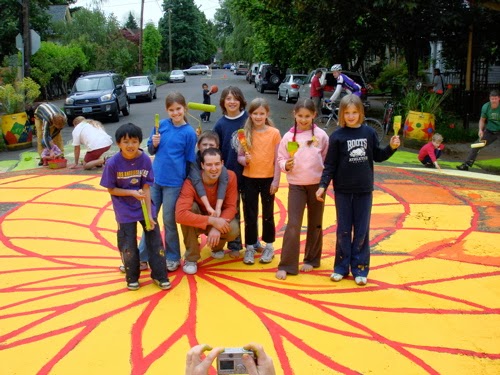
The lack of success isn’t surprising.  The difficulty behind City Repair projects was illustrated to me in an early meeting.  A local resident, intrigued by the possibilities of City Repair, brought her two sons to the meeting.  The boys were clearly there under duress, but were soon seduced by the possibility of painting designs on a public street, a concept that is only one of many City Repair possibilities but is the one most often associated with City Repair.

The two young men immediately began to discuss what the design should be, where the paint could be purchased, and whether both were free on the coming Saturday morning.

I had to rein in their enthusiasm, explaining that a City Repair project must be the culmination of an organizing effort, educating the neighbors about the options, identifying a project, and building support.  I estimated that it might well be a year, if not two, before brush could be applied to asphalt or any other project undertaken.

The two were disappointed, but agreed to stay involved for the duration.  Then the meeting ended and I never saw either of them, or their mother, again.

Even the project with which I was most involved seems to have foundered on a similar shoal.  The concept was street painting in front of a school to slow cars and to discourage illegal and unsafe traffic maneuvers.

It seemed a reasonable plan, but the organizers correctly decided that all affected neighbors had to be in favor of the plan before proceeding.  One neighbor was dubious and required several conversations over a period of six months before giving his assent.  By that time, the momentum had leaked away, although I expect that some faint possibility of a project still remains.

So, City Repair Petaluma seems have come up mostly empty, but there is the one possible exception noted above.  In the 2013 post in which I listed possible City Repair projects, I noted “bookshare kiosks.”  To the best of my knowledge, that was the first time that anyone wrote about the possibility of neighborhood sharing libraries in Petaluma.  And today there are at least eight libraries in operation.

(To be clear, I’m not claiming that all the neighborhood sharing libraries in Petaluma sprung from City Repair Petaluma effort.  After all, the Little Free Library organization was already underway in 2009.  But it wouldn’t surprise me if a couple of the local libraries could trace their roots back to the City Repair Petaluma effort.  Besides, what matters is that they exist, not how they came to be.)

Working from several sources, this is the current list of Petaluma sharing libraries of which I’m aware:

  • ·         A Street between 5th and 6th Streets
  • ·         638 E Street
  • ·         422 Walnut Street near Kent Street
  • ·         823 Madison Street across from McKinley Elementary
  • ·         Laurel Street at the intersection with Schumann Lane
  • ·         817 Bantam Way
  • ·         N. Napa Drive in the Petaluma Estates Mobile Home Park
  • ·         71 Purrington Road near I Street


Yesterday, I toured many of these sharing libraries.  Each of them made me smile.   (Had I thought ahead, I would have taken along a few books to leave behind.)

I’ve always expected that the concept would work best in walkable neighborhoods, so I’m most intrigued by
the locations on A Street, on E Street, and in the Petaluma Estates Mobile Home Park, but if the other locations can serve to increase neighborhood walking and connections, that would also be great.

And I’m greatly interested by the library across from McKinley Elementary.  At first, it would seem to duplicate the function of the school library, but I could see how a library away from the oversight of the school librarian might serve a function in supporting youthful curiosity.

If this blog and City Repair Petaluma had a small role in the proliferation of these libraries, then I’m happy about that.  And I encourage everyone to take a tour of the libraries.  They’ll make you feel good about your community.

Before closing, I should return to the issue of how City Repair projects sometimes push the boundaries of municipal codes.  Although neighborhood sharing libraries would seem to be nearly unassailable good things, a few curmudgeons found ways to complain.  In Leawood, Kansas, the City Council had to pass an emergency resolution allowing a nine-year-old to give a sharing library to his mother for Mothers Day.  In Shreveport, a debate erupted between proponents of the First Amendment and strict adherents to the local zoning code.  City Lab gives an overview of the issue.

Even Petaluma wasn’t immune.  An early adopter of the library idea approached City Planning about approval for a library in her neighborhood.  After a call to code enforcement, the counter planner advised her that sharing libraries weren’t permitted in Petaluma.

When I learned of the story, I double-checked with code enforcement and received a more nuanced response.  While the physical structure of the library might be considered a frontyard accessory structure, which is prohibited, code enforcement saw no need to enforce the rule unless someone objected.  The proponent proceeded with her library.

Now, if only we can find similar success with other City Repair ideas.

Next time, I’ll write about how downtowns are different from drivable shopping centers.  The difference may seem obvious, but at least one corporate marketing department seems unclear on the point.

As always, your questions or comments will be appreciated.  Please comment below or email me.  And thanks for reading. - Dave Alden (davealden53@comcast.net)

Monday, November 11, 2013

City Repair: Who Are These People and Why Am I Hanging Out with Them?

In my last three posts, I wrote about the concept of City Repair, a Petaluma effort at City Repair, and possible types of City Repair projects.  All of this was a build-up to an approaching joint meeting of Petaluma Urban Chat and City Repair Petaluma.  (Final reminder: Tomorrow, Tuesday November 12, 5:30pm, Petaluma Arts Center, 230 Lakeville.  All are welcome.)

In this final post before the meeting, I’ll ponder the breadth of the City Repair tent.  Who fits under it and why?  With all the online photos of happy neighbors holding hands in a circle around a newly painted intersection and singing “Kumbaya”, is City Repair really for everyone?

I’ll use myself as a test case.  I may not be a typical civil engineer, but I remain a civil engineer.  How and where do I fit into the City Repair ethos?

Many years ago, I walked a developer around a large project site.  As we walked the site, small rodents frequently scampered across our path.  The developer referred to them as “chipmunks”.

I’d been recently educated about the difference between the local chipmunks and ground squirrels.  I’m not a biology wonk, but the distinguishing characteristic, which had to do with the length of the stripes that ran from shoulder to flank, had stayed with me.

So I told the developer that the rodents were ground squirrels and I explained how they differed from chipmunks.

She pursed her lips, put her hands on her hips, and told me, “You’re unlike any engineer I’ve ever met.”  I took it as a compliment.

In every office I worked, I became known as the grammar and syntax guy.  Administrative assistants would come to me for help in making the words of their engineers readable, while still preserving the meaning.  (Those who regularly read my posts may dispute my standing as a grammar expert, but my office standing perhaps says more about other engineers than about me.)

Every once in awhile, one of the administrative assistants would purse her lips, put her hands on her hips, and tell me, “You’re unlike any engineer I’ve ever met.”  Once again, I took it as a compliment.

Despite being a couple of standard deviations away from the average engineer, it was still the appropriate career choice for me.  Whatever other character traits or personal skills I may have, I still look at the world through the eyes of an engineer.

I like data.  I like arguments based on data.  And I like data-based conclusions.  And that is the world view of an engineer.

I understand that not every element of a good life can be data-based.  Love of family, music, arts, and sports must be emotion-based rather than data-based.  (I know there is not one shred of data that supports following the Cal football team this fall and yet I still watch every down.)  And that’s fine.  Without those emotion-based attachments, life would be pale and bland.

But if there is data to support a conclusion, that’s all I want or need.  I wouldn’t think of using emotion to supplement a conclusion that can be reached on data alone.  I think people who use emotional arguments to buttress data-based conclusions are undermining their own efforts.

Let’s look at urbanism.  I can fully justify my commitment to urbanism by the facts that it would slow the pace of climate change, improve municipal budgets, meet the walkable urban market preferences of a growing number of people, and lead to economic growth by attracting the millennials who possess the creative energy on which much of the economy is based.  That argument is sound and conclusive.  Nothing need be added to it.

To supplement those urbanist justifications with concepts such as “social capital” or “deepen relationship with place” seems unnecessary.  Even worse, it implies that the data by itself isn’t enough.

And yet, when I espouse City Repair, I find myself collaborating with people who fully embrace those latter arguments.  Indeed, they start with them.  Sometimes I wonder how I found myself in league with them.  I know they’re good people, but can I really make common cause with people who see the world through such very different glasses?

But every time I ask that question of myself, the answer is a resounding “yes”.  Urbanism isn’t a rigid theology in which we must agree on every bit of dogma.  There are many routes to the conclusion that we need many more walkable urban places.  And the good of the world demands of us that we work shoulder-to-shoulder with those who might reach that conclusion by a different path.

The fact that I want a neighborhood meeting place where I can talk with a a friend about the upcoming NL West race or a new microbrewery while the folks across street might want a meeting place where they can chat about organic kohlrabi or the coming cosmic convergence isn’t relevant.  What matters is that we all want a walkable meeting place.

And so I find myself facilitating a City Repair meeting with folks who argue for a “community-centric art and people-loving city”.  It’s all good.

I’m not alone in sometimes feeling out-of-step with my nominal allies.  About a year ago, I attended a local counter-culture fair.  Based on some urbanist connections, I felt I should drop by, but it really wasn’t my comfort zone.  While wandering, I bumped into an old friend who joined me in looking and feeling out-of-place.

We stood there chatting in our khakis and polo shirts, surrounded by folks in tie-dyed t-shirts, striped djellebas, and fedoras.  Although we agreed that we felt awkward, we also agreed that there was no venue in the community where our thoughts on urbanism, climate change, etc. were more consistently shared.  And that made a more than sufficient reason to be there.

A downtown property owner was approached about a possible City Repair project at intersection adjoining his land.  He listened to the proposal and demurred.  In his words, intersection painting might be too “hippy-dippy” for him.

If you’re thinking you might pass on the City Repair meeting tomorrow evening for the same reason, thinking that you believe in the concept of neighborhood betterment but that City Repair might be too “hippy-dippy”, please come anyway.  What matters isn’t the path to good actions, but the actions themselves.

Besides, you can always chat with me.  I’ll be wearing khakis and a polo shirt.

As always, your questions or comments will be appreciated.  Please comment below or email me.  And thanks for reading. - Dave Alden (davealden53@comcast.net)

Friday, November 8, 2013

City Repair: Ponder the Possibilities

In recent posts, I’ve acquainted readers with City Repair, an organizational approach to grass-roots neighborhood improvements.  I’ve also introduced a fledgling City Repair effort in Petaluma.  Today, I’ll write about the kind of projects a City Repair group might tackle.

Intersections are logical places for neighborhood improvements.  Between the cross-traffic and the pedestrians, traffic hazards increase and most accidents happen at intersections.

Slowing traffic is a proven way of reducing risk.  And painting a design on the intersection pavement is a proven way of reducing speed.

So intersection painting, by slowing traffic, reducing accidents, and improving pedestrian safety, is a reasonable neighborhood project.  Plus, with its relatively low costs and large labor needs, it’s a good fit for City Repair.

However, most everyone reaches that conclusion, usually with unfortunate haste.  The first City Repair project was the painting of an intersection.  Most City Repair projects since then have been intersection painting.  When one searches online for City Repair photos, the most common image is smiling people surrounding a newly painted intersection.  When the initial City Repair Petaluma meeting convened, among the first questions asked were “Where do we buy paint?” and “Who draws the design?”  Intersection Repair has become a virtual synonym for City Repair.

All of which is a shame.  Intersection painting is an appropriate project for many neighborhoods, but we’re missing an opportunity if we don’t look at a broader range of possibilities before narrowing in.

At the upcoming meeting of City Repair Petaluma (details below), participants will be encouraged to imagine several different types of projects.  The goal will be to learn if there are ideas that might trump intersection painting.

To get the creative juices flowing, here are several ideas I can imagine.

Sidewalk benches:  Awhile back, I wrote about a Canadian who built a bench in his frontyard, a bench that was provided for use by neighbors and other passersby.  The bench was soon utilized by many and continues to serve the neighborhood five years later.  If the right location presents itself, I can see a neighborhood bench being a fine City Repair project.

Bookshare kiosk: I recently read of a neighborhood building a small kiosk where used books could be left for claiming by others.

Median landscaping: In Petaluma, there are several residential public streets with medians that are largely untended.  Organizing a neighborhood effort to landscape and maintain the median might change the character of the neighborhood.

Toolshed: A query sometimes voiced is why all the residents on a street need to own a lawnmower, hedgetrimmer, skillsaw, and power drill when none of those tools are used more than occasionally.  If appropriate maintenance of the tools can be ensured, communal use could be a cost savings for all.  And a shed to house the tools would simplify the sharing.

Not every neighborhood will have a site appropriate for a toolshed, but where a good site exists, toolshed construction could be a fine City Repair project.

Perhaps none of these projects make as much sense for a specific neighborhood as intersection painting.  But if we don’t at least ask the question, we don’t know.

And the time to begin asking will be the upcoming joint meeting of City Repair Petaluma and Petaluma Urban Chat.  We’ll meet on Tuesday, November 12.  We’ll begin gathering at 5:30pm, with the discussion and movie starting a little before 6:00pm.  The meeting place will be the Petaluma Arts Center at 230 Lakeville Street.  The meeting is free, although a $5 donation to the Arts Center is suggested.

Everyone is welcome, whether neighborhood activist or an interested observer.  Let’s see if we can get some traction.

As always, your questions or comments will be appreciated.  Please comment below or email me.  And thanks for reading. - Dave Alden (davealden53@comcast.net)

Wednesday, November 6, 2013

City Repair: Petaluma

In my last post, I wrote about City Repair and their approach to neighborhood self-improvement.

A point that I should have made is that, because City Repair projects have few sources of funding except for the neighbors themselves, projects tend to be low-cost and labor-intensive.  Of necessity, City Repair projects are grass-roots, hands-on efforts.  Broad neighborhood buy-in is essential, which makes improved neighborhood cohesion another product of City Repair.  In many cases, that cohesiveness may be even more important to the neighborhood than the project itself.

I closed my last post with a note that a City Repair group was trying to organize in Petaluma.

I probably should have said that another City Repair group was trying to organize in Petaluma.  Given the need for broad consensus, City Repair efforts tend to go through several false starts before gaining traction.  And Petaluma is no different.  I don’t know the entire Petaluma history of City Repair efforts, but I know that the current organizers aren’t the first to suggest this type of concept.

However, the current organizers seem particularly motivated and connected, so may be the ones to move City Repair ahead.

The key players are Rachel Kaplan, long-time community activist and author of “Urban Homesteading: Heirloom Skills for Sustainable Living” and John Crowley, owner of the Aqus Café.  (I’m also participating in the organizing efforts and hope to bring the commitment of Petaluma Urban Chat into City Repair Petaluma.)

John has long championed efforts like City Repair and persuaded Rachel to head the current effort.  I recently communicated with John and Rachel about their views on the fledgling City Repair Petaluma effort.


The two bring complementary perspectives to the effort.  John focuses on the bigger picture of community engagement and relationship building, noting his hope of “using City Repair to create community.”  Rachel looks more at the specific projects that might result, “I love the City Repair mindset, and the idea of bringing people together to deepen their relationship with place. Most of my work as an artist and healer has circled around this issue of place, home, and belonging.”
John has thought about specific neighborhoods as possible City Repair sites, noting “Oakhill/Brewster, the  Warehouse district, and Old East Petaluma”, although he agrees with Rachel in thinking that “I would hope to see engaged people in any neighborhood coming forward to work for the places where they live.  I don't have a preference or a leaning toward any particular neighborhood.”
Although both are familiar with City Repair and have heard City Repair spokesman Mark Lakeman speak, neither has assembled a City Repair project.   John notes that his background is in “general community building”, while Rachel mentions her “long history of creative political activism that integrates art practice, resistance culture, and social change agendas.”
The two have similar hopes for the future of City Repair Petaluma, although Rachel sees City Repair as an end itself, while Crowley has hopes of City Repair acting as a catalyst for community change.  Rachel hopes for City Repair to become “an active, self-generating force for creating beauty, abundance, and a culture of lively arts throughout our city”, while Crowley hopes that “City Repair Petaluma will be the fulcrum that helps Petaluma become a community-centric  art and people-loving city where neighborhoods are proud of the projects created by the community.”
To date, two organizing meetings have been held from which resulted in efforts to reach out to particular neighborhoods.

However, the question of which neighborhood is the first site for City Repair remains completely open.  That determination will be based solely on the ability of a neighborhood to coalesce around a vision.  Rachel, John, and others are eager to assist, but a project vision and enthusiasm must ultimately spring from within a neighborhood.
The next step, which will hopefully prove crucial in moving the concept ahead, will be a joint meeting of City Repair Petaluma and Petaluma Urban Chat.  We’ll meet at the established Urban Chat date and time, which will be Tuesday, November 12 at 5:30pm.  However, to accommodate the anticipated larger attendance, the meeting will be moved to the Petaluma Arts Center on Lakeville Boulevard.  We’ll view a City Repair movie and talk about where to go with this idea.

Everyone is welcome, whether a resident of neighborhood that might be a City Repair site or someone with a broader interest in the transformational potential of City Repair.  There is no cost to attend, although a $5 per person donation to the Arts Center is suggested in recognition of their generous offer of a meeting place.

Many City Repair projects have involved intersection painting.  And intersection painting is often a fine idea.  But we needn’t limit ourselves.  In my next post, I’ll offer other suggestions to consider and perhaps to build upon.

As always, your questions or comments will be appreciated.  Please comment below or email me.  And thanks for reading. - Dave Alden (davealden53@comcast.net)

Monday, November 4, 2013

City Repair: The Concept and the Book

Urbanism has many facets, but walkability is integral to most of them.  A goal of much of my blogging is encouraging more new walkable urban development.  I also write about enhancing walkability in places where it exists, but is flawed.

It’s also imperative to add walkability to existing neighborhoods where little walkability now exists.  And when I write of walkability, I don’t mean the exercise kind of walkability, but walkability that meets Jeff Speck’s four standards of walkability: safety, comfort, interest, and usefulness.  We have vast post-World War II neighborhoods for which Jeff Speck walkability was designed out by code.

(In “Walkable City”, Speck proposes that we use a walkability triage in which we devote no resources to post-World War II neighborhoods, arguing that that they’re lost causes.  I understand his point, but am unwilling to give up so quickly.  There are a lot of people living in those walkability wastelands and I believe they deserve attention.)

Retrofitting Jeff Speck walkability into non-walkable neighborhoods requires multiple tasks, for many of which city hall has primary responsibility.

Modifying the zoning ordinance to allow existing homes to be converted to retail uses?  That’s a city hall task.

Changing the zoning map to allow stores on vacant parcels?   That’s a city hall task.

Expanding transit systems so the more stops can be reached on foot?  That’s a city hall task, along with higher levels of government.

Fixing the sidewalks and street crossings so that pedestrians are safer?  That’s mostly a city hall task.

But not everything is within the purview of city hall.  Getting folks walking until casual meetings become so commonplace that a critical mass is created and retailers are motivated to move into a neighborhood?  City hall can’t touch that one.  It’s a task for the people we see in the mirror every morning.

But relying on individual decisions to reach a critical mass, especially when cars are so darned convenient, is somewhere between unlikely and impossible.  We need a mechanism to build a group walkability consensus.

Luckily for us, there are groups that do exactly that.  City Repair of Portland is one.  City Repair was a pioneer in helping neighbors to bond together to build features that reclaim walkability for their neighborhoods.

My copy of “Pocket Neighborhoods” is currently on loan, so I don’t recall the exact story, but author Ross Chapin writes of an early City Repair project, perhaps the very first one.  As I recall, a Portland neighborhood felt that an intersection needed traffic calming, thereby improving walkability.  They believed a painted design in the intersection would slow traffic.  They sought approval to do the work themselves.  City hall said no.

So they did it anyway.  On a Saturday morning, 200 neighbors blocked the surrounding streets and began to apply paint to the intersection.  The police were called.  The first officer on the scene saw 200 happy adults and children busily painting.  He shook his head and drove away.  He knew that there was no upside to trying to stop the effort.  Within months, the City of Portland had approved the project and had also adopted rules that would allow other neighborhoods to do similar projects.

From that beginning, City Repair has continued and has tried to export the concept to other neighborhoods and cities.  Growth has been slow.  It’s hard work to build critical masses, especially when the message is that neighbors have the right to exert more control over their neighborhoods, shoving city hall aside.  It’s not how most of us were raised.

City Repair has written a book about what they’ve done and what they hope to continue doing.  “City Repair’s Placemaking Guidebook: Creative Community Building in the Public Right-of-Way” can seem repetitive at times, but hammers home the key lessons, which are (1) build a strong consensus within a neighborhood, (2) don’t settle on a project until everyone is on board and has had the opportunity to participate in the process, and (3) don’t be afraid to push if city hall doesn’t accept the concept at first.

There have been a few stabs at City Repair projects in Sonoma County.  One correspondent recalls chalking an intersection in Santa Rosa a few years back.  But, like in many areas, a critical mass has been hard to gather.

But that doesn’t mean that people have stopped trying.  There’s a group in Petaluma trying to bring build a consensus around City Repair.  It’s an exciting possibility about which I’ll offer more information in my next few posts.

As always, your questions or comments will be appreciated.  Please comment below or email me.  And thanks for reading. - Dave Alden (davealden53@comcast.net)

 
(Note: Photo is from StreetsWiki.)


Friday, October 25, 2013

A City Trying to Rediscover Happiness


Leo Tolstoy’s most famous quote may be “All happy families resemble one another, each unhappy family is unhappy in its own way.”  (For those who haven’t studied Russian literature, it’s the first line in “Anna Karenina”.)

In the forty years since I first read that line, I’ve found it to be usually true.  Indeed, it often pops into my head when observing families both happy and unhappy.

However, its reverse may be true for U.S. cities.  There is a multitude of ways that cities can be successful and happy.  But many unhappy U.S. cities are surprisingly similar in their unhappiness.

To review the path to today’s discontent, many U.S. cities were founded in early 20th century or before.  Their original configuration was organized around walkability, supplemented with the occasional horse-drawn buggy or drayage wagon.  Even the advent of intracity public transit didn’t greatly affect the city layout.  (As Jeff Speck and others often note, a transit trip always begins and ends with walks.)

The advent of the mass-produced automobile in the 1920s put a little pressure on the city, but the Great Depression deferred the explosion.

It was only after World War II that the massive change came.  The final horses were put out to pasture, transit was largely abandoned, and we turned our cities over to the automobile and its parking lots, ever-widening streets, strip malls, and sprawl.

Which brings us to today, with the many costs of our automobile obsession accumulating out of control.  Climate change is peering at us over the horizon, public health is being affected by the car-culture, and we can’t afford to maintain all the stuff we built.  It’s a sad state of affairs.

Many cities recognize the problem and are trying to find solutions, often through a form of urbanism.  But it’s hard to back out of a 70-year-old cul-de-sac, especially when it’s all that most residents have ever known.

Admittedly, this history doesn’t pertain to every U.S. city.  But if you live in a city that was founded anytime before 1920, there’s more than a grain of truth in this summary.

Which brings us to Buffalo, New York, a place that had peaks of success that towered over its rivals and valleys of despair that remain legendary.  Buffalo is also a place that is now trying to find a successful future in the half-forgotten successes of its past, largely through a turn to urbanism.

Buffalo will be the 2014 host of the Congress for the New Urbanism (CNU 22).  At CNU 21, a newly-produced film about Buffalo was shown to kickoff the twelve-month buildup to CNU 22.  I’m unsure if the film was produced solely for CNU, but it might as well have been.  With crystal clarity, Buffalo hits all the notes in the urbanist anthem.  Buffalo will be a fine host city for CNU 22.

If your schedule allows twelve minutes, watch “Buffalo, America’s Best Designed City”.  It’s a tourism film, but a tourism film with a moral.  And if your schedule allows another ten minutes, think about what your city and Buffalo have in common and if your city is doing as much as Buffalo to restore its vitality.

Schedule Note

The next meeting of Petaluma Urban Chat will be a joint meeting with City Repair Petaluma.  To accommodate the larger group, we’ll meet at the Petaluma Arts Center.  (A voluntary $5 donation to the Arts Center is suggested for each attendee.)

We’ll view a City Repair video entitled “Transforming Space into Place” and discuss if the City Repair concept can be brought to Petaluma.  You can look at the City Repair website for an advance look at the model.

The meeting date will be Tuesday, November 12.  We’ll begin assembling and mingling at the Arts Center at 5:30.  The program will begin at 6:00.

As always, your questions or comments will be appreciated.  Please comment below or email me.  And thanks for reading. - Dave Alden (davealden53@comcast.net)